
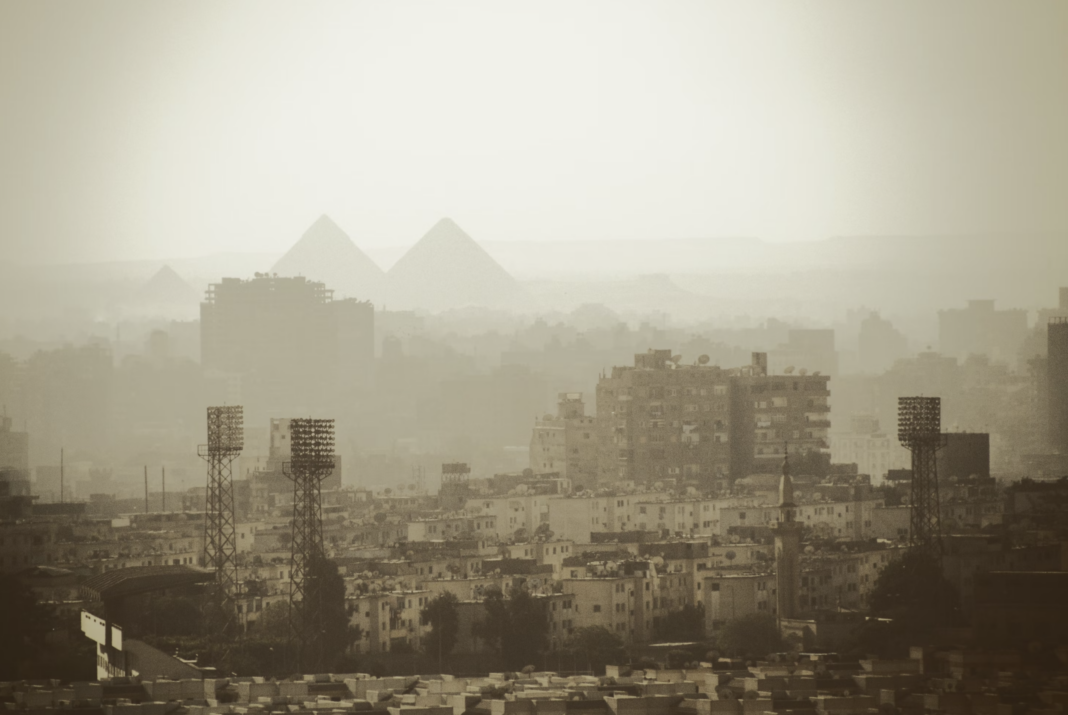
Black Cloud Season in Cairo

black smog cairo

In the West, leaves are falling from the trees. In the Middle East, Fall means the return of the throat-burning smog which settles over Cairo, Egypt once again. Rice fields are to blame.

Every year a noxious black smog hangs over Egypt as the seasonal burning of rice straw by farmers begins, and with it comes a surge in allergic reactions and lung infections. The inky haze lasts from October to November; it is a time when hospitals see a rise in patient numbers, and parents consider keeping their children out of school to avoid the worst of the throat-burning smog.

“Straw burning-induced pollution causes acute health problems,” Mahmud Abdel Meguid, chairman of the state-run Abbasiya Chest Hospital, told IRIN. “This pollution causes a long list of diseases, including chronic obstructive pulmonary disease, and chest sensitivity at best, and respiratory failure at worst.”

“This has led to pressure on the hospital,” he added. “Sometimes we run out of respirators for the patients.”

Egypt’s farmers have been burning the waste after the rice harvest for over 12 years. With more than 486,000 hectares of land devoted to the staple, farmers have huge amounts of straw to dispense with and torching it is the easiest solution.

The straw could be converted to animal feed or biofuel, but farmer Gamal al-Saedy says no one in his area of Sharqia, about 150km north of the capital, Cairo, has found a buyer. That makes burning “the normal solution for us”.

But it may have consequences for the rest of his community.

Suffering  from respiratory problems

Emad Hosni, a 30-year-old villager from the same governorate as al Saedy, has been visiting the Abbassiya Chest Hospital for more than three years seeking treatment for his respiratory problems: “My suffering increases particularly in October and November when the farmers burn the rice straw,” Hosni said. “I lock myself up in my home when I see the black cloud, but I am really afraid that my children may have respiratory diseases too.”

The Environment Ministry says rice straw burning accounts for 42 percent of Egypt’s overall air pollution during the two-month season, but it regards industrial pollution, the burning of garbage, and vehicle emissions as the biggest year-round threats to the air quality of the country’s 80 million people .

The ministry says it has managed to reduce the amount of pollution caused by straw burning, pointing to a decrease in the amount of land growing rice, and the presence of nine factories that buy the straw from farmers.

“Compared with previous years, the burning this year is much less,” said Ahmed Abulsoud, responsible for air quality at the Environment Ministry. “The cloud used to appear for 15 days, but now it appears briefly.”

However, with the burning of an estimated four million tons of straw this season, critics are loath to accept that the impact is minor: “True, the government does its best to reduce the burning, but the reality is the cloud is ushering in diseases that were rare in the past,” said Mohamed Awad Tag Eddin, Egypt’s former health minister.

“The farmers must get to know that the burning of the straw puts them and their fellow countrymen in extreme peril,” he told Egyptian TV recently.

More environment news from Egypt:
Top 5 Arab Designers
“Eco Options Egypt” Makes Egyptian Environmentalism Easy and Accessible
Gone Seabass Fishing…In Egypt’s Desert

Karin Kloosterman
Karin Kloostermanhttp://www.greenprophet.com
Karin Kloosterman is an award-winning journalist, innovation strategist, and founder of Green Prophet, one of the Middle East’s pioneering sustainability platforms. She has ranked in the Top 10 of Verizon innovation competitions, participated in NASA-linked challenges, and spoken worldwide on climate, food security, and future resilience. With an IoT technology patent, features in Canada’s National Post, and leadership inside teams building next-generation agricultural and planetary systems — including Mars-farming concepts — Karin operates at the intersection of storytelling, science, and systems change. She doesn’t report on the future – she helps design it. Reach out directly to [email protected]

Read More

2 COMMENTS
  1. Burning the straw is actually illegal and supposed to come with a big fine, but there’s no enforcement; the reason there’s no enforcement is that farmers have no other option (they often burn their straw at night, believing they won’t get in trouble).

    The government doesn’t provide any kind of waste management solutions – particularly out in the villages. A couple of NGOs had some success with one or two villages, but overall, the situation won’t improve until the government steps in. They should contract the same company that turned Alexandria’s trash situation around (Veolia, I think) – to find a reasonable solution.

TRENDING

Why does eczema so often begin in childhood and how can we prevent it?

The first years of life may represent a critical window when environmental exposures: dust, mold, indoor allergens, pollutants, microplastics, all shape immune trajectories in lasting ways. If scientists can find safe ways to calm this early-life immune pathway, it may be possible to prevent allergic disease before it spreads from the skin to the lungs or gut.

Ethiopians are Looking to Somaliland for Red Sea Access as Global Powers Move In

Somaliland, for its part, has operated as a de facto independent state since 1991. It has its own government, elections, currency, and security forces. It’s often described as one of the more stable and democratic political systems in the region, despite never being formally recognized internationally. 

Egypt building nuclear power

Egypt is building a nuclear energy plant, expected to go online in 2026 when countries like Germany have shut down all its domestic nuclear power. The El Dabaa Nuclear Power Plant is the first nuclear power plant planned for Egypt and will be located at El Dabaa, Matrouh Governorate, Egypt, about 320 kilometers northwest of Cairo. 

More investments of 1.2 GW in Benban solar, Egypt

Egypt’s Ministry of Electricity and Renewable Energy, the Egyptian Electricity Transmission Company, and a consortium comprising Infinity Power and Hassan Allam Utilities Energy Platform signed an agreement to jointly develop solar power projects at Benban Solar, one of the world's largest solar energy parks in Egypt.

Benban solar in Egypt and the companies that make the energy shine

Benban isn’t a single solar plant at all, but a collection of 41 facilities, each developed by different companies but connected through shared infrastructure. This structure is what makes Benban unique: dozens of developers working like nodes in a vast energy network, each feeding electricity into shared substations and Egypt’s national grid.

Yerukim Forms a New Green Economy Where the Money is Really Green

The Yerukim members who pick up the recyclables get to keep the monetary reward, the public earns "green" bills that can be used in shops, and business owners get to be associated with environmentalism.

Choosing Riyadh over Dubai? What Investors Should Know

Saudi Arabia is deploying capital at unmatched scale to catalyze tourism and advanced industry while rewiring its power-and-water backbone. The investable frontier is widening—especially in renewables, grid storage, water efficiency/desal retrofits, and hospitality operating platforms. Prudent investors will insist on phased delivery, enforceable KPIs (energy, water, biodiversity), and RHQ/zone compliance—while pricing political-economy and reputational risks alongside growth upside.

Sell your cooking oil for biodiesel money

Want to make money on old french fry oil? Sell it.

Qatar Alternative Energy Summit Pairs Investors And Innovators

Alternative energy investors and innovators can meet n' greet in Doha, Qatar March 16 and 17.

Here’s How To Implement The Four Pillars Of Employee Engagement

If you throw a party for your work team and they are vegans, don't make it a barbecue. Know the sustainability values of your team to boost moral and retain good people.

Locals From Rishon Fight IKEA

Big Box stores are a pretty new concept in Israel, and thank God that not every Israeli city wants them in their backyard. A word from someone who has see the beautiful farmland around her hometown Newmarket, Ontario stripped and converted into vulgar strip malls of big box shops: they have no place in a healthy and sustainable town or city.

The Jewish National Fund Meets An Inconvenient Truth

According to the JNF, it has transformed thousands of acres of barren land into green forests in Israel. They state that each person emits about 23 tons of carbon per year, estimating that each tree planted can absorb one ton of carbon in its lifetime. That's a whole lot of trees you'd need to be planting. Could so many fit in Israel?

How to quiet noise from construction in your office

Streets need to be resurfaced in New York but the humming and grinding noise is unsettling. Noise is environmental pollution. 

Popular Categories