

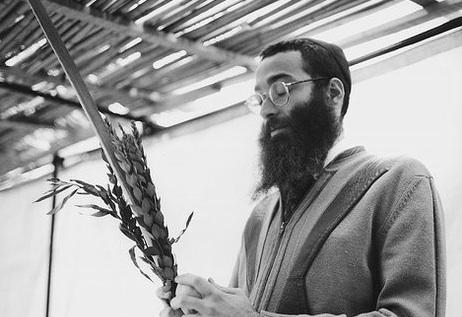
For Jews in Israel, there is probably no better time to reflect on one’s place in nature and the health of the environment than during Sukkot, the Festival of Booths or the Jewish harvest festival.
When I lived in Jerusalem, I could see the small make-shift sukkahs (huts) erected everywhere outside my window – each one has at least three walls made from wooden clapboard or cloth with a simple roof made from plant cuttings (skakh).
Here in Jaffa, a mixed Jewish-Arab city, the effect of the holiday is less profound, because half of the population won’t be building a sukkah, but I am hoping to get a chance to sleep in ours to remember Sinai – physically and metaphorically.
Integral in the building of a sukkah is that it must have an uninterrupted view to the sky and stars. The holidays’s meals are to be eaten in the hut and some of the more hardcore types sleep in it as well.
There is a host of elaborate customs during Sukkoth which involve waving plants and making blessings on a strange aromatic citrus fruit, the etrog, as well as a mitzvah (commandment) for people to travel and explore the land.
What I like most of all about Sukkoth, is that it is a leveler: Rich or poor, young or old, it is a time when people cast aside their worldly possessions and take life’s speed down a notch or two inside their own little hut. It is also about living among nature, not as a conqueror but as an equal to other creatures.
There are different interpretations about the spiritual meaning behind Sukkot – and one I like is that it teaches that existence is fleeting and momentary.
We think that a little bit of reflection on the environment can go a long way around this time as one sits in the hut listening to the nature outside. Even if it is urban nature.
 And if you build a sukkah and are not storing the skakh for next year, don’t forget to compost it (James’ has written a great little starter guide). We also hear that etrog makes a fabulous jam. Jack gives us the etrog jam recipe here. But make sure you do it after the holiday, not during or before.
There are a whole pile of green events taking place in Israel this Sukkot. Read Karen’s post on what is happening at Luna Park, with Greenpeace and at Junktion Studio.



[…] Sukkot which we have covered on Green Prophet. And which is still underway under Thursday. While Jews gather in makeshift booths to remember the reality of wandering throughout the desert this reality is one that is very much […]
[…] Karin remarked in this post, the sukkah levels the differences between people. Rich and poor alike abandon the never-ceasing […]
[…] Sukkot, the Jewish harvest festival, is a time when Jews attempt to get closer to nature. They live in make-shift huts covered with thatched roofs, sleep outdoors, and celebrate fruits of different species. Which is why Sukkot (which is coming up in a few weeks) is a great time to visit a farm. There are lots of great farms in Israel – including organic goat cheese farms and educational farms intended to teach kids that farming can be fun – but when you’re trying to get your nature on it is probably best to visit one that lets you be a farmer for a day. Such as Bel Ofri in the Golan, which is hosting special food and wine-making workshops during the holiday of Sukkot. […]
[…] fast approaching, some of us are thinking about honey recipes, sustainable festive meals, and sukkahs (or temporarily erected shelters). The folks over at Washington University in St. Louis (WUSL) […]
[…] how present day Jews continue to maintain solid connections to nature.) Formerly an Oxford scholar and currently Senior Lecturer at the Department of Theology and […]
[…] Make Your Own Ricotta on Sukkot“Ye Shall Live in Booths” and Be With Nature on Sukkot […]
Very good point, Hannah. I didn’t think of that. And citrus fruit peels are very oily. . I imagine they’d retain a lot of poisons. A new business venture: prize-winning organic etrogs.
One should be careful when cooking with etrogim. Since they are not grown for food, they are not subject to the same standards regarding pesticide use.
New Story:: "Ye Shall Live In Booths" And Be With Nature During Sukkot http://bit.ly/2t7cMT
.@greenprophet “Ye Shall Live In Booths” And Be With Nature During Sukkot. For #Jews in #Israel, there is probably no http://j.mp/gpspj