
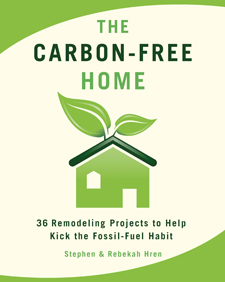
Architect Gil Peled Strives for a 'Carbon-Free House' in Stephen and Rebekah Hren's Book

351

Carbon emissions from the building environment are globally one of the major contributors to climate change. On average up to 50% of all carbon emissions are related to domestic use of energy – our household consumption.

How then will our personal conduct have any influence on the global climate?

The answer to that is it all adds up. As is the case in the current global economic crisis, the “butterfly effect” also works on carbon emissions, hence accumulations of local reductions will have a positive global impact. So we are not alone in reducing our carbon-footprint as you will be able to read in this book: ‘The Carbon-Free Home’ by Stephen and Rebekah Hren.

The authors have gone through several phases in their attempt to live in a carbon-free home and have gained many valuable insights they share from their experience.

Many of the eleven chapters not only include the technical nitty gritty but also personal stories which make reading this book more enjoyable. Some insights are quite remarkable and the authors also bravely admit their mistakes. One was moving out of the city only to find that their daily commuting cancelled out any carbon reductions they may have made in their green country house. They realized that ultimately moving back to the city and retrofitting existing houses is the preferable solution.

The book includes a very good overview in the form of a table of projects, 36 in total, as well as a useful index. The table provides estimated costs for each measure and an indication to their effectiveness in saving energy and CO2 emissions as well as time and skills required.

Many proposals are quite practical providing diverse solutions such as various alternative energy sources, alternative cooking methods an so on. Each chapter has also useful and hand-on advice, various references as well as black and white illustrations.

Unfortunately some of the technical information provided is not in metric units; perhaps in a future edition this can be put right.

All in all the book is recommended both for professionals as well as ordinary house holders as it provides enjoyable reading combined with practical advice which can be implemented, at large or in phases, in most homes. Their widespread implementation contributing to a more energy efficient and carbon-free home for our own benefit as well as for the benefit of the global environment.

The Carbon-Free Home – Stephen and Rebekah Hren, Chelsea Green Publishing, 2008, 260 pages www.chelseagreen.com

This book is reviewed by Gil Peled, a Jerusalem-based green architect, whose practise is called ‘Eco Challenges’, and he is the co-ordinator of Jerusalem’s Eco-Housing Pilot Project, in the Rehavia neighbourhood. And he is a great friend of Green Prophet to boot.

Read More

2 COMMENTS

LEAVE A REPLY

Please enter your comment!
Please enter your name here

TRENDING

How you create green steel on a blockchain

The thing about raw materials is that once they are melted down, you can't prove the source of the material. Same is true with gold, cucumbers and even forged products that look the same as the real thing. When it comes to steel, and how we produce it, it has a massive carbon problem. What's happening in Japan right now could change how we think about heavy industry and climate action.

EPA May Repeal Key Climate Health Ruling — But Scientists Warn of Dire Consequences

The endangerment finding has been the scientific and legal backbone of US climate policy for more than a decade. Without it, the EPA loses its authority to regulate carbon emissions under the Clean Air Act.

Sustainable Banking: Dame Alison Rose’s Approach to Climate Change and Corporate Responsibility

When Dame Alison Rose assumed leadership of NatWest Group in 2019, she recognised that climate change represented not just an environmental challenge but "probably the biggest existential threat that we will face as a society." Her response was to position the bank at the forefront of sustainable finance, implementing what she describes as "a very clear strategy on climate" that would fundamentally reshape how NatWest operates and lends.

Think Eat Cook Sustainably is a philosophy book in sustainable food, in edible form

It’s like finding a map back to your grandmother’s pantry, but with the tools of a climate-conscious chef.

A guide to rewilding your cities

Tel Aviv has started giving away free fruit trees in a bid to re-wild its city and make it greener. They are calling it an urban food forest. Researchers from Berlin come up with a blueprint on how to green and re-wild your city. You could use this with new greening AI research from MIT to make your city remarkably green.

How to quiet noise from construction in your office

Streets need to be resurfaced in New York but the humming and grinding noise is unsettling. Noise is environmental pollution. 

EarthX and a blueprint for sustainable investing

Trammell S. Crow, a Dallas-based businessman and father of four, is focusing his efforts on impact investing, and media that focuses on saving the planet through EarthX.

Mining Afghanistan’s Mineral Discoveries Similar to Avatar

Now that American forces in Afghanistan are commemorating the longest period of any war that America has been involved in, including the 1965-73 Vietnam War, the recent discoveries of large and extremely valuable mineral and metal deposits may finally bring to light a reason to continue the presence of US fighting forces in this war torn and backward country.

From Pilot Plant to Global Stage: How Aduro Clean Technologies’ 2026 Expansion Signals a Turning Point for Chemical Recycling Investors Like Yazan Al Homsi

The company's Next Generation Process (NGP) Pilot Plant in London, Ontario, has officially moved into initial operating campaigns, generating the kind of structured, repeatable data that separates laboratory promise from commercial viability.

Nobul’s Regan McGee on Shareholder Value: “Complacency Is the Silent Killer” 

Why the governance framework designed to protect shareholders so...

Should You Invest in the Private Market?

startustartup Unlike public stock exchanges, which offer daily trading, strict...

How to build a 100-year-company

Kongō Gumi is a Japanese construction company, purportedly founded in 578 A.D., making it the world's oldest documented company. What can we learn about building sustainable businesses from them?

How AI Helps SaaS Companies Reduce Repetitive Customer Support Work

SaaS products are designed for large numbers of users with different levels of experience, and also in renewable energy.

Popular Categories