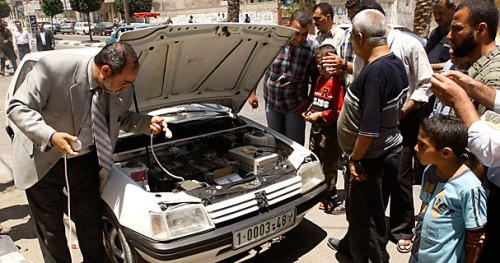
Electric Cars in Gaza: Necessity is the Mother of Invention!

electric car gaza picture
The Gaza Strip seems like the last place in the world where we would hear good news on the environmental – or any – front. Since Hamas took control of the Gaza Strip last summer, Israel has imposed a nearly total blockade, resulting in shortages of everything from fuel to water to food and medical supplies.

In the context of this crisis, two innovators from Gaza, Waseem Khazendar and Fayaz Anan, decided to respond to the dire conditions of their community, and in doing so made this corner of the globe a little greener.

Khazendar and Anan created the first Palestinian electric car!

Khazendar and Anan converted a 1994 Peugot 205 to run on 34 standard car batteries. It travels up to 60 mph, and can run for up to 100 miles on a single charge. The car can be charged by a standard electrical outlet for just $1.50 per charge, which is a stark contrast to the $50 per gallon highs that Gaza Strip drivers have paid for gasoline.

And best of all, the car produces zero greenhouse gas emissions!

Four hundred people in Gaza have already lined up to pay $2,500 for the conversion. Because of the Israeli blockade, however, Anan says that they only have the supplies to convert 30 or 40 cars. If Israel allows more materials to cross the border, it might drop the conversion price to $1,700.

The pair are thinking of turning their project into a multimillion dollar business. Khazendar spoke with an Israeli firm about obtaining a patent for their engine. Anan said he would be happy to work with Israelis for business: “Maybe we, Israelis and Palestinians, can save the world together.”

::Christian Science Monitor
Photo: Mohammed Salem/Reuters

Want to learn more about green automobiles in the Middle East? Check out Hybrid Cab Fleet Taking Over Tel Aviv? or The Electric Car Hype Intensifies

Rachel Bergstein
Rachel Bergsteinhttps://www.greenprophet.com/
When her vegan summer camp counselor explained to a fifteen-year-old Rachel how the dairy industry pollutes the groundwater in poor rural communities and causes global warming, there was no turning back. Her green fire lit, Rachel became increasingly passionate about the relationship between human societies and the natural environment, particularly about the systemic injustices associated with environmental degradation. After snagging a B.A. in Peace and Justice Studies at the University of Maryland, where she wrote an undergraduate thesis on water injustice in Israel/Palestine and South Africa, Rachel was awarded the New Israel Fund/Shatil’s Rabbi Richard J. Israel Social Justice Fellowship to come and spread the green gospel in Israel for the 2009-2010 academic year. She currently interns for Friends of the Earth Middle East in their Tel Aviv office. When Rachel is not having anxiety about her ecological footprint, carbon and otherwise, she can be found in hot pursuit of the best vegetarian food Tel Aviv has to offer. She also blogs about her experience as an NIF fellow and environmentalist in Israel at organichummus.wordpress.com. Rachel can be reached at rachelbergstein (at) gmail (dot) com.

Read More

7 COMMENTS
  1. Just a little nitpick – but an important one, in my view.

    There are greenhouse gas (GHG) emissions from driving this car, just not from the tailpipe. The electricity to drive the car comes from 70% burning of coal and almost all of the rest from burning oil or natural gas – all fossil fuels which emit substantial GHG. And that’s the good scenario: if the electricity comes from a diesel generator, then the GHG emissions are greater and air pollution is MUCH worse. Just because no emissions come out of the tailpipe, doesn’t mean that they disappear. In fact, instead of being spread out over large areas, they are concentrated in 2 or 3 point sources, usually in areas that have a disproportionate impact on poorer communities.
    The benefit of electric vehicles stems from the greater efficiency in centralized power production, and in the greater conversion of electrical energy into drive power.
    So on the balance, the electric car is beneficial – especially as the renewable portion increases – but it is not a ZEV (zero emissions vehicle) as some would present it.

TRENDING

Understanding Food Production: Karl Studer on the Urban-Rural Knowledge Gap

Karl Studer occupies an unusual position in American business. As President of Quanta Services, he oversees electrical infrastructure operations across the United States, Canada, and Australia, managing thousands of employees and multibillion-dollar projects.

Wave wind energy for Nvidia’s next AI energy boom?

As AI factories consume unprecedented amounts of electricity, NVIDIA is looking beyond chips and data centers to the ocean. The company recently spotlighted Israel's Eco Wave Power and its wave energy projects in Jaffa and Los Angeles, highlighting how AI, digital twins and renewable energy can work together to meet future power demands. The collaboration reflects a growing realization that the future of artificial intelligence may depend as much on clean energy infrastructure as it does on computing power.

Weston Higginbotham found dead in a Kyoto forest: is climate anxiety part of the story?

In some ways, Weston has become a symbol of a generation wrestling with environmental and technological anxiety. Friends and family described him as deeply concerned about environmental issues. Reports also noted that he questioned the growing role of artificial intelligence in daily life, even reportedly disagreeing with his mother about her use of AI.

Billie Eilish’s Mom Takes the Stage at Hollywood Climate Summit — But Does Hollywood Still Care About Climate Change?

Hollywood once promised to help save the planet. Leonardo DiCaprio warned of climate catastrophe from awards stages. Celebrities flew to climate conferences. Studios pledged greener productions. Streaming platforms rushed to commission environmental documentaries. But in 2026, with the aftermath of wildfires, heatwaves and floods becoming routine, a question lingers: Does Hollywood still care about climate change?

Can Scientists Predict Coral Bleaching Before It Happens?

Now researchers at the Woods Hole Oceanographic Institution (WHOI) in the US say they have developed a way to predict coral bleaching five to six months before it occurs, potentially giving reef managers enough time to intervene and save vulnerable corals.

Yerukim Forms a New Green Economy Where the Money is Really Green

The Yerukim members who pick up the recyclables get to keep the monetary reward, the public earns "green" bills that can be used in shops, and business owners get to be associated with environmentalism.

Choosing Riyadh over Dubai? What Investors Should Know

Saudi Arabia is deploying capital at unmatched scale to catalyze tourism and advanced industry while rewiring its power-and-water backbone. The investable frontier is widening—especially in renewables, grid storage, water efficiency/desal retrofits, and hospitality operating platforms. Prudent investors will insist on phased delivery, enforceable KPIs (energy, water, biodiversity), and RHQ/zone compliance—while pricing political-economy and reputational risks alongside growth upside.

Sell your cooking oil for biodiesel money

Want to make money on old french fry oil? Sell it.

Qatar Alternative Energy Summit Pairs Investors And Innovators

Alternative energy investors and innovators can meet n' greet in Doha, Qatar March 16 and 17.

Here’s How To Implement The Four Pillars Of Employee Engagement

If you throw a party for your work team and they are vegans, don't make it a barbecue. Know the sustainability values of your team to boost moral and retain good people.

Locals From Rishon Fight IKEA

Big Box stores are a pretty new concept in Israel, and thank God that not every Israeli city wants them in their backyard. A word from someone who has see the beautiful farmland around her hometown Newmarket, Ontario stripped and converted into vulgar strip malls of big box shops: they have no place in a healthy and sustainable town or city.

The Jewish National Fund Meets An Inconvenient Truth

According to the JNF, it has transformed thousands of acres of barren land into green forests in Israel. They state that each person emits about 23 tons of carbon per year, estimating that each tree planted can absorb one ton of carbon in its lifetime. That's a whole lot of trees you'd need to be planting. Could so many fit in Israel?

How to quiet noise from construction in your office

Streets need to be resurfaced in New York but the humming and grinding noise is unsettling. Noise is environmental pollution. 

Popular Categories