
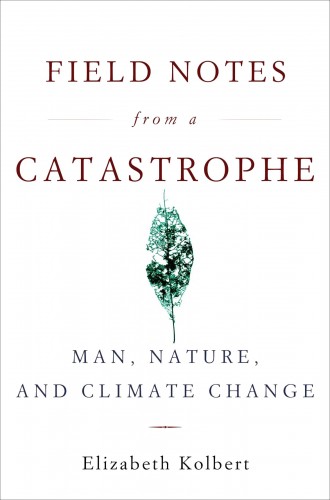

 This is the first book I’ve read in a long time that I have felt so conflicted about.
I bought it after having seen it prominently displayed in UK bookshops, and having read some of the author’s incisive political writings in The New Yorker.
I anticipated that it would be illuminating and instructive, and expected it to fit into a recent run of similar non-fiction books about the environment that equally inform with hard facts; frighten the reader at the scale of the problem humanity faces, and also provide some sense of optimism about human ingenuity and ecological salvation.
After reading ‘Field Notes from a Catastrophe’ I found that it did none of these, and that its style oddly jarred with me – not compulsive writing, nor reflective and so insightful as to leave me wanting more.
Indeed Kolbert’s closing lines leave a bleaker taste than other writers on this subject:
It may seem impossible to imagine that that a technologically advanced society could choose, in essence, to destroy itself, but that is what we are now in the process of doing.
Kolbert starts the book with an atmospheric description of the diminishing icebergs at Illulissat in Greenland. Later chapters investigate permafrost in Alaska and the heating seawaters of the Arctic, floating houses in Holland, and the most environmentally friendly City in the US, Burlington, Vermont.
She does succeed, as she states succinctly in the preface to:
“convey, as vividly as possible, the reality of global warming” and “the complicated relationship between the science and the politics of global warming”,
but she doesn’t find the balance between describing local atmosphere and the hard science. When the science comes in the book, as it does in a detailed description of climate modeling, it comes hard and fast, like a pre-examination cram session. In chapter 2, ‘A Warmer Sky’, Kolbert examines the history of scientists understanding atmospheric gases and their contribution to climate change.
I was fascinated to discover that Irishman John Tyndall (died 1893) and Swede Svante Arrhenius (died 1927) were responsible for the conceptual connection between Industrialization and climate change. But this is just one of the few strands that Kolbert could have disentangled to create several detailed and focussed books: too many diverse parts to a much misunderstood subject have been woven together to form a disjointed whole here.
“One thing about climate change is its potentially geopolitically destabilizing…I think its impossible to predict what will happen…
I wouldn’t be shocked to find out that by 2100 most things were destroyed.”
-– David Rind, climate scientist
The most interesting part of the book deals with the fall of the empire of Akkad, established 4,300 years ago between the Tigris and the Euphrates. This is in modern day Syria, on the Khabur Plains, and has been thoroughly excavated and researched, although the current war (itself an additional environmental disaster for a region suffering drought) has halted further exploration.
Soil samples at the site show that the empire was abandoned due to a drought so severe and prolonged:
“that the earthworms died out.”
What a terrible example of how climate change has affected civilization. An example that we could be learning from, if we so chose. The core of this book, fired throughout like a Gatling gun, is how human politics is at the core of our response to climate change, and how political machinations are marching us closer to the precipice that is rising sea levels, extended hurricane and storm season, and shifting temperature change.
It is depressing to learn that The Charney Commission set up by President Carter in 1979 concluded:
We may not be given a warning until the CO2 loading is such that an appreciable climate change is inevitable.
Chapter 8, ‘The day after tomorrow,’ continues this detailed and grim catalogue of political failure (largely in the US, but the UK is culpable too…if you are reading this, Mr Blair and Mr Brown…) on this issue, which overshadows our very existence. John McCain, the current Republican Presidential candidate, emerges from Kolbert’s political history of responses to climate change as a compassionate contender – twice he has tried to get ‘The Climate Stewardship Act’ through the Senate and twice he has failed.
I recommend this book as scientific and political/historical ammunition for the debate around climate change, albeit with a caveat: it is a difficult and as I said jarring read. Kolbert’s style isn’t engaging, and her narrative doesn’t flow. Take from ‘Field notes from a Catastrophe’ what you will – as with the impending catastrophe she tries to describe, there are lots of pieces to pick up.
Like this review? Inspired to read more? Others in this season of ‘summer eco reads’ here on Green Prophet include:
Review of ‘The Emerald Planet’ by David Beerling
Review of ‘Confessions of an Eco-Sinner’ by Fred Pearce
Review of ‘Wild Fermentation’ by Sandor Katz
And if you know of a book (or an environment-focused film) you’d like to see reviewed here, or indeed would like to review for us, please be in touch – we’ve got new titles & classics arriving every day, so stretch that writing muscle!
james”at”greenprophet.com
Buy this book on Amazon:



Review of the book is very interesting. It enjoy to read it.
Unlike Erin I found it a very fast read–a couple of days–and fascinating, full of information I hadn’t known, although I’m probably a climate change junkie. This book was different. Most of them fall into 2 parts: Part One tries to scare you to death, then Part Two is upbeat, full of what can be done about it, and “what YOU can do to fix this”. This book was all Part One. It left me seriously depressed about the future. The most important parts, I thought, were about the feedback mechanisms that will keep the process going now no matter what we do.
The one thing that struck me most forcefully was the comment–something I had been subliminally aware of, but hadn’t focused on before–that in most crises the public is much more alarmed and hysterical than the experts (the current Swine Flu outbreak is probably a good example), but as regards climate change the scientists are the ones who are much more alarmed. Now that’s scary!
I completely agree, this was a tough and boring read for me.
I am usually a strong and fast reader, but this book took me most of a summer. The writing was not very comprehensive and often I had trouble trying to make out exactly what message the author was trying to convey. This book just felt like information overload. Unless the reader is very interested in the subject of climate change and interested in science or awkward text book-like reading, I wouldn’t recommend this book.
good article
Hey thanks for the review. I no longer feel compelled to read this book. You saved me some time and I appreciate it.