
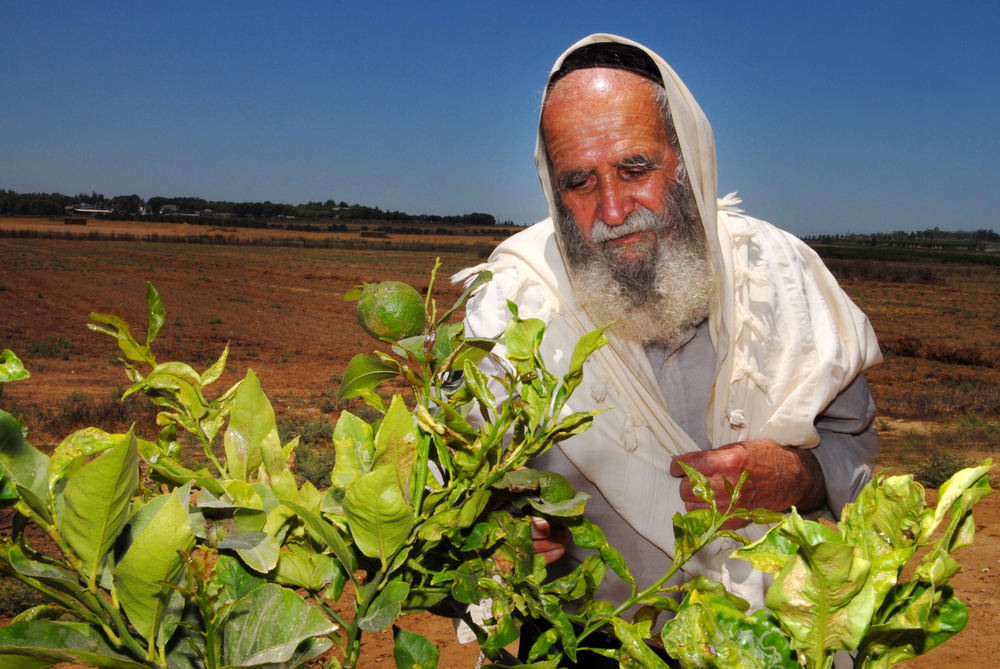
The Shmita year and its connection to the environment

Shmita year in Israel sabbath for the land
Thousands of years before green became hot, the Jewish people were observing the Shmitta, or shmita, a sabbatical year.

The Shmitta is documented in the bible as a year where farmers are forbidden to work the land in order to give the land a rest.

The Lord said to Moses on Mount Sinai. (2) Speak to the Israelites and say to them: ‘When you enter the land I am going to give you, the land itself must observe a sabbath to the Lord. (3) For six years sow your fields, and for six years prune your vineyards and gather their crops. (4) But in the seventh year the land is to have a sabbath of rest, a sabbath to the Lord. Do not sow your fields or prune your vineyards.’(Lev. 25: 1-4).

Talk about giving it a rest! In yesterday’s post we spoke about how radically we could cut down our emissions if the world would take upon itself the Jewish Sabbath. Now we would like you to consider the ramifications of taking a whole Sabbatical year.

For one out of seven years, religious Zionist farmers give the land a rest. No farming, no pruning, nada! Rabbis later on amended this law so that if there will be damage to your land as a result, you can take minimum care of your land so that you will not lose out in the long term.

It would take some pretty drastic planning ahead, stockpiling grains, pre-freezing fruits and veggies so that during the year off we could eat. But it could be feasible. The whole world could give it a try… The question is would it be good for the land?

Early crop rotation methods were mentioned in Roman literature, and referred to by several civilizations in Asia and Africa. Crop rotation is used in order to fortify the farmed land against depletion of its minerals. This isn’t quite the same, would a Sabbath replenish the land?

Israel’s Ministry of Foreign Affairs discusses this very same question on their website. Samuel Chayen explains that there is a current world-wide debate about sustainability; how to modify our current practices so that we can ensure a future for many years to come.

Chayen shares an anecdote: “Ten years ago, while attending a conference on Microbial Ecology, I listened to a “roundtable” debate dealing with Sustainable Agriculture. One of the speakers mentioned that in some places grazing land is abandoned every few years to let the grass grow and to enhance nitrogen assimilation on the roots of legumes by Rhizobacteria, thus increasing productivity in the following years.

“Given permission to speak, I pointed out that the Jewish law of Shmitta, the Sabbatical Year, provides exactly such orders for the Jewish farmer.”

Above image: ChameleonsEye / Shutterstock.com

Jack Reichert
Jack Reicherthttps://www.greenprophet.com/
As far back as he can remember Jack Reichert has been interested in the environment. In the second grade, he rallied all of his classmates to donate one recess a week to cleaning up litter from the schoolyard. That was the same year that a city councilman asked him to help with his campaign because of the letter Jack had written asking him to clean up Boston Harbor. Ever since Jack has followed the development of the international green conscience with anticipation and hope that one day we will treat Mother Earth with the respect she deserves and not turn her into another Giving Tree. For tips, feedback and prophet sightings, Jack can be reached at jack (at) greenprophet (dot) com.

Read More

4 COMMENTS
  1. I’ve never professed to be a writer nor do I think I want to be one. It was Dan’s intention to have Michele Borntreger with Kaleozone.com write a post but I felt led, as Michele’s husband, to write a post after reading the first few parts of The Naked Gospel.

  2. Worldwide??
    Im sure the Muslims would agree to that one.
    .
    And I dont see Torah really being followed, even by orthodox Jews. What happened to animal sacrifices, where is the Levitical priesthood and all the other things prescribed in the Torah?

LEAVE A REPLY

Please enter your comment!
Please enter your name here

TRENDING

A Quantum Kaddish? What fungal networks teach us about grief, God and death

Can Zara speak with her recently departed mother through...

Desalination experts debunk Aqua Solaire, the floating desalination barge

AI makes it easy to dream, develop, and create images of what could be world-changing ideas, until the reality sets in. A new project making the rounds is Aqua Solaire, an allged French concept for a solar-powered desalination vessel designed to bring drinking water to coastal communities facing drought, storms, and infrastructure failures.

Monitoring farmers’ tillage patterns from space

Tillage is one of the clearest signals of how a farm treats its soil. Intensive plowing can degrade structure, release carbon, and increase erosion. Conservation practices—no-till, cover cropping, minimal disturbance—do the opposite. They build soil, retain water, and support biodiversity. But until now, measuring these practices at scale has been slow, expensive, and often self-reported.

Jewish Vegans invite global community to “Compassionate Passover” event

As Passover approaches, a global online gathering is inviting...

Eco organization offices destroyed by Iran missile

Tel Aviv's eco organization, the Heschel Center, was impacted by an Iranian missile.

How to quiet noise from construction in your office

Streets need to be resurfaced in New York but the humming and grinding noise is unsettling. Noise is environmental pollution. 

EarthX and a blueprint for sustainable investing

Trammell S. Crow, a Dallas-based businessman and father of four, is focusing his efforts on impact investing, and media that focuses on saving the planet through EarthX.

Mining Afghanistan’s Mineral Discoveries Similar to Avatar

Now that American forces in Afghanistan are commemorating the longest period of any war that America has been involved in, including the 1965-73 Vietnam War, the recent discoveries of large and extremely valuable mineral and metal deposits may finally bring to light a reason to continue the presence of US fighting forces in this war torn and backward country.

From Pilot Plant to Global Stage: How Aduro Clean Technologies’ 2026 Expansion Signals a Turning Point for Chemical Recycling Investors Like Yazan Al Homsi

The company's Next Generation Process (NGP) Pilot Plant in London, Ontario, has officially moved into initial operating campaigns, generating the kind of structured, repeatable data that separates laboratory promise from commercial viability.

Nobul’s Regan McGee on Shareholder Value: “Complacency Is the Silent Killer” 

Why the governance framework designed to protect shareholders so...

Should You Invest in the Private Market?

startustartup Unlike public stock exchanges, which offer daily trading, strict...

How to build a 100-year-company

Kongō Gumi is a Japanese construction company, purportedly founded in 578 A.D., making it the world's oldest documented company. What can we learn about building sustainable businesses from them?

How AI Helps SaaS Companies Reduce Repetitive Customer Support Work

SaaS products are designed for large numbers of users with different levels of experience, and also in renewable energy.

Popular Categories