

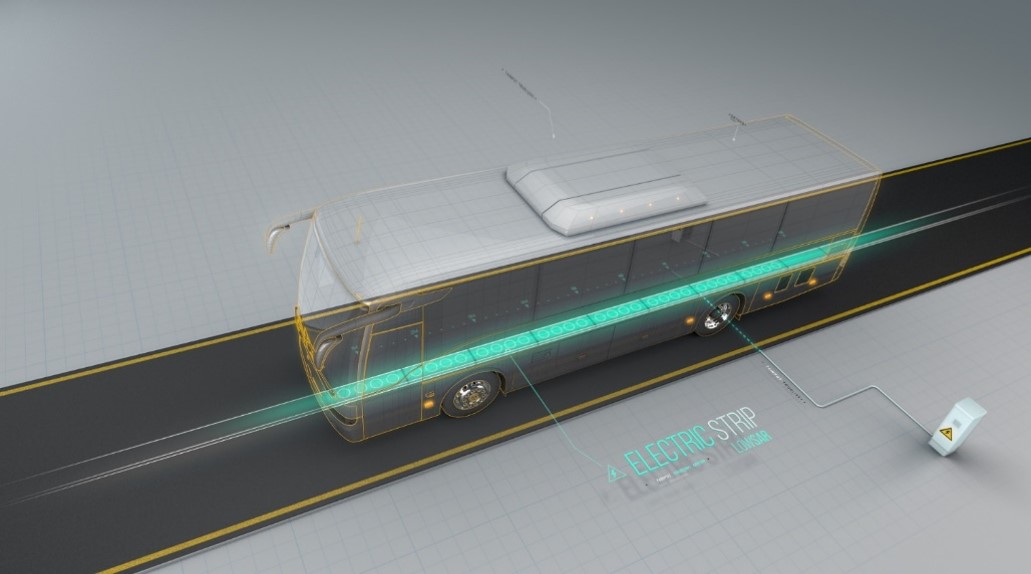
 “Roads? Where we’re going we don’t need roads!” Fans of the 1985 film “Back to the Future” watched the year 2015 slip from a promising future into a disappointing past with no sign of time travel, Mr. Fusion or flying cars.
And while hoverboards came surprisingly close to reality, even these require roads (of solid copper.) But rather than waiting for a roadless future, the inventors at Israel’s Electroad are working on the biggest road improvement since the Romans paved an empire. (Update Sept. 2020 and the website is out of business)
Electroad’s visionaries ask us to imagine a pioneer in the old American west with a horse-drawn wagon stacked high with the hay necessary to feed the horses pulling the wagon. It sounds ridiculous, archaic, inefficient and… well, that’s exactly how our automobile transportation system works today.
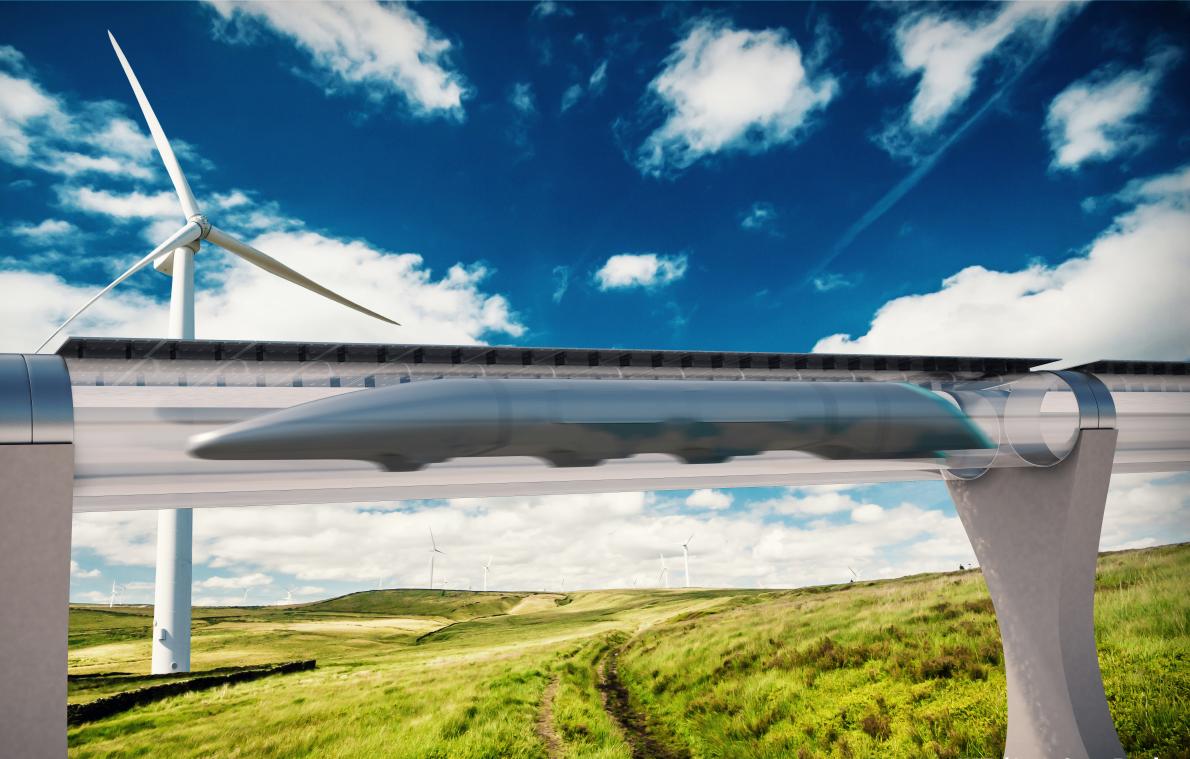
RELATED: Elon Musk’s hyperloop steps toward reality
 Cars carry the fuel that propels them. We don’t notice this with gasoline and diesel engines because these fuels can store a tremendous amount of energy per kilogram, more than 45 million Joules (10,000 kilocalories) per kilogram. While this isn’t the 1.21 Gigawatts necessary for time-travel in Doc Brown’s fictional DeLorean, it is about 50 times the amount of energy that can be stored in a kilogram of our best Lithium-Ion rechargeable batteries.
So while electric cars have advantages in efficiency, reliability and environmental impact– up to one third of the weight of a typical electric car is the battery.
This explains why electric vehicle range tends to be lower than that of gasoline and diesel powered vehicles. Do away with that heavy battery and imagine the acceleration, performance and efficiency of a powerful car with a light powerful motor. If you live in parts of the world served by trams and buses with overhead wires, you’ve seen one method for reducing the need for a battery.
Simply run high voltage wires along the road, over the road, just like the slot-cars we might have played with as children. But maintaining an electrical connection often requires unwieldy spring loaded devices, precise alignment and high voltage wires and rails that can be dangerous for pedestrians and cyclists!
Electroad has a unique technological approach that they call a Dynamic Wireless Power Transfer (DWPT) system. They envision electric vehicles without the need for a large battery, long charge cycles. The energy needed will be minimal due to the low vehicle weight.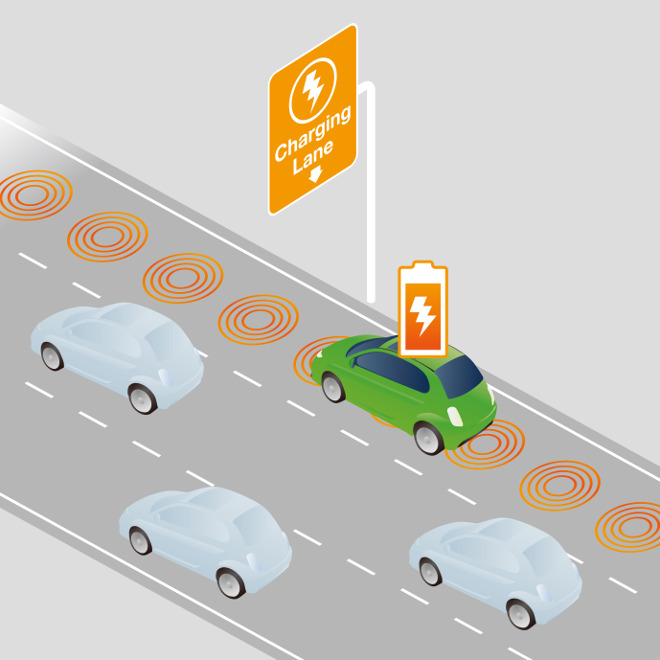
Recent Apple and Android phones, toothbrushes, electric razors, flashlights and even Skylanders light core toys, send electricity through the air by magnetic induction. The idea comes from a couple of basic laws of physics, change an electric current and that creates a changing magnetic field. Put that changing magnetic field near a wire and it will induce an electric current in the wire. So electricity moving through a coil of wire can induce a current in a nearby coil even without a physical connection.
Rather than relying on big batteries necessary to take you to the next charging station, Electroad intends to embed charging stations in the road so that you’re car is charging even while you drive it!
Powered coils beneath the road would accomplish this by inducing a current in coils attached to the bottom of the car. There are several challenges with this approach. One is an efficient way to embed and power the coils beneath the road, the other is alignment with the coils on the cars for maximum efficiency.
Another is the amount of energy that must be transferred during the brief moments the car passes over the coils. Electroad explains that the coils are switched on and off dynamically so that they don’t waste energy when cars aren’t nearby. While these challenges require some creative engineering, this is certainly a problem worth exploring. Electroad are looking for electrical engineers and a city whose visionaries are ready to test drive the future.
And if those induction coils are copper… who wants to be the first to skitch behind an electric car on a hoverboard? Great Scott!




[…] oder Ladestellen. ElectRoad hat eine Förderung durch das Horizon-2020-Programm der EU bekommen. http://www.greenprophet.com/2016/01/electroad-electric-bus/ http://electroad.me/ (Link zum Video [zum Zeitpunkt des Erstellens des Newsletters nicht […]
[…] http://www.greenprophet.com/2016/01/electroad-electric-bus/ […]
[…] http://www.greenprophet.com/2016/01/electroad-electric-bus/ http://electroad.me/ […]
[…] Source link […]