
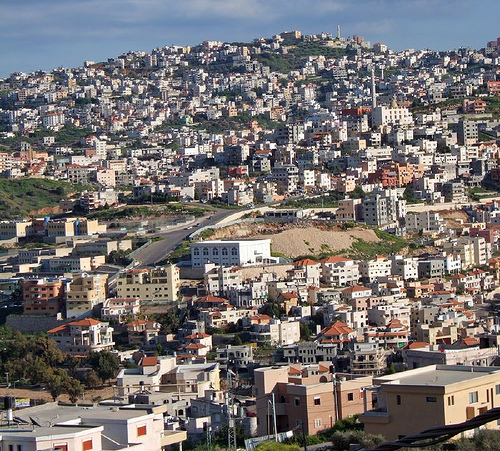

Palestinians in the south Mount Hebron region of the West Bank endure a complicated political situation and a stark reality. In this exceptionally poor area, they also live with the irony of looking up to see power lines crisscrossing their view of the sky, while they lack electricity in their homes.
Elad Orian and Noam Dotan, two political activists from Israel who are also physicists, have started a solar energy and wind project to supply power to the people who were left in the dark. They say that they both felt the time had come to do something practical with their politics that would improve people’s lives.
On their website, they describe the mission of their homegrown project, COMET (Community, Energy and Technology in the Middle East) as facilitating “social and economic empowerment… The core of our activity is the provision of basic energy services for off-grid communities in a way that is both environmentally and socially sustainable.”
Orian tells ISRAEL21: “You have the ridiculous yet terrible situation in which there are villages that have a high voltage energy line going over their head but they are not connected to the electricity, or a big water pipe going through their village but they are not connected to the water line.”
Switching on lights across the darkness
In the two and a half years since Orian and Dotan have been formulating their power-providing initiative they have created solar power installations for individual homes that have impacted about 400 people.
They have also built a small wind turbine project in a community center and last summer they held a wind turbine construction workshop that was attended by Palestinians from all over the West Bank. “The two blessings this area has are sun for solar energy and an abundance of wind,” Orian says.
Basic infrastructure components come from abroad. The solar panels come from the US, some switch components from China, while batteries are from Germany or the US. Key funders are the Sparkplug and Firedoll foundations and more funding is being sought so that COMET will be able to expand its homemade solar power installations.
A small project with big dreams
If Orian could dream and have access to unlimited funds, he says he’d like to see solar power go much further than the village of Susiya where COMET is currently installing systems, to Palestinian communities in the Jordan River area, all the way down to off-grid Bedouin villages in Israel’s Negev Desert.
Dreaming even bigger, he’d like to set up a local center that would build and install such systems, “an energy cooperative that would include people living here allowing them to regulate the project on their own.”
Financing and technical know-how come from outside, but the installations are locally owned and the decision-makers who support COMET are inside the Palestinian communities. And while so far the solar power units are not connected to a nation-wide grid or to other homes, in some communities the solar collectors and batteries could be connected by a micro-grid to provide more continuous power, Orian continues. To work in Gaza is another aspiration, but the approach there, technologically-speaking would need to be different, he says.
Striving toward a sustainable vision
Part of the vision he and Dotan had while setting up COMET was for the solar energy installations to become self-sustaining factors in the communities. Rather than have outsiders service and monitor the equipment, they’ve been training the nearby villagers to do it for themselves.
“The sustainability aspect has several levels,” Orian tells ISRAEL21c. “There is community sustainability to build a local capacity to maintain systems and install future systems, and hopefully in the future systems, most of the maintenance will be done locally. Another level is fundraising,” he says.
The cost of buying the necessary equipment is outside the limits of micro-loan financing, Orian states, adding that no one should have to pay to have access to power – something that he feels should be everyone’s right in the region.
In some areas COMET is building upon German infrastructure that was originally laid down 10 years ago, “But [they] didn’t stay to maintain them so many of the systems are not functioning now. We actually ‘cannibalized’ some of the systems to get more solar panels. The panels themselves are still working but you need to replace the batteries every couple of years,” he explains.
In addition to seeing to it that more people enjoy the basic right to have the benefits of electricity, Orian describes the project as a collaborative effort between “communities who believe that barriers of hostility can be overcome by joint, concrete work aimed at felling the walls of segregation and racism.”
(This story first appeared on ISRAEL21c – www.israel21c.org).



[…] Bank is one of the recipients of the solar panels project. German aid group Medico and Comet-ME, a group which has worked hard to bring renewable energy to the West Bank, are working to bring solar and wind power to 30 Palestinian […]
[…] Authority: Comet ME Finalist in BBC Challenge An Interview With Comet ME’s founder Elad Orian A Solar Powered Comet Lights Palestinian Villages Solar Ovens in Gaza AKPC_IDS += "14448,";Browse topics: Palestine, renewable energy, solar […]
News:: A Solar-Powered Comet Lights Palestinian Villages http://bit.ly/1SMP8