
 Dr. Mamdouh Khalil, a professor of environmental sciences at Cairo University, told Al-Shorfa there is currently a waste disposal crisis in Egypt, because of the lack of waste recycling plants.
Gaza Unliveable by 2020 and Its Water Undrinkable by 2016

It’s all bad news for Gazans – a UN report reveals that that region is under immense environmental stress which looks set to worsen unless dramatic action is taken
A comprehensive report released by the UN this week has warned that Gaza will no longer be ‘liveable’ by 2020 unless dramatic action is taken to improve its water supply, power, health and schooling. It adds that Gaza’s rapidly rising population of about 1.64 million could also lose its main source of fresh water by 2016. Clean water is limited for most Gazans to an average of 70-90 litres per person per day – the minimum global World Health Organization standard is 100 litres a day. “Damage to the coastal aquifer will be irreversible without immediate remedial action,” says the UN report.
UN Launches Climate Change Resilience Project In Western Balkans, Turkey
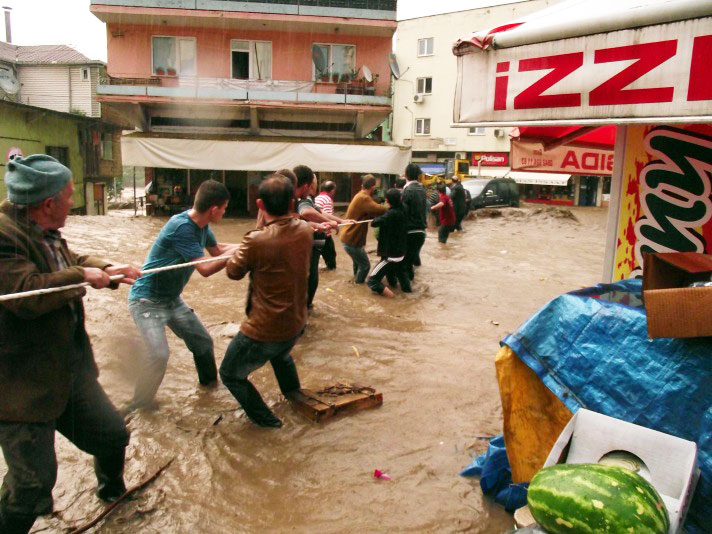
 The incidence and intensity of natural disasters, such as the flash floods last month that killed 12 people in Samsun, Turkey, are expected to increase as climate change intensifies.
A two-year project to improve the disaster response capacities of Turkey and the Western Balkans has just been launched, reports the United Nations Office for Disaster Risk Reduction (UNISDR). Co-sponsored by UNISDR and the World Meteorological Organization, the project will receive 2.2 million Euros ($2.8 million) from the European Commission.
Diwan Baladna Books Are Arab-Jordanian Culture for Dummies

Learn about Arab greetings, the evil eye, funeral traditions and the habit of pigeon-keeping in these colorful books from Jordan.
On my first free Friday in Amman, I walked to the downtown end of Rainbow Street and turned left to find the merchants of Souk Jara just beginning to set up shop. Souk Jara is Amman’s tidy Friday Market, and walking casually down the wide grassy lane, with abundant kiosks on either side – not to mention sampling watermelon slushes and other fresh fruit smoothies from the food stands down a perpendicular path – is a pleasant way to start the weekend.
While most vendors sell handmade jewelry or hand-painted kitchenware, Ahmad Kamal Azban sells copies of the books from the program he and his friend Tony Michael Anqoud created. When I encountered Azban that Friday, he gave me a winning sales pitch about his products.
Diwan Baladna, or “Our Country’s Meeting Place,” is a set of two informative books on Arab-Jordanian life. The first is on culture, the second on language. The books were published in January 2010 and May 2011, respectively.
You’d be hard-pressed to find a source for learning about Arab culture as light and humorous as the first book. Chapters are divided according to major aspects of life in the Arab world, including greeting behavior, the influence of the evil eye, wedding and funeral traditions, and even the practice of pigeon-keeping! An impending second edition boasts fifteen new topics.
How Much Gold Goes into a White Gold Mercedes Sports Coupe?

 Is this McLaren SLR Mercedes Sports Coupe Really White Gold? It Must be at US$ 2.5 Million
Super luxury sport cars such as solid gold Mercedes sport coupes , gold plated Porche 997 GT-2 coupes; and especially a gold trimmed armored plated Rolls Royce are not what one might call environmentally friendly vehicles. Even if the white gold Mercedes does run on biofuel, its no more green than scores of super luxury cars tooling around desert highways in the UAE, Saudi Arabia, and other similar locales.
Will Qatar Oust Israel At Climate Change Event?

Despite having to invite and welcome all members of the United Nations at the Qatar Climate Summit, Qatar is not being so friendly to welcoming Israel at the upcoming climate change event this fall. So goes speculation.
Qatar says Israel’s environment minister Gilad Erdan can come with his security detail. But Israel doesn’t believe Qatar. For an Israeli politician in an Arab land going it alone could mean suicide, opening him up to a range of possibilities including assassination and kidnapping.
Share Beirut is TED-style Creativity Conference for Lebanon

Lebanese illustartor Maya Zankoul “draws” against issues that range from pollution, electricity cuts, real estate pricing, to politics in Lebanon. She will be one of the guest speakers at SHARE Beirut.
In October there will be a free three day conference in Beirut which will look at “digital” rights in the MENA and promote creativity. Similar to the concept of TEDx (see the TEDx Jaffa conference), a platform where people can share innovative knowledge or “ideas worth spreading,” SHARE Beirut is a hybrid event that brings together hundreds of passionate people, forward-thinkers, cultural creatives, activists and artists from the Middle East and around the world to share ideas on how to levarege on the digital media.
For three days starting on October 5, SHARE Beirut will become a huge opportunity for the Middle East North Africa (MENA) region to promote an understanding of open, decentralized and accessible forms of communication, exchange and creation. The event is coordinated by the Share Foundation, a nonprofit organization dedicated to protecting the rights of Internet citizens and promoting free access and exchange of knowledge and information.
My guess is that this will be a very successful event.
Human Anti-Bacterial Drug to Help Coral Fight the White Plague
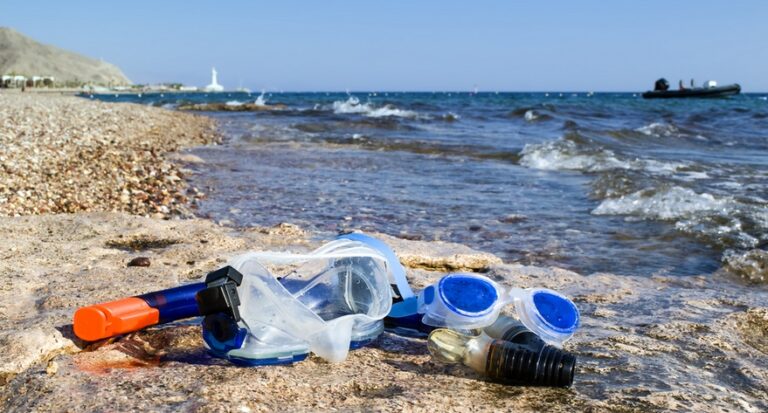
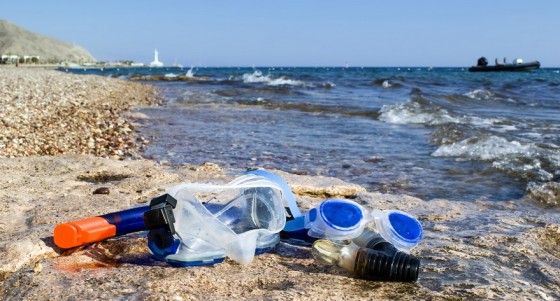 There is a losing battle in saving coral reefs worldwide, but a drug made for humans might be able to help corals fight the White Plague.
Corals reefs are an invaluable part of the marine ecosystem, fostering biodiversity and protecting coastlines. But coral reefs are increasingly endangered. Pathogenic bacteria, along with pollution, global warming and harmful fishing practices, are one of the biggest threats to the world’s coral populations today.
One of the solutions to the crisis may lie in human medicine. Prof. Eugene Rosenberg of Tel Aviv University has developed a treatment for coral infected by Thalassomonas loyana, otherwise known as White Plague disease. This deadly bacterium infects 9 percent of Favia favus corals on the Eilat coral reef in the Red Sea and readily transmits the disease to nearby healthy corals.
Arab Israeli Yafa Energy Plans to Solar Power Traditional Industry
Yafa Energy could be a bridge over which Arab-Israeli technology finds its way to industries in the Arab world seeking renewable energy solutions.
Eureka! Yafa Energy has become the first Arab-Israeli company to win a prestigious European Union EUREKA (Exceptional, Unconventional Research Enabling Knowledge Acceleration) grant. Awarded through Israel’s Prime Minister’s office, Yafa was named as the best technological initiative from an Israeli minority community. Created as an intergovernmental initiative in 1985, EUREKA aims to enhance industrial competitiveness by supporting businesses, research centers and universities that carry out pan-European projects to develop innovative products, processes and services.
We’d Need Five Worlds to Live Like the United Arab Emirates

If we all lived like the citizens of the UAE, we would need 5.4 planet earths to sustain us…
Sometimes the best way to say something is not with words but images. And there is truly no better wake up call to the UAE than this amazing infographic designed by Tim De Chant. It shows that if the world’s 7 billion people all lived like Emiratis, we would need 5.4 planet earths in terms of land to sustain us. That’s pretty scary – especially when you consider that the much-bemoaned lifestyle of the Chinese is, in contrast, pretty sustainable and would require only an extra 10% of planet earth. It’s also scary as the UAE doesn’t have the world’s largest carbon footprint, that particular privilege goes to Qatar.
::Thanks to Tim for granting us permission to use the infographic. See his website per square mile for more.
For more on the UAE and the environment see:
UAE Stands By Its Nuclear Plans
Qatar (Still) Has The World’s Largest Carbon Footprint
World Population Hits 7 Billion Today
Will Your City Survive A Nuclear Bomb? This App Gives The Answer

A nuclear bomb wipes out all of Tel Aviv and central Israel, using the Ground Zero app.
There was much disagreement around the dinner table the other night about whether or not Israel will be obliterated if Iran drops a nuclear bomb. Will there be something to spare? Should Israelis expect a bomb to melt the entire country or would a bomb just wipe out a small square kilometer of land? My husband says the actual direct impact of a nuclear bomb is not that severe.
Raised in Canada during the cold war between the USA and Russia I faced many a sleepless nights wondering if there was a Russian bomb targeting my parent’s home in suburbia. According to my Grade 4 teacher, Mr. Brich, there was. This trauma has left me with the notion that nuclear bombs melt everything within 50 miles of their wake. Who was right? Me or my sometimes more logical better half? I turned to the internet to see if I could find out. Turns out there is an app which lets you nuclear bomb your city. The results are grim. Below I bomb a few Middle Eastern cities to document the extent of the damage.
It makes mutant butterflies look like child’s play.
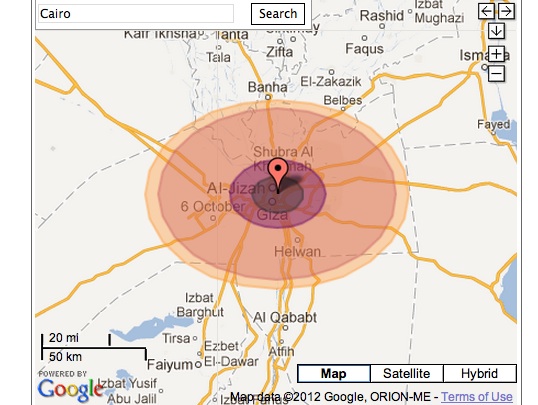
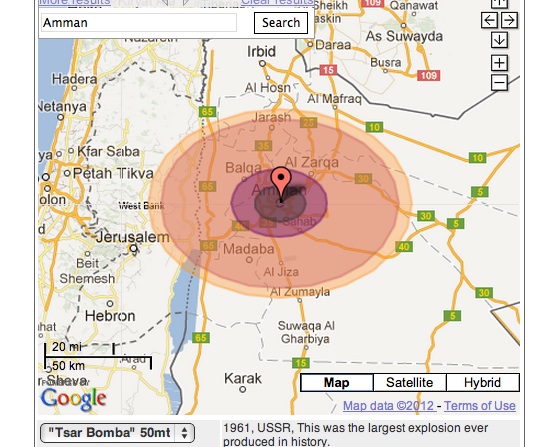
Since it’s not really known what kind of bombs either Israel or Russia possess, I chose a 50 mt Russian bomb, the Tsra Bomba (for the memories) and the results don’t look great.
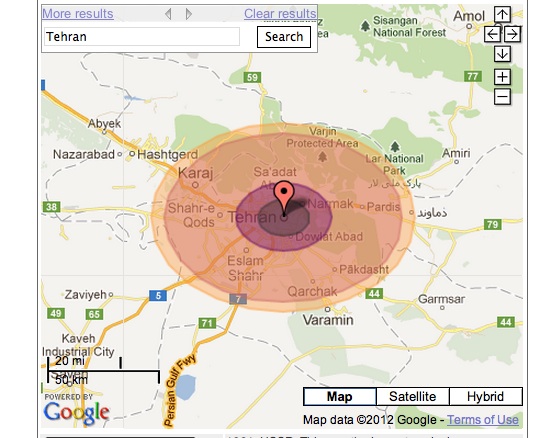
The inner circle is complete annihilation, and the outer rings represent instant fire, persistant fires, and radiation overload. See below in the maps for what happens to Beirut, Jeddah, Tehran, Amman, Cairo, and Istanbul. Will you survive the blast?
Below is the Tsar Bomba bomb dropped on Tehran. Say bye, bye to the city center, and the cities of Karaj, Eslam Shahr, and Shahr-e-Qods.
If you live in Beirut, say bye, bye to the city and the Sidon District. The bomb will even impact nearby Syria.

Now for the Turks. If you live in Istanbul, say goodbye forever to your beautiful city. It will be gone, as well as the cities of Sisli, Esenyurt, and Gebze.

What happens to Cairo makes us especially sad because of the Giza pyramids.
If you live in Damascus your lovely city will be gone.

Effects of a nuclear bomb dropped on Amman will be felt directly in Madaba, and Jarash, and the top of the Dead Sea. Triggering devastating earthquakes?
We have gone through this exercise in tongue and cheek. We wish for no nuclear weapons to be dropped on any city, people, environment or animals.
Update Aug 10, 2020- the app is no longer online. Given the horrible humanitarian disaster in Beirut, we hope no one will need to play around with bombing games.
Israel’s Better Place Electric Car Network Bleeds Capital
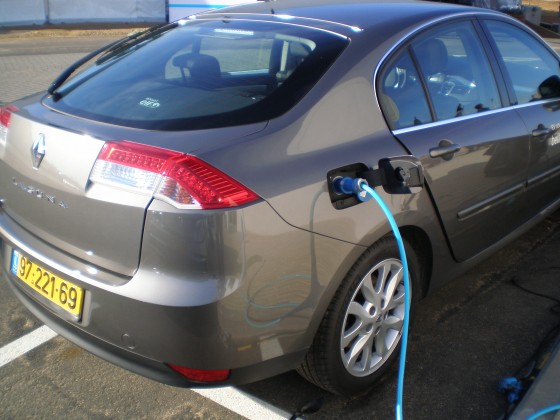

Last month Israel’s Better Place rolled out their all-electric vehicle network to the Israeli public with much fanfare. Of the hundreds of civilians that bought the cars, warm reviews of excitement ensued. Pictures and photo ops were maximized. Since opening the car sales channel to the public the number of Better Place cars on the road now exceeds the number of Better Place cars being driven by company employees. The company also released news that it had set an electric car distance world record, garnering some fresh enthusiasm for the business.
But a new report warns that the company is seriously bleeding cash, suggesting it’s light years away from putting 10,000 cars on the road – its break even point.
Green Miner Pulls Minerals from Desalination’s Seawater Brine
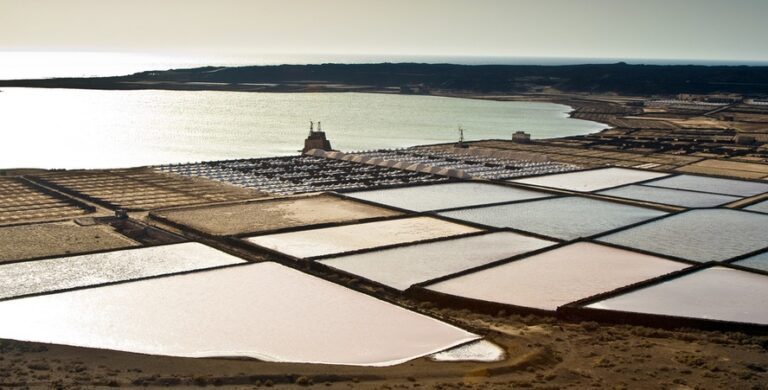
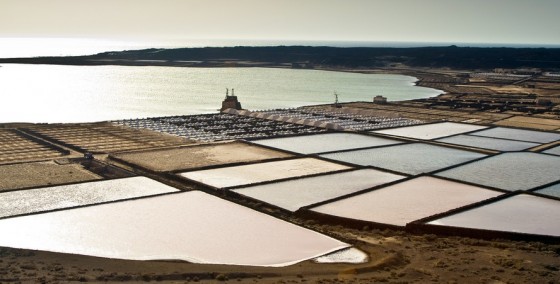 This new approach uses bacteria to mine sulphur and magnesium from desalination’s polluting brine.
Desalination’s no golden ticket to creating water for the Middle East but it’s an approach that more and more countries are turning to as a last resort. Desalination is energy intensive, and what to do with the toxic waste byproducts? Biomineralogist Damian Palin is turning to biology to mine valuable minerals from desalination brine. “I collaborate with bacteria,” deadpans the young Irishman. Watch him turn desalination on its head.
Palin teams up with metal-munching bacteria to biologically “mine” minerals from seawater: the byproduct of his process is pure, potable water. In this short talk, the TED Fellow describes his idea.
[youtube]http://youtu.be/9Q2hew8759w[/youtube]
Using bacteria to dissolve minerals, releasing the metals locked inside, is called bioleaching. Palin’s developing something different: a biological mining (not melting) process. Because seawater metals are already dissolved, his bacteria simply collect them. “A mining industry that’s in balance with nature,” he says.
 Microorganisms are everywhere, the oldest living things on the planet. As they evolved, they developed numerous adaptations. Think of Napolean Dynamite: each bacterium has its own “skills“.
Bacteria can form minerals from their surrounding environment as a defense mechanism; it’s one of their skills.
Introducing specific bacteria to ocean water can attract particular elements, effectively pulling them out of the water mix. The segregated elements have commercial value, which can be sold to finance the “mining” process. The freshwater that results is just gravy. For resource-poor, water-parched Middle East nations like Jordan, the prospect of mining the seas for high-value minerals – and – producing clean water as a by-product is like winning the Irish Sweepstakes.
“The thought that we take energy to remove the brine and then do nothing productive with that material reminded me of the issue of waste materials factories started to deal with decades ago. Now, I’d be hard pressed to find a company who doesn’t try to make money on intermediate products from their manufacturing processes”, Palin said in a TED interview.
Every megaliter of seawater contains about 1300 kg of magnesium, 900 kg of sulfur, 400 kg each of potassium and calcium, and smaller amounts of virtually every metal on the periodic table of elements. World demand for magnesium (Mg) is growing exponentially: the automotive and construction industries are increasingly Mg dependent.
The car industry is moving towards magnesium/aluminum alloys to make stronger, lighter vehicles: now using these alloys in engine blocks, but looking to expand application if magnesium supplies can be made scalable. In construction, magnesium gypsum board (MGO) is strong, mold and mildew-resistant, durable and non-flammable, all characteristics of a superior building product. Cement containing Mg holds potential to lock up small amounts of atmospheric CO2; new products such as Novacem explore these technologies. The bottom line is that we will probably never have enough Mg.
This technology could also be used to mine land-leached phosphate from the oceans; short-circuiting the predicted “peak phosphorus”crisis, with its devastating implications to world food production. Brine mining also allows nations with no natural resources to enact a lucrative mineral recovery industry.
Palin doesn’t condone massive desalination projects, he stresses that conservation and frugality must be on the agenda before production. The drive behind his work is environmental protection. “Until we’re able to stop polluting our water systems, desalination may provide a stopgap solution. Mining products from brine effluent should reduce the environmental impact of the technology, while also indirectly reducing the cost of the fresh water produced”, he said.
In the future, we may couple traditional filtration processes with biological processes to produce effluent that is essentially fresh drinking water. This would be a boon to water-starved Middle East nations.
Does water chemistry float your boat? Then check out NASA’s site to learn the basics of ocean salinity: a quick read in layman’s terms.
Image of desalination brine from Shutterstock
The State of The Middle East’s Oceans – A Report

Find out how Middle Eastern and North African nations fared in the recent global Ocean Health Index (I’ll give you a clue – not very well)
With a recent Greenpeace report urging action to tackle the toxicity of Lebanon’s waters due to trash, now seems the perfect time to look into the health of the region’s oceans. The Ocean Health Index is the first comprehensive global measurement of ocean health that includes people as part of the ocean ecosystem. The 2012 global index had been released and I’ve gone through the stats to dish the dirt on the MENA region’s oceans.
Food Shortages Could Force World To Go Veggie
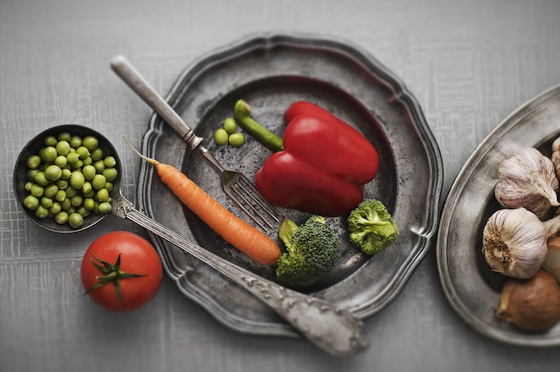
Iranians may have turned to aubergines due to chicken shortages – but the world over may be forced to go vegetarian due to food shortages in the next 40 years
According to the latest findings, the world’s population may have to switch almost completely to a vegetarian diet over the next 40 years to avoid catastrophic food shortages. Water scientists are concerned that as the global population increases by another two billion by 2050, there simply won’t be enough water to support cattle and so a bigger portion of our diet will have to come directly from crops. Animal protein-rich food consumes five to 10 times more water than a vegetarian diet. As it stands, 20% of the average human’s diet is animal based and this will have to drop to just 5% to feed the world’s growing population. Could you live on one quarter of the meat you are currently enjoying?