
UN Launches Climate Change Resilience Project In Western Balkans, Turkey

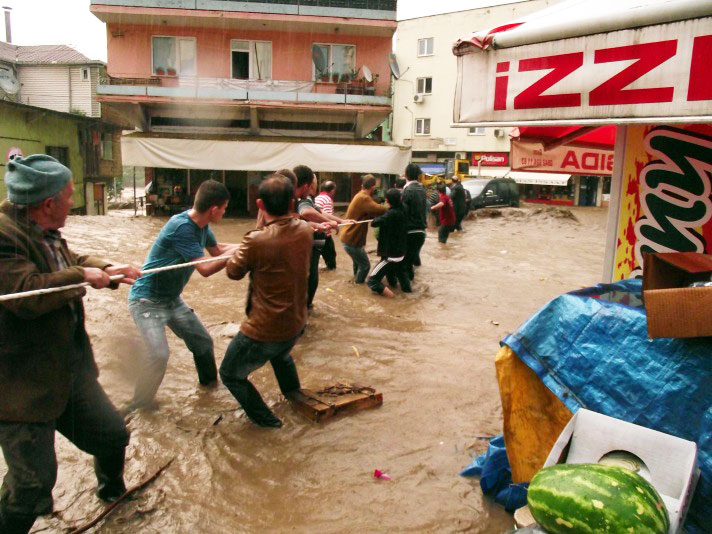
The incidence and intensity of natural disasters, such as the flash floods last month that killed 12 people in Samsun, Turkey, are expected to increase as climate change intensifies.

A two-year project to improve the disaster response capacities of Turkey and the Western Balkans has just been launched, reports theĀ United Nations Office for Disaster Risk Reduction (UNISDR). Co-sponsored by UNISDR and the World Meteorological Organization, the project will receive 2.2 million Euros ($2.8 million) from the European Commission.

Preparing for the worst

Turkey and its Balkan neighbors are already hit often by natural disasters — earthquakes,Ā floods, flash frosts and heat waves, droughts, and forest fires. Increased climate variability, as well as new land-use and settlement patterns, “may compound such problems,” according to the UNISDR press release about the project.

The project will place special emphasis on cross-border cooperation during times of disaster. The meteorological and hydrological capabilities of each participating country will also be strengthened.

One potential result of the project will be a multi-hazard early warning system that all countries can access. On the local scale, the project will increase disaster risk awareness in urban settlements and encourage the spread of disaster insurance among farmers, small and medium enterprises, and homeowners.

In addition to Turkey, the countries set to benefit from the project are:Ā Albania, Bosnia and Herzegovina, Croatia, Montenegro, Serbia, the former Yugoslav Republic of Macedonia, Turkey, and Kosovo.

Climate change prevention: Better than preparedness

Unfortunately, the UNISDR’s project does not include any measures to forestall climate change in the beneficiary countries.

Turkey, in particular, has long resisted policies to reduce its rising greenhouse-gas (GHG) emissions. The country’s addiction to petroleum, which greatly adds to its overall GHG emissions, is even holding Turkey back from its full economic growth potential, according to recent analysis.

The fact that Turkey’s local climate already inclines the country toward natural disasters should be a wake-up call to the government: Don’t contribute to increased climate variability! Instead, investing in renewable energy and limiting GHG emissions will put Turkey on an economically stronger — and safer — path.

:: UNISDR

Read more about Turkish climate policy:

Turkey’s Economic Growth Hampered By Oil Addition, Analysts Say

A 2012 Forecast For Turkey: Heading Down A Tried And False Path

Turkish Energy Analyst Says Biggest Emitters Avoided Durban Commitments

Turkey Avoiding Greenhouse Gas Reduction Despite Rapid Increases In Emissions, New Report Finds

Image via World Bulletin

Julia Harte
Julia Hartehttp://www.greenprophet.com
Julia spent her childhood summers in a remote research station in the Rocky Mountains of Colorado, helping her father with a 25-year-old experiment in which he simulated global warming over a patch of alpine meadow. When not measuring plant species diversity or carbon flux in the soil, she could be found scampering around the forests and finding snowbanks to slide down. Now she is a freelance journalist living in Istanbul, where her passion for the environment intersects with her interest in Turkish politics and grassroots culture. She also writes about Turkish climate and energy policy for Solve Climate News.

Read More

1 COMMENT
  1. They propose all sorts of ways to help the people, except the two that would relieve pressure on the environment and prevent such a string of disasters by peacefully reducing the human population with family planning education and safely recycling 100% of human-generated waste materials. But then, there’s probably a lot more money to be made providing disaster relief than prevention.

LEAVE A REPLY

Please enter your comment!
Please enter your name here

TRENDING

5 projects to help kickstart your company’s sustainability journeyĀ 

True progress happens when environmental ambition meets action. Decarbonizing efficiently is possible for any business in any sector, but actually getting started can sometimes feel daunting. Ā  The trick? It’s to start small and build momentum. Here are five potential projects to help you get started. Ā 

Hormuz 2026 Conflict Poses an Energy and Food Security Dilemma in a Warming World

As tensions rise in one of the world’s most critical maritime chokepoints, the ripple effects go far beyond oil—touching food systems, climate pressures, and regional stability

Climate change traced in sea turtle shells

It's sea turtles which may in the end save islands in the Seychelles. They may also better help us understand climate change. Like rings on a tree, scientists have found a way to read sea turtle shells and how they are impacted by climate change tells a story.Ā 

We’ve lived through the past 11 of the hottest years on record

Have we forgotten about global warming when the world...

Huge Fish Nursery Discovered Under Freezing Arctic Seas

In 2019, an underwater robot camera exploring the seabed...

How to quiet noise from construction in your office

Streets need to be resurfaced in New York but the humming and grinding noise is unsettling. Noise is environmental pollution.Ā 

EarthX and a blueprint for sustainable investing

Trammell S. Crow, a Dallas-based businessman and father of four, is focusing his efforts on impact investing, and media that focuses on saving the planet through EarthX.

Mining Afghanistan’s Mineral Discoveries Similar to Avatar

Now that American forces in Afghanistan are commemorating the longest period of any war that America has been involved in, including the 1965-73 Vietnam War, the recent discoveries of large and extremely valuable mineral and metal deposits may finally bring to light a reason to continue the presence of US fighting forces in this war torn and backward country.

From Pilot Plant to Global Stage: How Aduro Clean Technologies’ 2026 Expansion Signals a Turning Point for Chemical Recycling Investors Like Yazan Al Homsi

The company's Next Generation Process (NGP) Pilot Plant in London, Ontario, has officially moved into initial operating campaigns, generating the kind of structured, repeatable data that separates laboratory promise from commercial viability.

Nobul’s Regan McGee on Shareholder Value: “Complacency Is the Silent Killer”Ā 

Why the governance framework designed to protect shareholders so...

Should You Invest in the Private Market?

startustartup Unlike public stock exchanges, which offer daily trading, strict...

How to build a 100-year-company

Kongō Gumi is a Japanese construction company, purportedly founded in 578 A.D., making it the world's oldest documented company. What can we learn about building sustainable businesses from them?

How AI Helps SaaS Companies Reduce Repetitive Customer Support Work

SaaS products are designed for large numbers of users with different levels of experience, and also in renewable energy.

Popular Categories