
Home Blog Page 131

4 Ways to Grow Your CBD Business in 2022

0
cannabis oil
CBD is a natural medicine that can have a profound affect on mediating pain and anxiety.

The CBD business is estimated to be worth $13.2 billion in 2028. There are some strategies you can use to carve out your share of this growing market. Here are four ways to grow your CBD business in 2022:

Develop a Strong Online Presence

Digital marketing is an important strategy for growing your CBD business. Use social media, work with Cannabis SEO agencies, and other techniques to reach as many customers as possible. Make sure your website is optimized for search engines, and use keyword-rich content to attract potential buyers. This is especially important for small businesses that want to compete with larger companies. 

Grow Your Customer Base

To ensure consistent growth, you need to constantly acquire customers. Keep your marketing messages fresh and adapt to the changing demands of consumers. You need to have the right branding, and white-label your CBD products. If you choose a company like  Joy Organics to work with, you can make this process much easier.

You also need to build a strong working relationship with your customers and always strive for their satisfaction. This will encourage repeat business, which is great for building brand loyalty. Consider offering discounts on bulk purchases to further increase sales volume.

Expand Your Product Line

Remember that creating a successful CBD business is about more than just selling CBD oil. If you want to stay competitive, offer your customers the most complete range of products possible. This may mean offering different types of oils as well as topicals and other complementary items such as edibles. Consider offering new services such as customer support or special shipping options for bulk orders.

By expanding your product line, you can reach a larger audience and increase sales. You may also want to consider partnering with other companies in complementary industries to expand your reach even further.

One way to grow your CBD business is to expand your product line. You can add new products that cater to different markets. For example, you could launch a line of CBD-infused beauty products or CBD-infused snacks.

Strategic partnerships can also be a great way to grow your CBD business. Find companies that offer complementary products and services, and team up with them to increase sales. You may also want to consider working with organizations that promote the use of CBD oil.

Create a Niche Market

There is plenty of room to grow your CBD business by targeting a specific niche market. For example, you could focus on selling CBD products to seniors or cancer patients. Develop new products. As the CBD industry continues to grow, you may want to consider expanding your product line.

Work with organizations that promote the use of CBD oil and develop a good reputation in the industry. This will make it easier for people to find out about your company when they search online or visit dispensaries. For example, if you sell topical products such as ointments, look into getting your products certified by well-known organizations such as the Arthritis Foundation or other health charities.

Finally, remember that customer satisfaction is key to a successful CBD business. Keep your branding consistent, and make sure you provide excellent customer service. Offer discounts on bulk purchases, and go the extra mile to ensure that your customers are happy with their purchases.


 

Make a vegetable, vegan maqluba

0
vegan-recipe-makluba
Makluba is a traditional Palestinian dish. We like the vegan version.

Would you like to taste the Arabic all-in-one-pot Maqluba, but prefer to keep it vegan? Green Prophet offers you a meat-free version, where carrots, fennel bulbs, and big, meaty Portobello mushrooms make great substitutes for the traditional chicken. It was inspired by the spin put on macrobiotic Maqluba by chef Moshe Basson, who runs the Eucalyptus Slow Food restaurant in Jerusalem. 

And for dessert, try these amazing vegan tahini and chocolate popsicles

Make Maqluba, The Vegan Version

Serves 6 generously.

DO-AHEAD: Soak the raw rice in cold water for 30 minutes. Drain before proceeding.
Ingredients for vegan maqluba:

3-4 tablespoons extra-virgin olive oil
1 tablespoon ground turmeric
Optional: 1/2 teaspoon saffron threads soaked in 2 tablespoons hot water
1/2 teaspoon dried thyme or 1 teaspoon fresh thyme
1 teaspoons ground allspice 
1 teaspoon paprika

2 large onions, thickly sliced
3 medium potatoes, sliced thickly
1 small head cauliflower, separated into florets
1 large sweet red bell pepper, thickly sliced
1 medium eggplant, quartered and cut into 1-inch-thick slices
2 large carrots, peeled and sliced into thick rounds
1 fennel bulb, trimmed and sliced horizontally

6 big Portobello mushrooms, sliced into thirds

4 large cloves garlic, peeled and halved
3 large tomatoes, thickly sliced
Freshly ground black pepper to taste
2 teaspoons sea salt
2-1/2 cups raw brown basmati rice, soaked in cold water for 1/2 hour.  Set aside 1/2 cup of it.
3-5 cups vegetable broth or lightly salted water
Optional garnish: a scattering of finely chopped parsley and/or toasted pine nuts

Set the oven to 400° F – 200° C.

In a large sauté pan, cook onions in 1 tablespoon olive oil over medium heat until golden. Salt and pepper the onions lightly. Set aside.

Add 1 tablespoon of oil to the pan. Cook the potatoes in it until lightly golden, but not cooked through. Salt lightly. Set aside.

Line a baking sheet with parchment paper. 

Toss the cauliflower, bell pepper, eggplant, carrots, fennel, mushrooms and garlic in a large bowl with the remaining oil and the spices. Roast for 15 minutes, removing the garlic after 5 minutes, then the rest of the vegetables as they cook.
The vegetables should be cooked only until not-quite tender. They will continue cooking later.

In a large pot, spread sliced tomatoes along the bottom. Cover the tomatoes with the 1/2-cup of reserved soaked rice and sautéed onion. 

Place the sliced vegetables in layers over the rice and onions. Tuck the garlic pieces here and there among the vegetables.

Spread the potatoes on top.

Press everything down in the pot with the back of a large spoon or spatula.

Spread 2 cups remaining rice over potatoes. Sprinkle 1-1/2 teaspoons salt over rice. Add broth or water to cover. If using saffron, pour the threads and their soaking water over everything.

Place the pot, uncovered, over a medium flame and let the liquid simmer 15 minutes. Then cover the pot, reduce heat to low, and cook for 30 minutes. Add more liquid by tablespoons if it seems to be drying out, but be careful not to add so much that rice becomes sticky.

Remove the pot from the heat and let it sit, covered, for 10 minutes.

Take a round metal tray and place on top of the pot. Flip the pot onto the tray. You may need help to do that, if the pot is very large: it will be heavy.

Pat the pot on the top and sides to release the food. Wait a minute, then pat again. Carefully lift the pot to display a lovely “cake” of makluba, ready to be spooned out to hungry family and guests.

Garnish with finely chopped parsley and/or toasted pine nuts if desired.

Any slightly burned rice from the bottom of the pot is considered a delicacy to be scraped out and eaten.

Notes on variations: If you wish, substitute broccoli or zucchini for the cauliflower.

Some cooks substitute nutmeg for allspice.

Serve with a simple leafy salad.

Enjoy!

Editor’s note: Maqluba originated in the Levantine region, with its first written record appearing in a 13th-century cookbook from the Abbasid Caliphate. The name “Maqluba” means “upside-down” in Arabic, referring to the dish’s signature presentation where it is flipped onto a platter for serving. It is believed to have been influenced by Persian and Indian biryanis brought by Arab traders. It is eaten in Syria, Jordan, Lebanon, and by people in Israel with Palestinian heritage. 

Cooking the Healthy Way: Protein Powder Recipes for Everyone

0

oat milk shake with bananas

Protein is a necessary element in the human body that needs constant uptake and in considerable amounts. Finding the perfect balance between all the nutrients is too much work and may require a dietician’s help. Many suggest the usage of protein powder in daily cooking and healthy foods for those who need additional supplements to improve their eating habits and weight-related issues. These powders are easy to mix with almost every food and drink to make a delicious meal ready for consumption.

Here are some creative recipes that turn out super tasty and are easy to combine with these supplement powders. 

1) Pancakes, waffles, and other smacking breakfast items:

What is a better way to start the day with some light dishes that are super tasty and healthy at the same time? Pick powders with a grainy and smooth touch that is easily mixable with any batter. Add any protein powder to the batter using a sieve for even spreading and avoid lumps. These lumps can cause uneven cooking and might ruin the taste. Look for tasteless powders to create a custom flavour. Flavoured powders can add to the meal and produce a delicious and mild taste if required. 

Oats and other cereals can also use these powders. Some people find it difficult to mix these powders and avoid a bitter taste. Make sure to pick the right milk type or yogurt for the best consistency.

2) Delightful lattes, smoothies, and parfaits:

Combine these powders with healthy and low-fat milk for super healthy drinks. These powders work like a charm when used with smoothies to make for an amazing after workout drink. Many companies sell soy, whey, and other types of proteins that work differently. Using the right kind depends on likeability, taste, effectiveness, and whether it fulfils its purpose. 

Flavoured powders used with milk or water can create superb juices and shakes. Many people like to mix it with caffeine or make caffeine-related drinks for an extra kick of energy. It keeps them on their toes and makes for a delicious pre-workout shake. 

3) Bakes, bread, and snacks:

Protein as a snack? Absolutely! Mix it with oats and other healthy ingredients to make a thick paste that can be rolled into balls or bars to be eaten anytime throughout the day. These are super filling and max out the energy levels. Cakes and cookies can also use these powders by simply mixing them into the batter. Use a little milk to add consistency or make it easier to roll them up. Cakes batters can become thick. Make sure the taste is not too overwhelming and fits the taste buds well. 

Many like to eat mashed potatoes as a side dish. Use lightly flavoured or unflavoured powders to mix with spicy foods to consume them the right way. Mix it with salsa and other dips for additional benefits, if required. 

4) Fast foods:

Missing out on the regular burgers and pizzas? Protein powder is the solution to these, too. Protein-on-protein can never be too much. Find the recommended dosage and combine it with the burger patties for tasty results. Many restaurants serve healthy pizzas and other fast foods made with these powders. Make sure to eat in a balanced manner to avoid too much protein or junk that may be detrimental to the usage of the powder.

Any cheat day could use some boba or shakes that may not be too healthy. Add a touch of whey or soy protein to reduce the guilt! Look for natural powders and consider their ingredients before purchase. Amino acids, other nutrients, collagens, and flavouring are some aspects to look at for an upgraded experience and ease of use. 


Incorporate communications into your new business

0

office workers, startup wework New York, recycling

So, you and your team are great at collaborating, but what about when you have to start collaborating with a new department? Maybe you want to bring in environmental policy or standards? It can be tricky to keep your internal communications strategy running smoothly across different teams, but there are steps you can take to streamline them.

Tips for Effectively Communicating with Teams in Different Departments

Use the right team communication platform

Choosing the right team communication platform is the first step towards improving team collaboration in your business. Using an all-in-one team chat app and workspace, like Spike, makes a huge difference in productivity, especially when you have to communicate with team members in other departments.

It’s much easier to stay organized and keep track of important information when all your messages and notes are in one place, instead of being spread around in emails and various apps. Also, with team chat apps, you can create chat groups based on team, project, client, or whatever else makes sense.

So, let’s say you and your marketing team are collaborating with the graphic design department on a big client project. You can create a chat group for that project with key team members from each department to optimize your cross-team collaboration.

Everyone in the group can see what everyone else is talking about and working on, and all the messages are archived in one place where everyone can instantly review them. All you have to do is use the chat app’s built-in search and filtering features to look for key pieces of information. That way, everyone has access to the info they need to complete their tasks.

Get everyone on the same page

Once you’ve chosen a team communication platform for your cross-team collaboration, it’s important to make sure everyone in all departments is on the same page about how to communicate questions, requests, and updates.

For instance, maybe your immediate team members are all accustomed to giving you daily updates on their project tasks, but people in another department might do things differently. If you need team members in the new department you’re collaborating with to do things a certain way, communicate this clearly to them to ensure you’re all on the same page.

Encourage open, transparent communication

Nothing puts a wrench in team collaboration like a lack of communication, especially when you’re working with different internal teams. If people don’t communicate, it’s very hard to know how projects are progressing and if there are any delays or other issues you need to keep an eye on.

Once you start working together with a new department, encourage them to openly communicate with you and your team about how they’re doing and make a promise to do the same. This fosters a strong working relationship between departments and helps everyone in the organization understand how others work.

Use common language

Different departments use different jargon or technical terms and abbreviations that not everyone knows the definition of. In order to ensure clear cross-team communication, make sure everyone uses common-knowledge language. 

If there are certain department-specific terms that you can’t avoid using, you could create a collaborative cheat sheet with the terms and their definitions. Whenever anyone uses an unfamiliar term, call it out and ask them to add it to the database, so everyone can learn it.

Ask for regular feedback (and listen to it!)

It’s very hard to improve cross-department collaboration and communication if you don’t get feedback about how it’s going so far. Ask your immediate team members and people on the other teams you collaborate with to give you feedback on how they think communication and processes are working. If there’s room for improvement, ask your colleagues to give you specific ideas for how to do so. 

For example, if you’re working with the design department, they might have a different idea for how to give them design orders from what you’re currently doing. Listening to feedback and taking actions to improve workflows helps everyone work more efficiently and increases your business’s overall productivity.

Celebrate wins together

Working with new departments gives you and your team opportunities to get to know others in your company better and build stronger relationships. When you successfully complete a project with another team, celebrate the win together, no matter how big a role the other team had in it.

For instance, if your marketing team scored a big client after a presentation you gave with a video the graphic design department put together for you, invite their team out to lunch or happy hour. These small chances to celebrate together are great for team building and cultivating trust between departments.

The Bottom Line

Working with new departments for the first time doesn’t have to be awkward or complicated. By following the steps we outlined above, you can effectively communicate project needs and collaborate efficiently between teams and do amazing work together! 

Just remember, it all starts with the right team communication app. From there, just try the tips we discussed in this article for smooth cross-team collaboration.

Electric cars and lithium for batteries? Serbs revolt against Rio Tinto

Elon Musk Tesla - Israel
Hey Elon – can you solve the problem of mining for lithium needed to run Teslas?

Electric cars are probably for the greater good, especially if they are powered up with renewable energy. But fewer emissions on our city streets, certainly helps with bringing down high rates of lung cancer and bringing problems in cities. 

But as always the case, lithium batteries that are good for your Tesla in Oakland or Montreal might be terrible in someone else’s backyard. As we speak the Serbians are heavily fighting against lithium mining by Rio Tinto, and are calling out the government for its corruption.

According to The Guardian, which I consider to be the greatest environmental newspaper on the planet, Rio Tinto and the Serb government started its advertising campaign using clean tech as the greater good on national TV, announcing:

“Green technologies, electric cars, clean air – all of these depend on one of the most significant lithium deposits in the world, which is located right here in Jadar, Serbia.

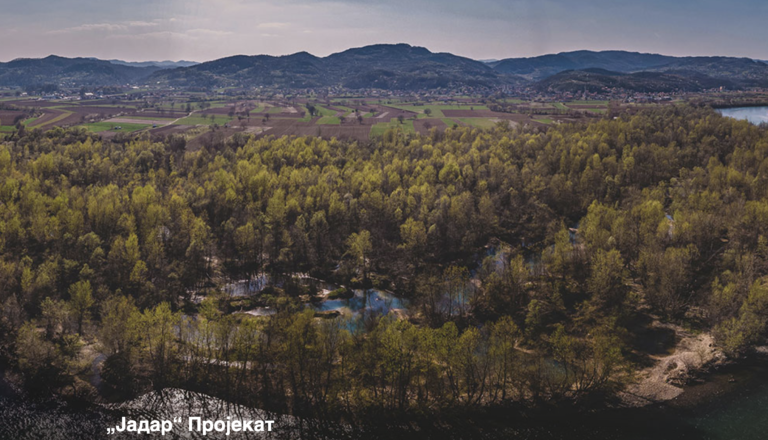
Jadar Valley Serbia, area of lithium mining
Area of lithium mining, Jadar Valley, Serbia via Rio Tinto website

“We completely understand your concerns about the environment. Rio Tinto is carrying out detailed analyses, so as to make all of us sure that we develop the Jadar project in line with the highest environmental, security and health standards.”

In July, Rio Tinto announced that it would invest $2.4bn in a project in the Jadar valley, in western Serbia, overlooked by the Cer and Gučevo mountains, building what it says will be Europe’s biggest lithium mine, and one of the world’s largest on a greenfield site. The site will also over 40 years produce boric acid and raw materials for solar panels.

“Such mines are mostly opened in deserts precisely because of the detrimental effect on the environment and biodiversity,” said Prof Dragana Đorđević, head of environmental chemistry and engineering at the University of Belgrade told The Guardian: “The basins of the Drina and Sava rivers, from which about 2.5 million people are supplied with water, are endangered.”

“Woke” Serbs aren’t buying the propaganda. One critic told the Guardian that Rio Tinto could be seen as “a poster child for corporate malfeasance.”

They fear displacement, toxic pollution and loss of land and biodiversity.

So we are in a bit of a pickle. On one had we want renewable energy and electric cars but these “things” require raw materials. But is a company that provides products and parts we need, despite not being able to save the planet too, a demon? Not long ago we interviewed Rio Tinto for their aluminium supply chain progress – on the blockchain. We know that corporates can do better, want to do better, but how and at what risk to communities and ecosystems?

Or perhaps all mines should just move to Africa where the people are not organized enough, or safe enough to rise up against authorities? Or to Canada

We received a dispatch from Jun, a Serbian eco activism group. They write:

“Of the myriad of environmental problems in Serbia, we are most concerned with the proposed Rio Tinto-operated Jadar lithium mine. Rio Tinto executives told EU officials that the development of the mine will begin after the March 2022 elections in Serbia. This amounts to strategic manipulation of Serbia’s democratic process by foreign corporations and governments,” they write.

“As the regional implementation leader of the Sustainable Development Goals (SDGs) agenda in the Western Balkans, 28. Jun is obliged to communicate on the deteriorating ecological situation and its potential for humanitarian crisis.

“We will use our Special Consultative Status with the United Nations to enlist, organize and shape public support of necessary policy changes to benefit the people of Serbia.

“Our report will be submitted to the United Nations, the Serbian Ministry of Environmental Protection and made public before the March 2022 elections. In addition to the communiqué, 28. Jun will make contributions in support of environmental projects to both municipal governments and civil society organizations in Serbia.

“Our foray into the battle to protect our land, air and water begins immediately.”

We’d be happy if anyone from Rio Tinto would like to comment and we will publish it here. I suspect jobs of the future aren’t in blockchain. They are in renewable mining for resources. Get learning your green MBAs people, and start here:

::Jun

::Rio Tinto Serbia

Africa’s Great Green Wall works!

0

Africa’s Great Green Wall (GGW) programme to combat desertification in the Sahel region is not only crucial to the battle against climate change but also makes commercial sense for investors, a new study led by the Food and Agriculture Organization of the United Nations (FAO) and published in Nature Sustainability shows. The lead author is from Bonn, Germany. 

For every US dollar put into the massive effort to halt land degradation across the African continent from Senegal in the west to Djibouti in the east, investors can expect an average return of USD 1.2, with outcomes ranging between USD 1.1  and USD 4.4, the analysis finds.

Imagine if such a project extends to North African regions of Tunisia and Libya and then makes its way to water-starved regions like Yemen and Syrian in the east?

“We need to change the rhetoric about the Sahel region,” to reflect the fact that despite its harsh and dry environment, “investors can get a viable return on their investment in  efforts to restore the land,” says Moctar Sacande, from the FAO.

drought, water shortages, food shortages, Sahel, Oxfam, Baaba Maal,
World-renowned Sengalese musician Baaba Maal visits drought victims in Mauritania.

But the study results might just be UN rhetoric as well to justify their means. According to Politico Only 4% of the Great Green Wall’s original goal has been met, and an estimated $43 billion would be needed to achieve the rest.

If you read below Jeff Bezos has contributed a billion, but we’d need a few dozen more billionaires to realize the grand dream. Planting trees in Africa is one thing, but what happens when temperatures not accounted for rises and it doesn’t rain and millions of trees die?

Teachings for the Middle East on desert agriculture?

“The project that doesn’t involve the community is doomed to failure,”  Diegane Ndiaye told Politico. He is part of a group known as SOS Sahel, which has helped with planting programs in Senegal and other countries across the Sahel, a broad geographic zone between the Sahara in the north and the more temperate African savanna to the south. His data might fine-tune what the UN is not seeing. 

How to grow trees on sandy soils in the Sahel:

But a US diplomat visiting the region also told Politico that there wasn’t initially much hope that it would succeed from the outset, yet progress is seen:

Jonathan Pershing, deputy special envoy for climate at the US State Department, visited Senegal as part of an Africa trip last month, saying the US wants to partner with African nations to fight climate change.

“The desert is encroaching. You see it really moving south,” Pershing said.

Investing for longer term goals

In terms of the Great Green Wall project, he told Politico, “I don’t think that very many people thought it was going to go very far. But there are indications of progress, as seen in the community projects.

“It has a global benefit, and people are prepared to make those kinds of long-term investments through their children and their families, which I think is a hallmark of what we need to do in other climate arenas.”

The UN analysis uses field and satellite data to track the land degradation over the period 2001 to 2018 and then compares the costs and benefits of restoring the land based on different scenarios adapted to the local contexts.

The results provide the final piece of economic transparency in a jigsaw, with the political will and technical know-how already in place and should encourage the private sector, which is showing increased interest, Sacande says.

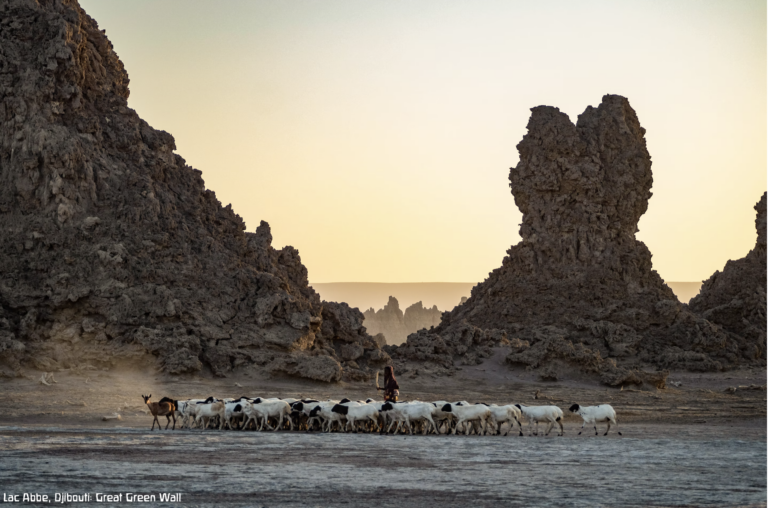
The greening and land restoration along this belt stretching 8,000 km across the continent is already underway. Communities are planting resilient and hardy tree species such as the Acacia senegal, providing gum arabic, widely used as an emulsifier in food and drinks and the Gao tree or Faidherbia albida, which helps to fertilise soil for the cultivation of such staples as millet, and for animal fodder.

With technical support from the UN, more than 500 communities have seen improved food security and income generation opportunities. The total area the GGW programme encompasses remains limited, with only 4 million hectares out of a targeted 100 million, according to the study.

Jeff Bezos pledges a billion USD

A total of some 20 billion USD dollars has been pledged internationally to support the scaling up of the Great Green Wall programme, including USD 14.3 billion at a One Planet summit for biodiversity held in Paris in January this year and USD 1 billion from Amazon founder Jeff Bezos at the just-concluded COP26 climate conference.

Concrete details of how these funds can be accessed are yet to be clearly mapped out, Sacande says, adding that unless some of the funding is delivered urgently, it could be too late for planting to catch the limited rainfall expected in June and July.

bees honey, south africa hives

With its potential for carbon sequestration and restoring biodiversity and its emphasis on the socio-economic benefits to the impoverished communities inhabiting the region, the GGW straddles the key areas of climate mitigation, adaptation and resilience. 

The Green Wall also addresses UN Sustainable Development Goals on hunger, climate, life on land, and more.

The armed conflicts pervading the region have long made some wary about its potential. And the study finds that about 50 percent of the land area involved is currently inaccessible for security reasons. But even taking this into account, land restoration interventions still represent a viable business proposition, the authors report.

Solar power for 10 mosques

0

mosques going solar, green

Muslims are also environmentalists and a group of them from a few NGOs want to help 10 mosques in the world go green.

As part of the activities of the Ummah for Earth alliance during the UN Climate Change Summit (COP26) Greenpeace Middle East and North Africa announced a new initiative aimed at reducing the carbon footprint of mosques and other community buildings around the world. Faith can play a role in mitigating the effects of the climate crisis, and it has potential to inspire an alternative future, completely free of fossil fuels. 

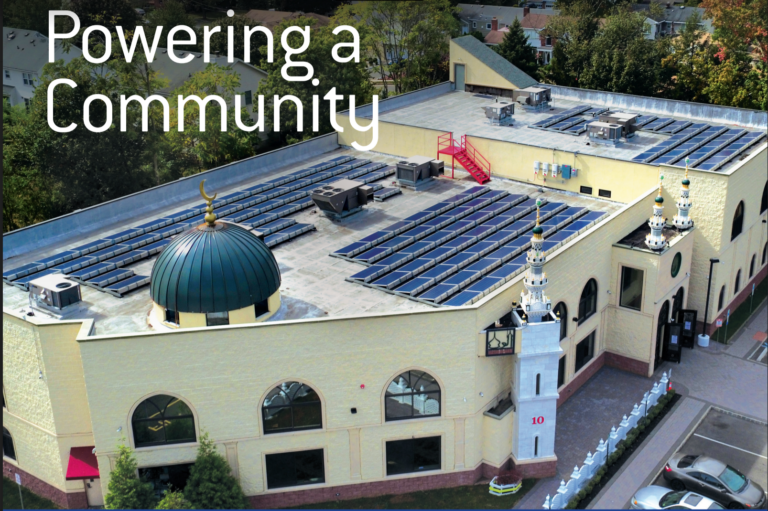
The Green Mosques initiative aims to build on the examples already set by various mosques around the world, including The Glasgow Central Mosque in Scotland, where solar power systems are currently being installed thanks to generous support from Islamic Relief – an Ummah for Earth alliance member, as well as the Istiqlal Mosque in Jakarta, Indonesia, which made a move to partial solar energy production last year. 

eco mosques infogram

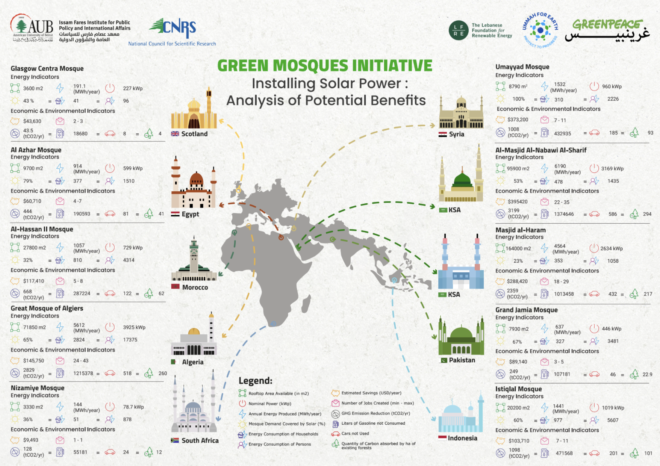
The initiative is being launched with a detailed technical report that analyses the potential carbon savings that can be made by installing solar systems at ten key sites around the world, as well as the potential social, economic and environmental impact these systems can have within each community. 

The report was developed by a team from the Issam Fares Institute for Public Policy and International Affairs at the American University of Beirut, in collaboration with The Lebanese Foundation for Renewable Energy and the National Council for Scientific Research.

“This initiative is a testimony of the Ummah’s ambition to be part of the climate solution and a message to leaders representing the countries from the Muslim world in the ongoing climate negotiations, that they should be true to its ambition and push hard for a world free of fossil fuels,” Mouhad Awwad, Project Campaigner – Ummah for Earth at Greenpeace Middle East and North Africa said.

In total, the installation of the proposed solar power systems at the ten locations would generate approximately 22.3 gigawatt-hours of electricity, and reduce 12,025 tonnes of carbon dioxide emissions per year. The equivalent of a reduction in consumption of more than 5 million litres of gasoline, a reduction of 2203 light vehicles on the roads, or the preservation of 1107 hectares of forest.

Additionally, the proposed solar plan would create between 93 and 153 new jobs within the local communities around the mosques. 

The ten mosques aiming to go solar

Al Azhar Mosque – Cairo, Egypt

Al Haram Mosque – Mecca, Kingdom of Saudi Arabia

Al Hassan II Mosque – Casablanca, Morocco

Al Nabawi Mosque – Medina, Kingdom of Saudi Arabia

Glasgow Central Mosque – Glasgow, Scotland

Grand Jamia Mosque – Lahore, Pakistan

Great Mosque of Algiers – Algiers, Algeria

Istiqlal Mosque – Jakarta, Indonesia

Nizamiye Mosque – Johannesburg, South Africa

Umayyad Mosque – Damascus, Syria

The initiative will be followed by a global drive on Greenpeace’s social media channels and its Ummah for Earth allies, inviting people to take part from within their communities, by first working together to produce a cost-benefit analysis of installing solar systems at their local places of worship – along the lines of what was done in the report, with the ultimate aim of empowering them to physically implement the conversion to solar energy throughout the coming year. 


Abraham Accords gets real in Tel Aviv

0

Just before the Covid-19 variant Omicron shuts down Israel’s borders to foreign visitors, Ahmad Belhoul Al Falasi, the Minister of State Entrepreneurship from the United Arab Emirates, visited Israel for a whirlwind tour to cement the Abraham Accords.   

United Arab Emirates ambassador to Israel Mohamed Al Khaja joined them.

The Abraham Accords is a treaty between Israel and the United Arab Emirates and the United States reached on August 13, 2020 to develop sustainable business relationships between Israel and the UAE. The hope is peace treaties between Israel and other Arab states. So far relationships have started in energy and water

Abraham Accords Abraham Accords Abraham Accords Abraham Accords

Mid-November, Al Falasi visited the city of Tel Aviv, guided by the Israeli Minister of Tourism Yoel Razvozov and Mayor of Tel Aviv-Yafo Ron Huldai. As part of the tour, they visited the Peres Center for Peace and Innovation in Jaffa, on the way they stopped at the observatory deck in Jaffa to take in the views of Tel Aviv.

Mayor Ron Huldai then showed Israel’s guests around the Rothschild area, where history meets modernity, explaining its current significance for the city. We hope they didn’t get hit by electric bikes while they were walking because the city is fraught with violent speeding electric bikes and mopeds that neither the city nor the police can control.

The delegation continued onto “The Library” – located in an historic building off of the boulevard and founded by the the municipality, it provides a working space for startups and entrepreneurs.

Founders of Tel Aviv start-ups got the chance to meet the reps from the UAE and expressed wanting to meet with them all again soon. With shared problems such as water, and combined talents and resources: start ups and energy, the United Arab Emirates and Israel could do extraordinary things in clean tech, energy and water. 

Abraham Accords

Ten Cool Home Gadgets You Need in 2022, to Make Your Life Easier 

floating home
A quick sustainable gift guide

Domestic chores never end, even with all the helping hands at the ready. Therefore, if you could get some ‘automatic’ assistance, it should serve to make life for your family, much easier. Here are ten gadgets that should prove useful, especially as they are affordable, and just a one-time investment.

  1. Shine Automatic Toilet Cleaner

This gadget is perfect to take over the unpleasant job of frequent toilet cleaning from you! The Shine Automatic Toilet Cleaner works on a simple command from your Smartphone/Voice Assistant. Working on electrolyzed water technology, it cleans and deodorizes your toilet. Easy to set up and maintain, with a six-month rechargeable battery, the gadget can also keep track of water use, sense overflows, identify leaks/breakages, and detect other issues. No chemicals come into play. 

  1. Ring Video Doorbell

This splendid doorbell should prove highly useful for identifying visitors to your home. After connecting it with the requisite app, the Ring doorbell’s in-built video will begin recording the features and movements of your visitors. This gadget possesses motion-sensing capacities. You may even direct the video lens towards the busy street (if any) in front of your house. Above all, there is a night-vision camera for filming during dark nights. You may obtain this doorbell at home101.co.uk which sells several other gadgets too. 

  1. Google Nest Protect

A highly advanced smoke alarm system, it works on a battery, or can be hardwired. You may install it wherever you want. The system has night lights too. With the app installed on your Smartphone, you should always be aware of a fast-burning/slow fire, if any. A voice alert informs you about the spread of carbon monoxide or smoke in a particular location of the house. The gadget gives you time to check the situation for yourself, before triggering the siren. You may silence it via a voice command or a mute button. Your gadget has wireless connections with other Protects too.

nest labs google

  1. Midea Air Conditioner

It is not as noisy, or as greedy for energy (consumes less than 35%), as a traditional AC is. Regardless, it offers several advantages. The easy-to-install gadget has already received certification in 2020, for being energy-efficient, thanks to using something called Inverto Quattro technology. The AC’s U-shape permits easy flow of air, thereby ensuring that you sleep well. Additionally, the cooling effect is rapid, and greatly substantial. Control it through an app (Smartphone), or via voice (Google Assistant/Alexa). 

  1. Lcaoful Smart Combo

The combo is smart in both, looks, and function. It comprises of a 52-inch ceiling fan with three blades, and a spherical-shaped LED light. The light is attached to the central motor. This light is highly energy-efficient. An additional feature is the reversible motor, which helps the fan to work in any direction. Therefore, you may have an updraft in winter, and a downdraft in summer. The compact and silent combo is susceptible to voice control (Alexa, Google Assistant, app on Smartphone).

  1. AirSoap Air Purifier

Keep clean and healthy air circulating within your house/office by installing this aesthetically appealing, portable model, with handles on both sides, in it. The material is sturdy plastic (ABC), with an easy-to-clean, white finish. With the aid of a lone button, the fan can move through auto mode and manual (low, medium, and high). There is even a child lock system in place. Operating on electric wind technology, the air purifier displays a soft hum. Its collecting plates are washable, and ozone emission is low.

image-soap-bubbles

  1. Ultraloq UL200 Door Lock

Created from stainless steel, the smart Ultraloq offers the option of several locking mechanisms. You may unlock it in six ways. The traditional way is to use a mechanical key. Another way is to use the Smartphone app. Bluetooth bonds your lock and Smartphone. Wi-Fi is for controlling the lock. The other four ways, include using a pin/password, Magic Shake (shake the phone when near the lock), capacitive fingerprint scanner, and contactless key fob (such as, an RFID tag). Other features are the anti-peep touchscreen and two-factor authentication. The lock welcomes Alexa and Google Assistant too.

  1. Ecobee Smart Thermostat

Use your voice (Alexa, Google Assistant, or Siri) or the given app, to control the heating and the air conditioning at your residence. The thermostat adjusts automatically, since it can sense the temperature easily. It has a remote sensor within it. You may switch it on, for adjusting the temperature anywhere and everywhere, in the house. The thermostat works beautifully with wi-fi. Since it is compatible with Alexa, it doubles up as an Alexa speaker. The sound quality is excellent. The look of this product is great, with a glass finish.

Bird's Nest, ONZ Architects, Parasitic Architecture, Green design Turkey, eco architects Turkey, solar power, green design, sustainable design,

  1. Neabot NoMo Vacuum Cleaner

It is a hands-free, cleaning robot! Use the Neabot Home app to schedule the cleansing timings, the areas to be cleaned, and outline the cleansing strategy. You may use voice control (Google Assistant or Alexa) for monitoring the work from anywhere in the house. The presence of anti-collision sensors and other modern technologies, ensure that Neabot navigates any kind of obstacle intelligently, in a z-shaped pattern. Capable of functioning at three power levels, the vacuum cleaner displays three types of suction – small, regular, or strong. It can deep clean carpets very efficiently too. The highlight is Neabot’s ability to transfer dirt, dust, and debris automatically, into a home canister/lined and sealed dustbin. 

  1. MeshForce M3 Whole Home Mesh Wi-Fi System

True, it is more expensive than a traditional router. However, the advantage is having a single system cover the entire house, especially if it is a large residence. According to the manufacturer, the coverage of wi-fi can extend anywhere between 3,000-4,000 sq. ft. Regardless, it would still be good to opt for a suitable placement with the help of the company’s Smartphone app. This way, every part of your house will be able to access the Internet 24 x 7, and with speed. The dual band wi-fi aids in connecting six dots. Best of all, the router is small, and thereby, portable.

10 Tips to Stay Safe on the Road

0
Tesla Model S
From the streets of Montreal to the highways of Tel Aviv, Tesla S is quickly becoming a popular choice for consumers. But an electric car won’t save you from road accidents. Read on about staying safe.

It’s the circle of life; more people equal more drivers, more drivers equal more cars, and more cars, unfortunately, equal more accidents. And while some things are entirely outside of our control while driving, there are ways to keep ourselves and those around us safer on the road. 

Safety Tips that we can all use

We all could use a refresher with some tips and reminders to help keep the roads safe. This is true whether you are a brand new driver who was just licensed or you’ve been driving for 50 years. We all have a responsibility to learn more about driving safety. It’s a good idea to have the contact information for your personal injury attorney ready in case of an accident.

Hands-Free may not be as Safe as You Think

According to the National Safety Council, distracted driving has been a leading cause of traffic accidents in the U.S, and the number one distraction is the cell phone. According to NSC, there is little difference between using hands-free technology and a handheld device from a safety perspective.

The real distraction, it seems, occurs in the brain, not with the hands. So our first three tips are (1) Place the Cell Phone out of sight, (2) Pay attention to the road and surroundings, and (3) Eliminate distractions.

Following The Rules of the Road

Following too closely behind another driver is hazardous for several reasons. Among these, you may not have the ability to see what’s ahead entirely, and if the driver in front of you is forced to stop suddenly, this could lead to an accident. In addition, following too closely may cause you to miss warning signs regarding possible hazards ahead. With this in mind, our following tips are (4) Always maintain a safe distance, (5) Observe the proper speed limit, and (6) Respect the rules of the road.

drifting into crowds saudi arabia

Arab Drifting, Saudi Drifting, or Middle East drifting, known in Arab countries as Tafheet (تفحيط), or Hajwalah (هجولة), is an illegal street racing–like phenomenon believed to have started in the late 1970s that involves trying to “drift” cars. In the process, racers often drive dangerously close to traffic, barriers, and spectators watching from the roadsides without any protection.

Remember to be Prepared

Being prepared for unexpected situations when setting out on a trip is part of being a responsible driver. And while it certainly isn’t possible to be prepared for every issue that may occur, we can take steps beforehand to prepare for the unexpected. This includes things like (7) Always wearing our seatbelt in case of an accident, (8) Plan for emergencies, if you happen to be driving where cell service could be a problem, maybe take a satellite phone. (9) Check the weather forecast before leaving. 

If you’re wondering what to do if you are hit by a car as a pedestrian, it’s important to know your rights and the immediate steps to take for safety and legal protection. Understanding these actions ahead of time can make a big difference in how effectively you handle a crisis.

Please, Don’t Drink and Drive

The last tip on our list is a big one. According to the Centers for Disease Control and Prevention, nearly 30 people die every day due to drunk driving. These deaths are entirely avoidable as there are other options available. When going out, if you plan to consume alcohol, please select a designated driver beforehand so that everyone can enjoy the evening. 

If a designated driver was not selected beforehand and you have been drinking, please order an Uber or Lyft to ensure everyone arrives home safely. The penalties of driving while impaired can be steep. In most states, drunk drivers are given a suspended license for up to a year, and many states have mandatory jail time for first-time offenders. A drunk driving conviction will remain on the driving record for decades, and in some states, it stays on the driver’s record for the remainder of their life. 

Hopefully, these tips have helped keep you and those around you a little safer on the road.  


A College Student’s Guide to Living an Organic Lifestyle: 6 Insider Tips

0
organic lifetstyle college
Make a bed with shipping crates

College living isn’t what most people think of when they think of clean living, but it’s never too early to start making better choices for your health. Living an organic lifestyle is one significant way you can breathe and sleep easier. 

Incorporating organic swaps into your everyday routine is the perfect low-effort way for college students to join sustainability and wellness movements. Many of these organic-friendly swaps won’t disrupt your habits, meaning they’re as impactful as they are beginner-friendly. 

Don’t worry about chemicals in your food, clothing, or bedding while you’re stressing about finals this year. Instead, here are six insider tips that will help you transition to all things all-natural. 

Shop for organic dorm essentials

You don’t have control over some things as a college student, but one thing you can control is the products you use to fill your dorm room. Just like clothing, furniture and dorm essentials can also be organic. If you’re in search for sustainable home swaps, there are companies like these that manufacture safe, chemical-free versions of dorm essentials like mattress toppers. 

One of the best things about moving into a dorm is that you’re typically starting fresh so that you can buy everything organic the first time around. If you treat them well, these planet-friendly, skin-friendly alternatives can stay with you all four years and beyond. 

Consider local food producers and small markets

Food is what most consumers think of when they hear the word “organic.” Organic food is food raised without the help of harmful pesticides, meaning they’re better for our bodies and the environment. 

Organic food often has a higher nutrition value, and many swear it tastes better. Look for certified organic products, cruelty-free labels, and shop at local markets to jump on the chemical-free food bandwagon. 

Organic produce isn’t always uniformly shaped. Look for the five-digit codes on produce, starting with the number 9, which means organic. If you’re not living the vegetarian lifestyle, that’s perfectly fine–you can choose meats that are certified organic by USDA standards. 

Wherever possible, avoid processed food. When eating out, try to eat locally and inquire whether any of your community’s restaurants source their food from nearby farms. 

Read about product ingredients

Living organically is a way of life that means learning about the domino effect our purchasing decisions can have on the world around us. 

Develop a habit of checking product labels and researching various ingredients. Even foods that you might assume are all-natural can undergo harsh treatments to make them more aesthetically pleasing or long-lasting. 

Alternative to plastic

Today’s market is chock full of refillable, reusable water bottles and storage containers. Single-use plastics are one of the most straightforward items to replace with something more eco-friendly. 

Use refillable water bottles and mugs. If there’s no alternative option to packaged goods, consider recycling afterward. Though reusable plastics will undergo similar treatment to single-use plastics, this swap is still a low-effort way to reduce your carbon footprint

Detoxify your skincare routine

Did you know that many cosmetics products are bursting with harsh, skin-damaging chemicals? Research companies with an all-natural, chemical-free promise for a less damaging way to apply your morning makeup. 

Dress to impress

Reading food labels is a great habit, but take it to the next level. Check the tag on your clothing. Is it made locally or imported from long distances away? Consider how it came to be in the store where you bought it and what substances might have treated the fabric before processing. 

Choosing organic clothing is another excellent tool to unleash the eco-survivor. Hemp and wool make great alternatives to traditional fabrics like cotton. 

Trendy clothing comes and goes and leaves a massive footprint on the environment from start to finish. High-quality garments not only look good, but they’re sustainable. 

Parting shot 

Living organically is about considering all of the available options, not just the most popular or cheapest. By making a few simple adjustments to your buying habits, you can score an “A” in organic living this semester. 


Cook Shulbatto, a vegan Druze bulgur pilaf

0
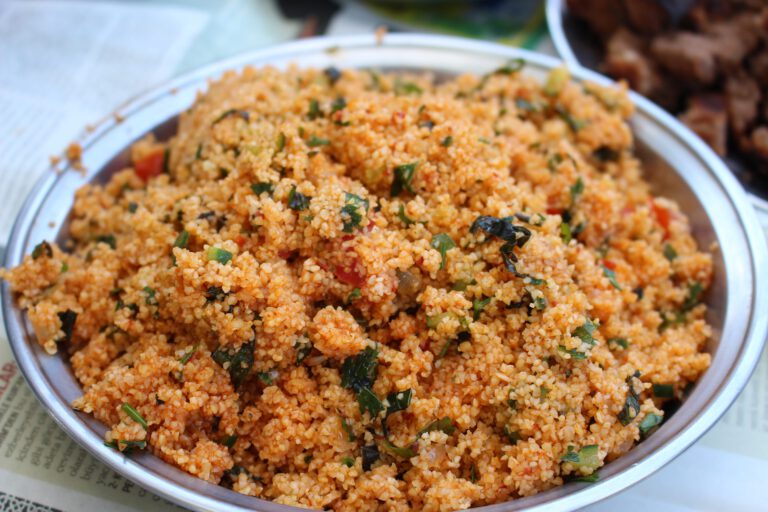
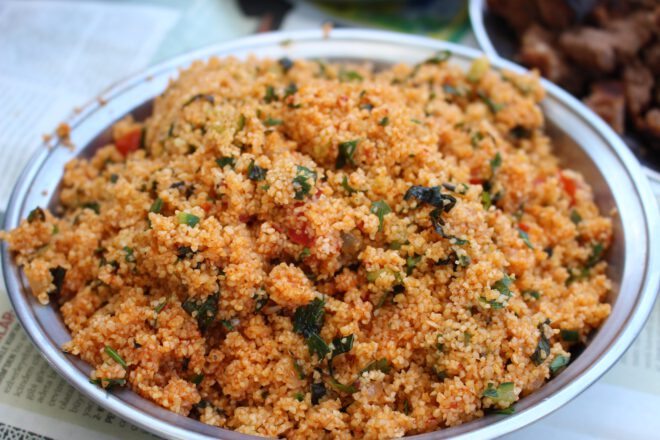
Shulbatto, Druze Bulgur Pilaf

Bulgar wheat, or burgul as it’s known in the Middle East, begins as husked wheat grains. Farmers – or more likely, their wives – boil the grains for one hour, then dry them. The processed wheat grains are then take to the local mill for grinding into fine, medium, and coarse-sized particles.

Each burgul quality has its particular uses in cooking. Fine-ground burgul is used in tabouleh, for a light background to salad vegetables; medium-grind for dishes like kubbeh, and the coarse grind for hearty dishes such as majadra (the burgul substituting rice) or shulbatto. We have many dishes that feature burgul, including this luscious recipe for bulgur balls in tomato sauce. 

Move over tabuleh, meet shulbatto

Shulbatto is a dish known around the Arabic culinary world, but hasn’t been made as popular to Westerners as, for example, tabuleh. This version comes from the Druze villages of northern Israel and Syria, via the Galileat culinary workshop organization.. 

It’s important to use coarse-grind bulgur wheat, as finer grades will cook up mushy.

Shulbatto, A Druze Bulgur Pilaf

Serves 4 generously.

Ingredients:

2 zucchinis 

1 large onion

3 ripe tomatoes, hand-grated whole, or peeled and blended – may use 1 cup canned chopped tomatoes instead.

1 medium eggplant

1 medium red bell pepper, or 1/2 cup roasted red peppers from a jar

OPTIONAL: 1 hot red pepper, for those who like it spicy

1 cup room-temperature water

1 cup coarse-grind bulgur wheat

1 teaspoon ground cumin

1 tablespoon baharat spice (found in Middle-Eastern shops, or make your own from Karin’s baharat recipe)

Salt and pepper to taste

1 cup olive oil

How to make Shulbatto

Chop the zucchinis, onion, eggplant, bell pepper and optional hot pepper into medium cubes.

Put the onions in a large saucepan and cover them with the olive oil.

Sauté the onions over high heat, until transparent.

Add the eggplant. Sauté 10 minutes, until it begins to soften.

Add the zucchinis, bell pepper and optional hot pepper to the pot. Cook and stir another 15 minutes, until everything is cooked through but not mushy.

Add the grated tomatoes, with their juice, plus one cup of water.

Cover the pan and bring to a simmer. Continue simmering 5 minutes.

Pour the bulgur and spices into the pot, stirring to distribute. 

Reduce the heat to low and cook 10 minutes longer. 

Taste to adjust seasoning.

Remove from the heat, but let the dish rest, covered, about 5 minutes. 

Serve with a leafy salad, halves of hard-boiled eggs, and a dish of olives.

Enjoy!

Photo via Pixabay.

Desalination investments from unlikely business partners

0
masdar city
A zero energy city built by Masdar

Just around the beginning of Covid something remarkable happened. After years of cold shoulders, the Arabian Emirati nations which make up the United Arab Emirates declared peace and friendship with Israel. It was a first from the Arab world to thaw out decades of boycotts and sanctions. While Israel has official peace with Jordan and Egypt, nothing could have prepared Israel for the open arms it received from Dubai.

The United Arab Emirates and Israel share ambitions in renewable energy and both face extreme water shortages. Some of the early partnerships in business and cooperation will be in these areas. Just recently Masdar, the net zero energy city that really has yet to take off, announced it will work with Israel on desalination technology. 

Desalination is mainly constrained by filters and the amount of energy needed to create the end product. Out of necessity Israel has developed an industry out of filter technology and renewable energy. 

“I can tell you that Masdar is already active in Israel and we are exploring opportunities to help Israel reach very ambitious targets,” said Mohammad El Ramahi, director of asset management and technical services for Masdar’s clean energy division in the United Arab Emirates. He was speaking at a panel discussion with Israeli and US energy executives at the US Pavilion at Expo 2020 Dubai.

He explained how Israel and Jordan, which have an official peace treaty, but luke warm relations, want to use renewables in their energy mixes to 30 per cent by 2030.

“That is 15 gigawatts, which opens a great horizon for developers like Masdar to compete … against price and against value creation for the best welfare of the Israeli people and also create opportunities,” said El Ramahi.

Following the announcement the UAE, Jordan and Israel signed an agreement to develop a renewable energy and desalination plant in Jordan to slow climate change and add to the growth of clean energy in the country.

According to The National, the partners plan to build solar photovoltaic plants that can generate 600 megawatts of electricity in Jordan. The electricity will be exported to Israel, which will supply 200 million cubic metres of water from a new desalination project.

Feasibility studies for the project will begin in 2022.

The UAE became the first country in the Arab world to pledge to reach net zero emissions by 2050. Israel also pledged to become carbon neutral by the same year. Saudi Arabia pledged to be carbon neutral by 2060.  All promises are at least 30 years away which seems too late. 

mars-science-city-skylight
Watery skylight in Mars Science City

But there is hope for peace perhaps: “The Abraham Accord not only opens horizons for [the] UAE and Israel, but also for US companies and for Jordanian companies to collaborate and explore opportunities in the spectrum of not just in renewable energy but also in sustainable water desalination,” said Mr El Ramahi.

Masdar not only built a model city in the United Arab Emirates, it’s also an energy company. They are an early developer of renewables in Jordan and their first overseas investment in a Jordanian wind farm in 2013. It also developed Baynouna, a 200MW single solar energy project located east of the capital Amman, which became operational in 2020.


Farm Inventory Management: How It Can Help Your Business Be More ‘Green’

crop management software, wind turbines, sun setting on farm
Sustainable technologies of the future include software to manage crops

Inventory is the term that is simply used to indicate keeping track of the raw materials and the finished products that are in stock. Farm inventory management happens to be an extremely important thing for businesses that are in the sector. If making your food business greener is important to you, investing in food produce ERP software can be a great idea.

Here are some of the ways it can help you.

  • Proper Management Is Essential

When crops are managed from seed to a product that is sold to the end customer, a business is better able to manage its inventory. This can be great because it can use its resources in the right places so that wastage of such resources does not happen.

  • Better Seeds Used

When every seed is accounted for with the help of ERP software, it is easier for the business to be green. This is because every seed is accounted for and this is wonderful for the grower. With such software, the crop grower essentially finds himself in a position where he knows what each seed has produced because the produce ERP software tracks everything.

This ensures that the grower buys better seeds because he knows that the produce he gets from them will be of high quality. When this is done, the ultimate result is that the product that is got is always of excellent quality.

  • Less Wastage Of Resources

When everything is accounted for, from seeds to grow to harvesting and packing of the end product, it is easier to make sure that there is as little wastage of resources as possible. While it means that only as many seeds that are required are used, water is also used only in the quantity that is required.

This is great because, with less wastage of resources, the business itself can be as green as possible.

  • Better Stock Organization

With farm inventory management produce ERP system software at service, it is easier for a business to organize its stocks better. This is often a problem with farmers who are more traditional in the sense that they don’t use software to organize their stock. This can be problematic because stocks in the farming business can be difficult to deal with.

With software to help, this becomes a lot easier.

  • Better Crops

With such software, it is possible for growers and agro-based businesses to track and analyses seasons and what kind of crops grow in those seasons, how much water and fertilizer are required in these seasons and how the resources can be utilized in better ways.

It certainly aids in daily farm work.

  • Reduction Of Impact On Environment

Ultimately, farm inventory software helps in reducing the growers’ impact on the environment. This is great because it lets businesses work without worrying about the impact they are having on the environment.

Using farm inventory management software is a better choice for people and businesses who want to do their bit for the environment.

Irish Golfer announces going green in Dubai

0
new giza golf club cairo, pyramids
New Giza golf club Cairo

Rory McIlroy is an Irishman who loves being green –– and not just the color. While playing in Dubai, the United Arab Emirates this fall, he pledged he would become more green ecologically speaking by slashing his environmental footprint. Golfers who play professionally are jetsetters by nature, but that doesn’t mean they can’t do more to cut down on carbon emissions from private travel, the greens they play on and through the hotels they choose to stay, he tells Golf Digest when he was in Dubai. 

He told the magazine, “Two years ago, after I won in China – at the WGC-HSBC Champions – I flew back home privately. It was just me on the plane and a massive sense of guilt came over me. This can’t be good, I thought.” 

But the golf odds weren’t against him: “When the R&A and the USGA brought out their distance insights report, the best thing they spoke about was the sustainability aspect of golf and how to make the footprint of courses smaller. So that is certainly something we can all do.”

The GEO Foundation is involved in making golf more sustainable and for McIlroy’s part he is offsetting his travel by buying carbon credits, which cost him about $200,000 extra every year.

“It’s something I have a conscience about and I take it seriously,” he told the golf lifestyle magazine. “Especially when you see some of the weather events that are happening. This isn’t something I’ve talked to many of the players about. But for my own peace of mind, I know that when I do travel I’m not doing it to the detriment of the world that we live in.”

We’ve covered golf going green on Green Prophet in the past and while golfing isn’t the most famous Middle Eastern or Levantine sport it is something that tourists typically like to do when they visit Egypt, Jordan or the United Arab Emirates. 

Some newer housing developments in Cairo, for instance, have mirrored suburban or gated communities in the United States, and the Cairo development New Giza most likely would not have impressed the Pharaoh with its luxurious views to the pyramids from the golf green.

Greens in the Middle East should be brown 

mena house golf course

Golfing started as a favorite pastime in the British Isles where climate ensures steady growth of thick grasses, and then over the years with colonization and now globalization the sport had migrated to the Middle East where it was originally played on sand flats and putting surfaces called “browns”. Today, hotel developers and real estate investors want to recreate the greens of the British Isles which are largely unsustainable in a very dry Middle East, with countries such as Jordan and Yemen being among the most water insecure in the world. 

It’s hard to imagine lush greens in these locals and luckily some creative golfers have opted to grow browns and not greens as we see today at Jordan’s only golf course, still in operation even after Covid hit so many businesses poorly.