

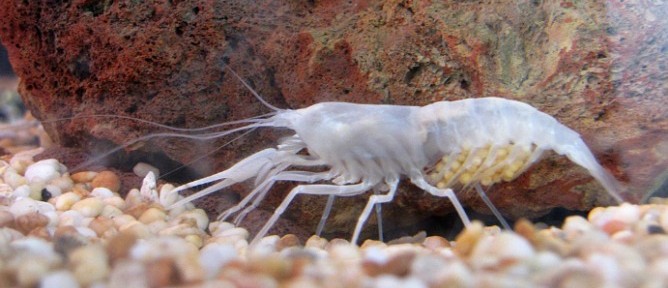
 When Noah was told by God to load two of all animals onto a special hand-built ark, there was no mention of the blind shrimp species found only in Israel. There probably was no need to protect the small crustacean living happily underwater – until now.
Human development has put this blind shrimp, or prawn to be more precise (Typhlocaris Galilea), at severe risk of extinction.
The prawn is found in a remarkable habitat: It lives in one chamber of an ancient Roman cistern in a forgotten city on the north shore of the Sea of Galilee. Water from the chamber doesn’t flow in or out directly, but seeps through the clay bottom, and then into other sections.
There are others similar to these blind shrimp in cave systems around the world, including Mexico, but these shellfish “are really the last on earth,” says Nicole Wexler, development director for the Tisch Family Zoological Gardens, also known as the Jerusalem Biblical Zoo.
Habitat threatened as groundwater use changes
Described first in 1909, the blind prawns are now critically endangered because the only place they can live is in the En-Nur pool, where groundwater drilling and pumping has leaked foreign water into their environment, changing the composition and temperature.
The three-inch-long, transparent creatures aren’t especially cute.
The three-inch-long, transparent creatures may not be especially cute, nor do ecosystems depend on their survival. But the Israel Nature and Parks Authority approached the zoo to help keep the species alive through a dedicated behind-the-scenes breeding program.
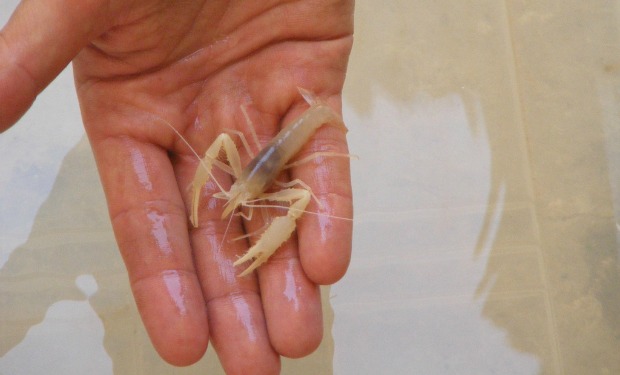
This “genetic bank” — an ark of sorts, Wexler tells ISRAEL21c – is a little windowless hut to limit the prawns’ exposure to light, and the water is carefully balanced with just the right amount of salinity and dissolved gases they need in order to thrive. Someday they may be able to be returned to their native habitat.
“One of the functions of a modern zoo is to act as a genetic ark for critically endangered species — particularly where their natural environment is disappearing – to ensure that they do not become lost to us forever,” said Shai Doron, director of the Biblical Zoo.
Animals from Persia and Arab countries fill the ark
There are many other breeding and conservation efforts at the Jerusalem zoo. Zoologists there have done remarkable work with Persian fallow deer, believed to be extinct until the 1950s when a few were found in Iran and brought to Israel to be bred. Also once native to Israel, the deer decades later are now back in the wild in the north of Israel and in the Jerusalem hills.
The European otter, also a threatened species, has been bred successfully at the zoo as well as the sand cat, the Negev tortoise and the Griffon vulture, says Wexler.
The zoo was also the first in the world to breed captive Asian elephants using artificial insemination.
Recently, Israel’s nature authority and zoos have had to deal with an influx of gray wolves entering Israel from the north. It appears the animals are fleeing troubles in surrounding Arab countries, such as Lebanon.
“It’s so endangered and hunted so that’s why we are seeing an influx into Israel,” says Wexler.
Wolves, among them the gray wolves, will be part of a new exhibit opening at the zoo in the spring in June. “It will be stocked with wolves rescued from the wild and in time they will breed and then we’ll see what we can do for them next.”
Wexler argues that only zoos can accomplish this species rescue work.
“Today the world’s natural habitats are so threatened that without zoos these animals aren’t going to be preserved,” Wexler says. “We participate in both local and global programs to save animals and it’s important work as a whole.”
This story is reprinted from ISRAEL21c – www.israel21c.org



That’s strong evidence in favor of peacefully reducing the human population of 7 billion with family planning programs. If not, eventually all wilderness animals will go extinct.