

 Cut your meat consumption by half to combat global warming, urges UN Environment Program.
All over the US, Europe and even in the Tel Aviv University, people are adopting Paul McCartney and Yoko Ono’s Meat-Free Mondays. But one meatless day a week isn’t enough to undo the environmental damage that industrial farming methods cause. The UN Environmental Program (Unep) is asking us to cut our meat consumption in half.
UK consumers are buying less meat since the horse meat scandal came to light through contaminated Burger King Whoppers. Now its believed that the fraud stretches across the European Union, with horse meat even appearing in school lunches. It’s like a finger pointed at the meat-eating consumer, shaking us into awareness.
While appreciating the useful, although nauseating lesson in transparency and awareness, there’s an issue just as serious at stake. That is, at steak.
If the first world doesn’t curb its runaway appetite for meat, the fragile balance of the natural world will tip over.
As reported by the Unep, the huge expansion of industrial beef-farming methods in the Europe and the US causes “a web of water and air pollution.” The fertilizers, pesticides and chemical weed-killers so freely used in growing grain to feed cattle don’t only pass into the bodies of beasts (and eventually man). The very seas are dying from toxic runoff. The bees that pollinate our fresh food are dying out. And methane emissions produced by our gigantic beef cattle industries are proved to cause global warming on a scale that not even all the transportation in the world combined does.
And while people in poor countries actually need more animal protein, Westerners are consuming much more meat than they need to maintain health.
Professor Mark Sutton, author of the Unep study, says,
“Eat meat, but less often – make it special. Portion size is key. Many portions are too big, more than you want to eat.”
The enormous Burger King Whoppers come to mind.
The UN scientists paint an optimistic picture in which the undernourished in the world are allotted more meat, while developed countries conscientiously reduce meat in their diet. But it seems unlikely to happen on some ideal internationally regulated scale. The best ordinary people can do is start planning more meatless meals every week. One less cow slaughtered, one less cow raised.
At least, people can turn to poultry and pork. Chicken in particular is the most environmentally friendly meat, according to Professor Sutton.
” Chicken is one of the most efficient meats, as it grows very quickly and you can collect the manure,” he says.
The Unep study forewarns of dark scenario for the planet.
“Unless action is taken, increases in pollution and per capita consumption of energy and animal products will exacerbate nutrient losses, pollution levels and land degradation, further threatening the quality of our water, air and soils, affecting climate and biodiversity.”
So, what’s for dinner tonight?
Try one of our savory vegewarian main-dish recipes:
- Sweet Potato Tajine
- Moroccan Chickpea and Spinach Soup
- Saudi Arabian Bukhari Rice
- Jerusalem Artichoke Soup
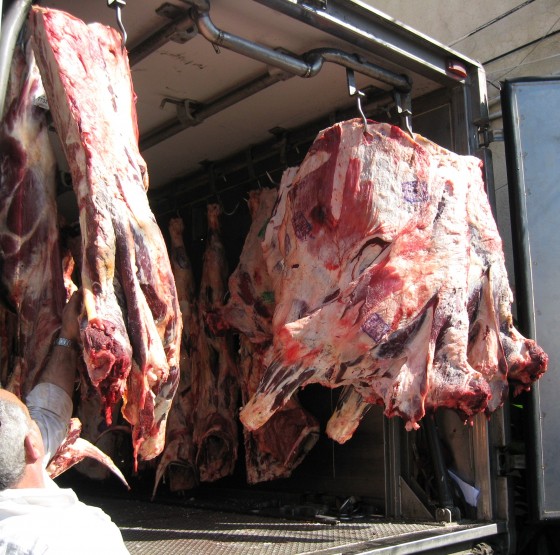
Photo of beef truck in Shuk HaCarmel, Israel, by Miriam Kresh.




i fuvked your bitch with my “Beef”.
You say that: “The very seas are dying from toxic runoff..” but it isn’t merely from raising meat that this is happening, but the use of fertilizer and chemicals – especially companies such as Monsanto – for increasing crop produce – as well as the accumulation of plastic and garbage in our waterways and oceans.
..and what about the scariest of all – disposal of radio active wastes into the oceans; see locations of ocean toxic waste dumps: http://businesslifestyle.site88.net/ocean-disposal-of-radioactive-waste/
Note nuclear reactors on Earth are just ticking time bombs, which was a wake up call for Russia who no longer builds them:
http://nuclearinfo.net/twiki/pub/Nuclearpower/CurrentReactors/world_map.png