
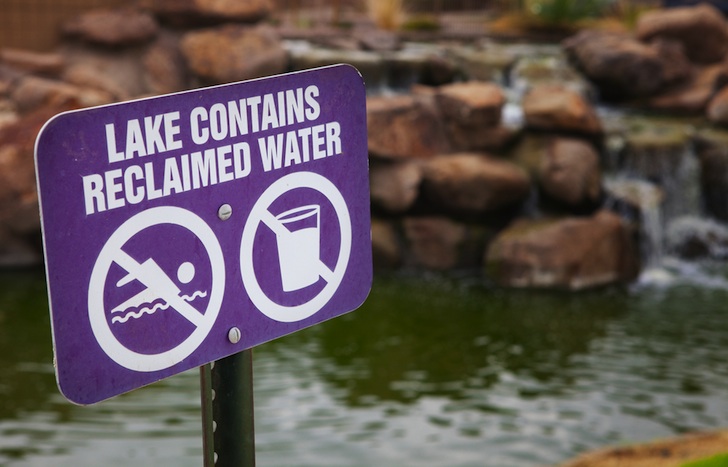

Gulf Greywater Recycling Could Cut Water Use by 30%

greywater recyling, reclaimed water, United Arab EmiratesThe United Arab Emirates could save approximately 30 per cent of its daily water use if multi-residential buildings implement greywater recycling programs, according to a recent report compiled by researchers from the University of Sharjah. Currently the average Emirati consumes roughly 550 liters of clean water every day, 30% of which is flushed down the toilet. Literally.

If groundwater supplies weren’t running dry and if water didn’t have to be treated in desalination plants, which requires a great deal of energy, this would be less of a travesty. But the Environment Agency Abu Dhabi estimates that the UAE could run out of groundwater within the next five decades if serious measures aren’t put in place to curtail consumption.

The report A Framework for Reducing Water Demand in Multi-Storey and Detached Dwelling details what it would take to implement greywater recycling programs in the UAE. Specifically it addresses multi-residential buildings given that a great majority of the Emirati and expatriate population lives in dwellings of this type.

Within buildings taller than ten floors will recover the cost of installing an onsite treatment system that uses recycled water from the top floors for the remaining building’s plumbing within five years, according to the report. Whereas smaller buildings will have to wait longer.

“Water issues are very important for the UAE. We are spending a lot of money on desalination and all the other infrastructure that goes with it,” one of the authors of the report, Professor Abdallah Shanableh, an environmental engineer at University of Sharjah told The National.

“We need to do whatever we can to reduce consumption of water,” he added.

Unfortunately, the current system doesn’t give landowners a lot of incentive to recycle water, which is why Shanableh urges government to subsidize a nationwide program. In so doing, daily water consumption could drop to just 385 liters a day.

One fifth of the world’s population battles water scarcity according to the World Health Organization and demand for this life force continues to explode alongside population.

Until recently, wealthy Gulf countries have been consuming water with impunity, ignorant of the long term consequences. But within the last few years, the gravity of a future without groundwater supplies, which receive little to no rainfall replenishment, has begun to settle in and a series of initiatives have been implemented to avoid the worst.

In 2010, Abu Dhabi announced that it was creating an artificial reservoir in a secret location and filling it with desalinated water in the event of an emergency. When that story broke, it emerged that if desalination facilities fail, the emirate will only have enough water to satiate its expanding population for a few short days.

But Muslims are reluctant to consider re-using wastewater, which could be a barrier, though we suspect that these sensibilities will be forced to evolve.

:: The National

Image of reclaimed water sign, Shutterstock

Tafline Laylin
Tafline Laylinhttp://www.greenprophet.com
As a tour leader who led “eco-friendly” camping trips throughout North America, Tafline soon realized that she was instead leaving behind a trail of gas fumes, plastic bottles and Pringles. In fact, wherever she traveled – whether it was Viet Nam or South Africa or England – it became clear how inefficiently the mandate to re-think our consumer culture is reaching the general public. Born in Iran, raised in South Africa and the United States, she currently splits her time between Africa and the Middle East. Tafline can be reached at tafline (at) greenprophet (dot) com.

Hot this week

How Renewable Energy is Revolutionizing the Way We Power Our World

Solar has become the star of the transition thanks to modular hardware and straightforward installation. It fits dense cities and remote towns alike. Many companies are turning to rooftop arrays and carport systems - and exploring commercial solar installation as a practical way to lock in future savings.

How does one start prepping?

Faced with an extreme winter storm this year, Americans wonder how to be prepared for catastrophe. Miriam has lived through wars in the Middle East - so she's prepared on giving you a guide to prepping.

Fishermen sue tire manufacturers on behalf of the salmon

A federal trial in San Francisco has brought US tire manufacturers, fishing groups, and environmental scientists into court over a chemical most drivers have never heard of — but which scientists say may be silently reshaping aquatic ecosystems.

Listening to Water: Tarek Atoui’s Next Work for Tate Modern

Born in Beirut, Lebanon in 1980 and now living in Paris, Atoui has spent years building instruments that don’t sit comfortably in concert halls. Many of them involve water, glass, and ceramics — materials that react to sound instead of simply producing it.

Leading Through a Dual-Energy Transition: Balancing Decarbonisation with Energy Security

Experience in one area of the energy industry isn't enough to guarantee readiness across all the others. That's where a structured program like an MBA in energy can come in. Today's advanced curricula explore energy economics, finance, policy, and strategic management alongside the technical subjects. And when pursuing an energy MBA online, professionals can skill up and retrain without having to step out of the labor market -- an important perk at a time when skilled professionals are already in short supply.

Topics

How Renewable Energy is Revolutionizing the Way We Power Our World

Solar has become the star of the transition thanks to modular hardware and straightforward installation. It fits dense cities and remote towns alike. Many companies are turning to rooftop arrays and carport systems - and exploring commercial solar installation as a practical way to lock in future savings.

How does one start prepping?

Faced with an extreme winter storm this year, Americans wonder how to be prepared for catastrophe. Miriam has lived through wars in the Middle East - so she's prepared on giving you a guide to prepping.

Fishermen sue tire manufacturers on behalf of the salmon

A federal trial in San Francisco has brought US tire manufacturers, fishing groups, and environmental scientists into court over a chemical most drivers have never heard of — but which scientists say may be silently reshaping aquatic ecosystems.

Listening to Water: Tarek Atoui’s Next Work for Tate Modern

Born in Beirut, Lebanon in 1980 and now living in Paris, Atoui has spent years building instruments that don’t sit comfortably in concert halls. Many of them involve water, glass, and ceramics — materials that react to sound instead of simply producing it.

Leading Through a Dual-Energy Transition: Balancing Decarbonisation with Energy Security

Experience in one area of the energy industry isn't enough to guarantee readiness across all the others. That's where a structured program like an MBA in energy can come in. Today's advanced curricula explore energy economics, finance, policy, and strategic management alongside the technical subjects. And when pursuing an energy MBA online, professionals can skill up and retrain without having to step out of the labor market -- an important perk at a time when skilled professionals are already in short supply.

From Green Energy to Healthy Societies: Why old systems thinking is becoming relevant again

Across the Middle East and North Africa, large investments are being made in green hydrogen, renewable energy, water infrastructure and sustainability. Most of these efforts are discussed in the context of climate change, decarbonization and economic diversification. That framing is important, but it may not capture their full value.

We saw peace – an interreligious encounter deep in our eyes

They came from Israel, Palestine, Jordan, Iraq, Yemen, Morocco, Tunisia, Lebanon, Egypt… There are Sunni Muslims, Shiite Muslims, Jews (Orthodox and Reform), Orthodox Christians, Coptic Christians, Protestant Christians, Druze, Baha'is, a Scientologist.

Can biochar reduce ‘Forever Chemicals’ in food if it’s used in farms?

Biochar is produced by heating organic material in a low-oxygen environment so it does not burn. This process, known as pyrolysis, transforms plant matter into a stable, carbon-rich material.

Related Articles

Popular Categories