

Gulf Greywater Recycling Could Cut Water Use by 30%

greywater recyling, reclaimed water, United Arab EmiratesThe United Arab Emirates could save approximately 30 per cent of its daily water use if multi-residential buildings implement greywater recycling programs, according to a recent report compiled by researchers from the University of Sharjah. Currently the average Emirati consumes roughly 550 liters of clean water every day, 30% of which is flushed down the toilet. Literally.

If groundwater supplies weren’t running dry and if water didn’t have to be treated in desalination plants, which requires a great deal of energy, this would be less of a travesty. But the Environment Agency Abu Dhabi estimates that the UAE could run out of groundwater within the next five decades if serious measures aren’t put in place to curtail consumption.

The report A Framework for Reducing Water Demand in Multi-Storey and Detached Dwelling details what it would take to implement greywater recycling programs in the UAE. Specifically it addresses multi-residential buildings given that a great majority of the Emirati and expatriate population lives in dwellings of this type.

Within buildings taller than ten floors will recover the cost of installing an onsite treatment system that uses recycled water from the top floors for the remaining building’s plumbing within five years, according to the report. Whereas smaller buildings will have to wait longer.

“Water issues are very important for the UAE. We are spending a lot of money on desalination and all the other infrastructure that goes with it,” one of the authors of the report, Professor Abdallah Shanableh, an environmental engineer at University of Sharjah told The National.

“We need to do whatever we can to reduce consumption of water,” he added.

Unfortunately, the current system doesn’t give landowners a lot of incentive to recycle water, which is why Shanableh urges government to subsidize a nationwide program. In so doing, daily water consumption could drop to just 385 liters a day.

One fifth of the world’s population battles water scarcity according to the World Health Organization and demand for this life force continues to explode alongside population.

Until recently, wealthy Gulf countries have been consuming water with impunity, ignorant of the long term consequences. But within the last few years, the gravity of a future without groundwater supplies, which receive little to no rainfall replenishment, has begun to settle in and a series of initiatives have been implemented to avoid the worst.

In 2010, Abu Dhabi announced that it was creating an artificial reservoir in a secret location and filling it with desalinated water in the event of an emergency. When that story broke, it emerged that if desalination facilities fail, the emirate will only have enough water to satiate its expanding population for a few short days.

But Muslims are reluctant to consider re-using wastewater, which could be a barrier, though we suspect that these sensibilities will be forced to evolve.

:: The National

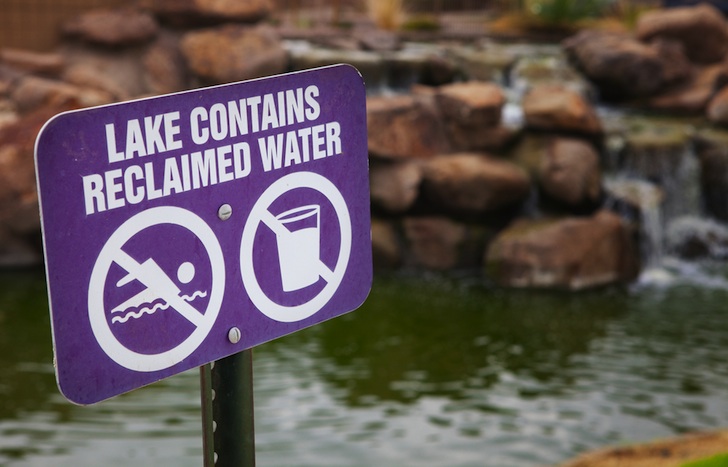
Image of reclaimed water sign, Shutterstock
Tafline Laylin
Tafline Laylinhttp://www.greenprophet.com
As a tour leader who led “eco-friendly” camping trips throughout North America, Tafline soon realized that she was instead leaving behind a trail of gas fumes, plastic bottles and Pringles. In fact, wherever she traveled – whether it was Viet Nam or South Africa or England – it became clear how inefficiently the mandate to re-think our consumer culture is reaching the general public. Born in Iran, raised in South Africa and the United States, she currently splits her time between Africa and the Middle East. Tafline can be reached at tafline (at) greenprophet (dot) com.

Read More

TRENDING

Iran is sinking in sinkholes from overwatering

What's that sinking feeling? In Iran, the very ground under...

Greenhouse agriculture in Kazakhstan

A story of greenhouse agriculture in Kazakhstan

4 Hidden Sources Of Environmental Damage

The gold dust bought at Walmart may make your graduation photo pretty. But one blow and it's forever cycling as microplastics that will get into our lungs.

Empowering consumers: Rio Tinto’s aluminum becomes accountable upstream and down, on the blockchain

What if you want to buy items like smart phones, cars and even your favorite can of drink, knowing that they’re made from ethically and sustainable sourced materials? It’s about to become a reality with a radical new idea in the raw materials manufacturing space, started by a leading mining and metals company that deals in diamonds, copper, iron ore and aluminum.

Ethiopian Nile dam to destroy about half of Egypt’s agriculture

Ethiopia has been building Africa's largest hydro-electric dam since 2011. $4 billion later and it is about to go online. It could drain Egypt's Nile so that life in Egypt as they know it (at least since the 70s) will never be the same again.

Yerukim Forms a New Green Economy Where the Money is Really Green

The Yerukim members who pick up the recyclables get to keep the monetary reward, the public earns "green" bills that can be used in shops, and business owners get to be associated with environmentalism.

Choosing Riyadh over Dubai? What Investors Should Know

Saudi Arabia is deploying capital at unmatched scale to catalyze tourism and advanced industry while rewiring its power-and-water backbone. The investable frontier is widening—especially in renewables, grid storage, water efficiency/desal retrofits, and hospitality operating platforms. Prudent investors will insist on phased delivery, enforceable KPIs (energy, water, biodiversity), and RHQ/zone compliance—while pricing political-economy and reputational risks alongside growth upside.

Sell your cooking oil for biodiesel money

Want to make money on old french fry oil? Sell it.

Qatar Alternative Energy Summit Pairs Investors And Innovators

Alternative energy investors and innovators can meet n' greet in Doha, Qatar March 16 and 17.

Here’s How To Implement The Four Pillars Of Employee Engagement

If you throw a party for your work team and they are vegans, don't make it a barbecue. Know the sustainability values of your team to boost moral and retain good people.

Locals From Rishon Fight IKEA

Big Box stores are a pretty new concept in Israel, and thank God that not every Israeli city wants them in their backyard. A word from someone who has see the beautiful farmland around her hometown Newmarket, Ontario stripped and converted into vulgar strip malls of big box shops: they have no place in a healthy and sustainable town or city.

The Jewish National Fund Meets An Inconvenient Truth

According to the JNF, it has transformed thousands of acres of barren land into green forests in Israel. They state that each person emits about 23 tons of carbon per year, estimating that each tree planted can absorb one ton of carbon in its lifetime. That's a whole lot of trees you'd need to be planting. Could so many fit in Israel?

How to quiet noise from construction in your office

Streets need to be resurfaced in New York but the humming and grinding noise is unsettling. Noise is environmental pollution. 

Popular Categories