How Green and Lean Is the New USDA Food Pyramid?

French fries picture USDAPotatoes are bad for heart health, according to recent research.

The United States Department of Agriculture released the Dietary Guidelines for Americans, 2010, a little bit late–on January 31, 2011. And according to the Harvard School of Public Health, the recommendations are behind the times as well. The new USDA guidelines emphasize a diet rich in plants and fish, and replacing some of the high-fat protein like red meat with plant-based proteins like legumes. But the pyramid still allows low-fat dairy products,  and up to half of carbohydrate intake can include refined grains like white flour. Even potatoes raise the level of blood sugar more quickly than whole grains.

The Israeli newspaper Haaretz published a detailed analysis of the debate between the Harvard School of Public Health and the USDA, which is accused of having too strong a connection with the American dairy and beef industries. The article pointed out that Israel’s own food pyramid still shows pita, made with refined flour. Updated in 2008 but ignoring 2008 USDA updates, it gives equal nutritional weight to meat and legumes. Soda and candy appear at the top of the Israeli pyramid, as a food recommended in small quantities.

Harvard’s version of the food pyramid, pictured below, focuses on exercise, weight control, healthy fats and whole grains. The Healthy Eating Pyramid is more environmentally friendly, recommending avoiding processed foods and limiting the amount of meat, dairy and egg products. The cattle and poultry industry introduce large amounts of amounts of antibiotics and hormones in the environment. Meat and dairy products are less efficient as a food source than vegetables, although animal manure is important for agriculture.
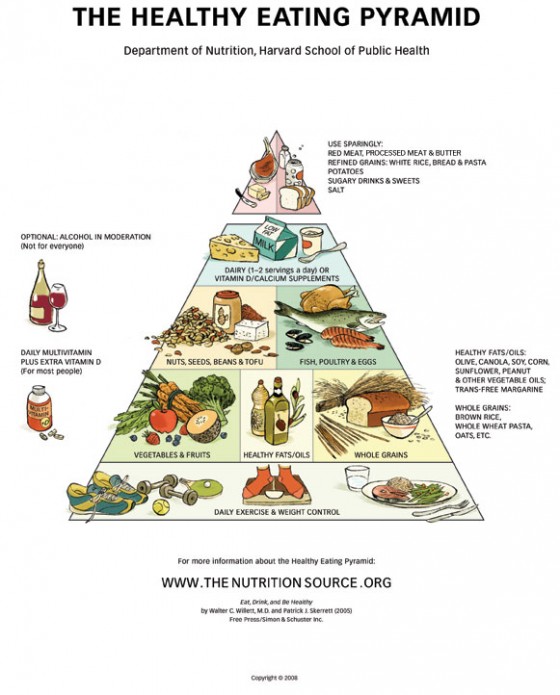
healthy eating pyramid Harvard University

More Green Posts on Diet:
Saudi Blogger Gets Death Threats for Quitting Vegan Diet
Meat Prices Going Up? Tips for Switching to a Vegetable-Based Diet
:: Harvard Nutrition Source

:: Haaretz

Photo: BRNFRRR

Hannah Katsman
Hannah Katsmanhttps://www.greenprophet.com/
Hannah learned environmentalism from her mother, a conservationist before it was in style. Once a burglar tried to enter their home in Cincinnati after noticing the darkened windows (covered with blankets for insulation) and the snow-covered car in the driveway. Mom always set the thermostat for 62 degrees Fahrenheit (17 Celsius) — 3 degrees lower than recommended by President Nixon — because “the thermostat is in the dining room, but the stove’s pilot light keeps the kitchen warmer.” Her mother would still have preferred today’s gas-saving pilotless stoves. Hannah studied English in college and education in graduate school, and arrived in Petach Tikva in 1990 with her husband and oldest child. Her mother died suddenly six weeks after Hannah arrived and six weeks before the first Gulf War, and Hannah stayed anyway. She has taught English but her passion is parental education and support, especially breastfeeding. She recently began a new blog about energy- and time-efficient meal preparation called CookingManager.Com. You can find her thoughts on parenting, breastfeeding, Israeli living and women in Judaism at A Mother in Israel. Hannah can be reached at hannahk (at) greenprophet (dot) com.

Read More

LEAVE A REPLY

Please enter your comment!
Please enter your name here

TRENDING

Desalination experts debunk Aqua Solaire, the floating desalination barge

AI makes it easy to dream, develop, and create images of what could be world-changing ideas, until the reality sets in. A new project making the rounds is Aqua Solaire, an allged French concept for a solar-powered desalination vessel designed to bring drinking water to coastal communities facing drought, storms, and infrastructure failures.

AI data centers are triggering panic, instead of cleantech opportunities

AI may unintentionally become the economic engine that finally modernizes America’s aging grid. California is experiencing a massive AI data center boom, ranking 3rd in the U.S. with 227 operating centers and 54 more in development as of April 2026, according to Stanford.

Abortion Pills, Plan B and Mifepristone and what the new US mail ban means

Abortion pills, often confused with Plan B (the morning-after pill), and historically referred to as RU486 (mifepristone), are part of a broader category of reproductive health medications that women have been using for decades. But they are not the same thing.

SunZia comes online and America’s 11B, and largest renewable project begins wind power

The impact is already being felt. California has broken its wind generation record multiple times in recent weeks as SunZia begins feeding electricity into the grid. It’s a glimpse of what a renewable-powered future could look like when large-scale infrastructure finally comes online. Can we start saying goodbye to Saudi Aramco and Arabian Gulf oil? 

The Evolution of Nutrition Advice Over the Last 50 Years, According to Trainer Peter Embiricos

Reading nutrition advice from 50, 40, and even 20 years ago feels like stepping into an alternate universe. It’s hard to believe how close-minded and definitive those tips were when we look at them in relation to today’s actual scientific studies.

How to quiet noise from construction in your office

Streets need to be resurfaced in New York but the humming and grinding noise is unsettling. Noise is environmental pollution. 

EarthX and a blueprint for sustainable investing

Trammell S. Crow, a Dallas-based businessman and father of four, is focusing his efforts on impact investing, and media that focuses on saving the planet through EarthX.

Mining Afghanistan’s Mineral Discoveries Similar to Avatar

Now that American forces in Afghanistan are commemorating the longest period of any war that America has been involved in, including the 1965-73 Vietnam War, the recent discoveries of large and extremely valuable mineral and metal deposits may finally bring to light a reason to continue the presence of US fighting forces in this war torn and backward country.

From Pilot Plant to Global Stage: How Aduro Clean Technologies’ 2026 Expansion Signals a Turning Point for Chemical Recycling Investors Like Yazan Al Homsi

The company's Next Generation Process (NGP) Pilot Plant in London, Ontario, has officially moved into initial operating campaigns, generating the kind of structured, repeatable data that separates laboratory promise from commercial viability.

Nobul’s Regan McGee on Shareholder Value: “Complacency Is the Silent Killer” 

Why the governance framework designed to protect shareholders so...

Should You Invest in the Private Market?

startustartup Unlike public stock exchanges, which offer daily trading, strict...

How to build a 100-year-company

Kongō Gumi is a Japanese construction company, purportedly founded in 578 A.D., making it the world's oldest documented company. What can we learn about building sustainable businesses from them?

How AI Helps SaaS Companies Reduce Repetitive Customer Support Work

SaaS products are designed for large numbers of users with different levels of experience, and also in renewable energy.

Popular Categories