
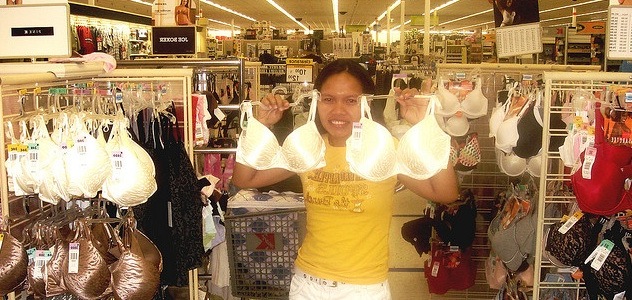

 From an average B to a C cup in 50 years: Is our modern lives making our breasts bigger?
Britain’s Daily Mail reports that women in England have larger breasts than even a generation ago. Women (and men) are getting fatter, but obesity alone does not account for most of the increase: Women are exhibiting a greater cup size in relation to the rest of their bodies.One theory suggests that they have simply begun wearing a properly sized bra. Women tend to choose bras with a larger band, when they really need a larger cup. Bravissimo, a bra manufacturer, recently began producing their largest cup size ever, “L”. But the increase in size can’t be attributed to poor fit alone. In the 50’s, the average woman wore a size B cup. Now she’s gone up to a C.
Dr Marilyn Glenville, a nutritionist specialising in women’s health and hormones, says: “It’s clear that we’re not just talking about fat, but increased levels of breast tissue, too.
“So we have to look at what stimulates breast tissue growth — and that’s estrogen, the female sex hormone. Estrogen is what changes our body shape during puberty.”
Glenville explains how it’s nearly impossible for a woman to avoid exposure to different forms of estrogen in the environment that affect sexual development:
- This generation of women was born to the first group of moms who took the pill for long periods. We don’t yet know how this increased amount of estrogen in a mother’s system affects the fetus.
- Putting off pregnancy, and shortened periods of breastfeeding, lead to more menstrual cycles and thus more estrogen. We know that women who take estrogen after menopause as part of hormone replacement therapy (HRT) see a breast increase of one or two cup sizes.
- The presence of xenoestrogens, a synthetic type of super-estrogen, has been found in British rivers. These hormones, which most likely come from urine of women using estrogen for birth control and HRT, have led to a decrease in male sperm count. These hormones may affect women as well, including increased breast size. The xenoestrogens have been found in Israeli waters as well.
- Bisphenol A (or BPA) is widely used in the manufacture of tinned food, drinks cans, plastic bottles, glass jars, electronic equipment and till receipts — to name but a few items. They are also present in deodorants, cosmetics, make-up and moisturizers.
- Modern farming methods mean that much of the milk we drink comes from pregnant cows, which produce more estrogen.
- A sedentary lifestyle means that modern women may metabolize hormones less quickly.
How about the Middle East? It’s hard to find statistics, but Israeli women appear concerned about small breast size, with a 700 percent increase in the number of breast enhancement surgeries since 2007. The number of breast reductions, which is mainly performed to reduce back pain, has remained stable during the same period. Breast enhancement is popular in Saudi Arabia, too, where a recent Islamic ruling allows it.
More green posts on hormones and the environment:
What is Causing Breast Growth in Chinese Toddlers?
Environmental Toxin Dioxin Affects Milk Production in Mice – What Does This Mean For Us Humans?
Image via glenpooh




are implants taken into account in the increase in cup size?
Good question
I linked to this article in my latest – this information is so important!
Karin, what have you been eating late at night? Soy milk?
Ha ha!! You’re a vivid dreamer Karin. These last few posts from Miriam and Hannah have been very illuminating.
I also had a dream about you. We were in Africa, again. And there was some trouble.
Thanks for the comment. Soy could definitely be a factor, especially soy baby formula (as you mention in your newest post!).
Ladies – last night I had a dream about 2 year old lactating children, with breasts. You have scared me.
Interesting, Hannah. I’m convinced that unfermented, genetically modified soy – present in thousands of processed foods people routinely eat – is responsible for increased breast growth in today’s girls.