
Spacefaring Civilization Finds Evidence of Great Lake in Paleolithic Egypt

New images taken from the space shuttle, using radar, are revealing that 100,000 years ago, Egypt had a lake broader than the gigantic Lake Erie, one of the Great Lakes in the US.

New evidence of a once wetter Middle East comes from high above the earth, where we are able to peer back through the centuries with the aid of technology that we have gradually developed over centuries of civilization, in the space shuttle.

When the giant body of water first appeared, a few hundred miles West of the Nile in what is now Egypt’s Tushka region, about 250,000 years ago, Paleolithic hunters and gatherers would have fished here. The lake appears to have grown and shrunk and finally disappeared about 80,000 years ago, say the scientists.

The lake would have nurtured nomadic hunter-gathers, and served as a migration route as early civilizations made their way out of Africa. Paleontologists believe that the fertile crescent, with water, game and arable land made our expansion out of Africa possible.

University of Toronto anthropologist Maxine Kleindienst says that now that radar has uncovered these ancient shores, they will now be able to explore on land at the edge of the once huge lake. It is likely that they will find evidence of settlements around the shores of what is now a vast flat desert. Paleolithic sites are usually found near the shores of dried-up lakes or rivers – or where stone is available to make stone tools.

This is yet more evidence that the fertile crescent, where our civilization began was once lush fertile land, where now, it is just sand. Yet, of course, the fertile crescent must have been once fertile and green – for civilization to have arisen there.

This news truly resonates with me. Desertification scares me. It scares me personally, as someone living in California, because we face desertification over the next few centuries, and more generally, as someone who follows climate change news, that includes increasing desertification in our future. Once land is desert for many centuries, human progress is threatened. Our future is a future much impeded by desert.

Some scientists have suggested that half the planet will be uninhabitable by humans by the 2300s, because it will be too hot to survive in regions that are drying up. Desertification is the result of heat that dries rivers and kills plant life.

It is hard to imagine us making it out into space again after a few centuries of this degree of desertification, making this historic discovery of this ancient lake in Egypt even more poignant.

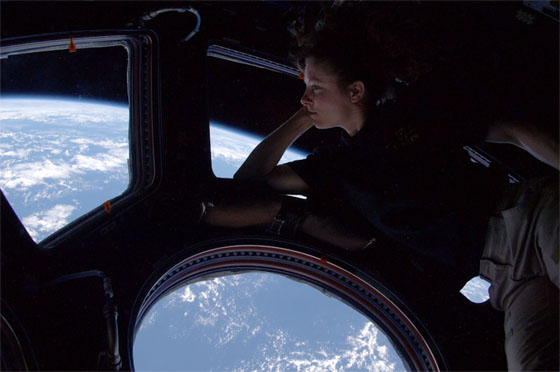
Image: Expedition 24 Crew, NASA astronaut Tracy Caldwell Dyson takes in the planet on which we were all born, and to which she would soon return.

:: ScienceDaily

More about climate change and Egypt:
12 Million Egyptians to be Affected by Climate Change
In the Face of Waterlessness, Egyptians Take to the Streets
Climate Change Killing Crops in Cradle of Civilization

Read More

LEAVE A REPLY

Please enter your comment!
Please enter your name here

TRENDING

Tanner Winterhof on the Custom Harvesters Quietly Holding American Agriculture Together

In late January, in a Des Moines hotel ballroom that smelled faintly of diesel and convention coffee, Tanner Winterhof spent three days hosting the members and attendees of the  U.S. Custom Harvesters Inc. annual convention on his podcast as Farm4Profit’s official media partner for the show.

AC Water Uses: How to Reuse Air Conditioner Condensate Water for Plants, Cleaning and Water Conservation

That means the water dripping from your air conditioner may already be usable for gardening, cleaning, flushing toilets, topping up humidifiers, or cooling systems — instead of disappearing into the sewer. A new study. Is it safe?

5 projects to help kickstart your company’s sustainability journey 

True progress happens when environmental ambition meets action. Decarbonizing efficiently is possible for any business in any sector, but actually getting started can sometimes feel daunting.   The trick? It’s to start small and build momentum. Here are five potential projects to help you get started.  

Hormuz 2026 Conflict Poses an Energy and Food Security Dilemma in a Warming World

As tensions rise in one of the world’s most critical maritime chokepoints, the ripple effects go far beyond oil—touching food systems, climate pressures, and regional stability

Baby teeth read like tree rings paint a picture of toxins in early life

A new study from the Icahn School of Medicine at Mount Sinai in New York offers a striking insight into how the environments we are born into can quietly shape our brains years later. By analyzing naturally shed baby teeth, the ones tucked under pillows for the tooth fairy, researchers have reconstructed a detailed timeline of exposure to environmental metals during pregnancy and early infancy.

How to quiet noise from construction in your office

Streets need to be resurfaced in New York but the humming and grinding noise is unsettling. Noise is environmental pollution. 

EarthX and a blueprint for sustainable investing

Trammell S. Crow, a Dallas-based businessman and father of four, is focusing his efforts on impact investing, and media that focuses on saving the planet through EarthX.

Mining Afghanistan’s Mineral Discoveries Similar to Avatar

Now that American forces in Afghanistan are commemorating the longest period of any war that America has been involved in, including the 1965-73 Vietnam War, the recent discoveries of large and extremely valuable mineral and metal deposits may finally bring to light a reason to continue the presence of US fighting forces in this war torn and backward country.

From Pilot Plant to Global Stage: How Aduro Clean Technologies’ 2026 Expansion Signals a Turning Point for Chemical Recycling Investors Like Yazan Al Homsi

The company's Next Generation Process (NGP) Pilot Plant in London, Ontario, has officially moved into initial operating campaigns, generating the kind of structured, repeatable data that separates laboratory promise from commercial viability.

Nobul’s Regan McGee on Shareholder Value: “Complacency Is the Silent Killer” 

Why the governance framework designed to protect shareholders so...

Should You Invest in the Private Market?

startustartup Unlike public stock exchanges, which offer daily trading, strict...

How to build a 100-year-company

Kongō Gumi is a Japanese construction company, purportedly founded in 578 A.D., making it the world's oldest documented company. What can we learn about building sustainable businesses from them?

How AI Helps SaaS Companies Reduce Repetitive Customer Support Work

SaaS products are designed for large numbers of users with different levels of experience, and also in renewable energy.

Popular Categories