 New images taken from the space shuttle, using radar, are revealing that 100,000 years ago, Egypt had a lake broader than the gigantic Lake Erie, one of the Great Lakes in the US.
New evidence of a once wetter Middle East comes from high above the earth, where we are able to peer back through the centuries with the aid of technology that we have gradually developed over centuries of civilization, in the space shuttle.
When the giant body of water first appeared, a few hundred miles West of the Nile in what is now Egypt’s Tushka region, about 250,000 years ago, Paleolithic hunters and gatherers would have fished here. The lake appears to have grown and shrunk and finally disappeared about 80,000 years ago, say the scientists.
The lake would have nurtured nomadic hunter-gathers, and served as a migration route as early civilizations made their way out of Africa. Paleontologists believe that the fertile crescent, with water, game and arable land made our expansion out of Africa possible.
University of Toronto anthropologist Maxine Kleindienst says that now that radar has uncovered these ancient shores, they will now be able to explore on land at the edge of the once huge lake. It is likely that they will find evidence of settlements around the shores of what is now a vast flat desert. Paleolithic sites are usually found near the shores of dried-up lakes or rivers – or where stone is available to make stone tools.
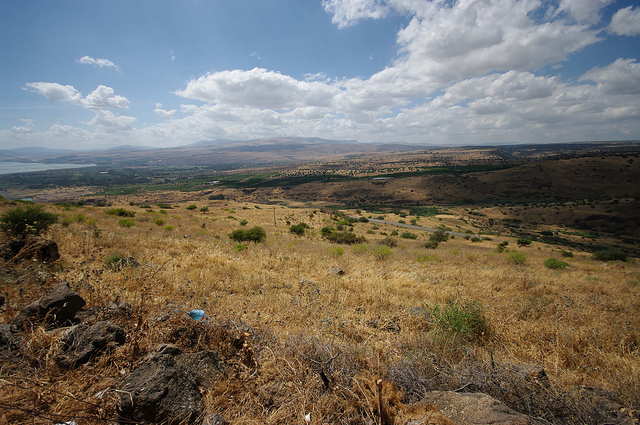
This is yet more evidence that the fertile crescent, where our civilization began was once lush fertile land, where now, it is just sand. Yet, of course, the fertile crescent must have been once fertile and green – for civilization to have arisen there.
This news truly resonates with me. Desertification scares me. It scares me personally, as someone living in California, because we face desertification over the next few centuries, and more generally, as someone who follows climate change news, that includes increasing desertification in our future. Once land is desert for many centuries, human progress is threatened. Our future is a future much impeded by desert.
Some scientists have suggested that half the planet will be uninhabitable by humans by the 2300s, because it will be too hot to survive in regions that are drying up. Desertification is the result of heat that dries rivers and kills plant life.
It is hard to imagine us making it out into space again after a few centuries of this degree of desertification, making this historic discovery of this ancient lake in Egypt even more poignant.
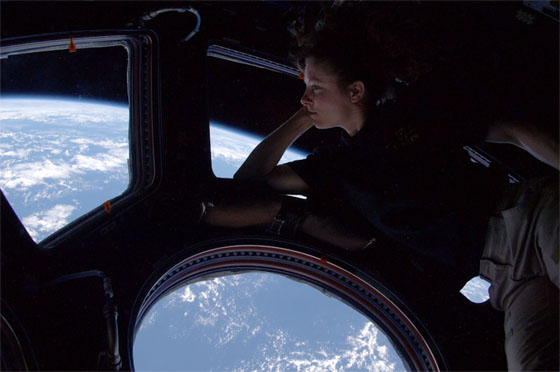
Image: Expedition 24 Crew, NASA astronaut Tracy Caldwell Dyson takes in the planet on which we were all born, and to which she would soon return.
More about climate change and Egypt:
12 Million Egyptians to be Affected by Climate Change
In the Face of Waterlessness, Egyptians Take to the Streets
Climate Change Killing Crops in Cradle of Civilization