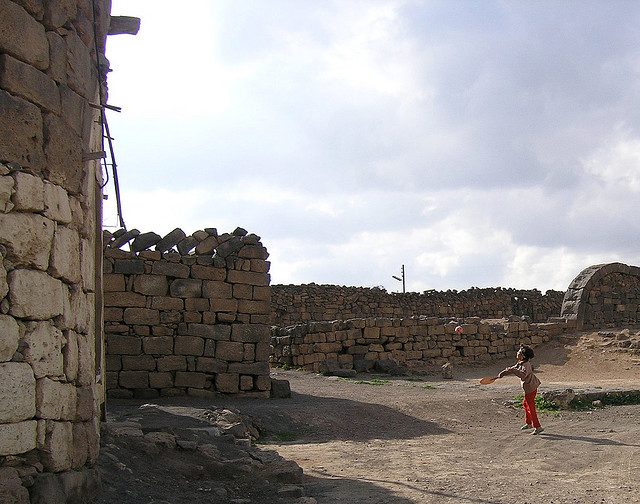

500,000 Syrians Flee Drought-Stricken Zone

deserted-wasteland-syriaCorruption, poor management, and climate change have driven away nearly half a million Eastern Syrians and impoverished thousands more.

Nearly half a million people have abandoned an area in Eastern Syria near the Euphrates River that has shrivelled under a five year drought. Fierce temperatures and dwindling rainfall, as well as corruption and mismanagement of existing water resources, has led to what Trade Arabia calls the largest internal migration of people since Britain and France “carved the country out of the Ottoman empire in 1920.”

Those that stayed behind must scrape life out of ruined croplands and filthy water – since most of the choice supplies have been diverted to well-connected farm owners. Others irrigate crops with water usurped from illegal wells, but that’s not enough to provide for everyone. Thousands of people are receiving aid from the World Food Program, while others have been relegated to slums.

In the 1980’s, the region that used to belong to the ancient Inezi tribe received 189mm rainfall annually. During the nineties that fell to 163mm and has plummeted to 152mm in the last decade. Meanwhile, thispast summer, Syria experienced 46 consecutive days of temperatures higher than 40 degrees Celsius, according to Trade Arabia.

Only 15% of livestock remain, and locals are unable to till their own land for food.

“Environment Minister Kawkab al-Dayeh told a water conference in Damascus last month pollution had played a role in the deterioration of 59 percent of total agricultural land, with raw sewage being widely used for irrigation,” AT reports.

With more than a hint of nepotism, water trenches divert water to the west, where farms are flourishing, while the nearby lands on the eastern side are parched.

“Jub Shaeer is only 3 km from the canal, but look how dry the land is in the village,” Ahmad al-Mehbash, head of the state-backed Peasants Union in Raqqa province, told the paper.

With a population of 20 million that is expanding at a rate of 2.5%, the antique irrigation system promises to fail its citizens even further in the future. In response, the government has suggested that it must scale back subsidies.

“Subsidies on fertilisers have been abolished, helping to lessen corruption,” agriculture minister Kawkab al-Dayeh told AT. But in the meantime, those that are using 90-95 percent of Syria’s water contribute only 13% to the Gross Domestic Product and tales of suffering are streaming out of the country.

“Mariam al-Falaj is raising five children alone. Her husband found work as a shepherd in Saudi Arabia after his own flock died,” according to the paper. Children are going without vaccinations and government efforts to render the area “drought resistant” has done no more than collect data.

The World Food Program has stepped in to feed nearly 200,000 people, while over 100,000 more are in need of rations.

Thank goodness for that, but how long will aid agencies be able to pick up the government’s slack?

:: Trade Arabia
 

Tafline Laylin
Tafline Laylinhttp://www.greenprophet.com
As a tour leader who led “eco-friendly” camping trips throughout North America, Tafline soon realized that she was instead leaving behind a trail of gas fumes, plastic bottles and Pringles. In fact, wherever she traveled – whether it was Viet Nam or South Africa or England – it became clear how inefficiently the mandate to re-think our consumer culture is reaching the general public. Born in Iran, raised in South Africa and the United States, she currently splits her time between Africa and the Middle East. Tafline can be reached at tafline (at) greenprophet (dot) com.

Read More

2 COMMENTS
  1. What this area needs is large scale desalinized water via reactor plants along the coast-most practical.Can advise please let me know([email protected]). Others; redouse the ground water plane such as with Iranian technology or perhaps pipe-in from Black sea.
    E-

Comments are closed.

TRENDING

5 projects to help kickstart your company’s sustainability journey 

True progress happens when environmental ambition meets action. Decarbonizing efficiently is possible for any business in any sector, but actually getting started can sometimes feel daunting.   The trick? It’s to start small and build momentum. Here are five potential projects to help you get started.  

Hormuz 2026 Conflict Poses an Energy and Food Security Dilemma in a Warming World

As tensions rise in one of the world’s most critical maritime chokepoints, the ripple effects go far beyond oil—touching food systems, climate pressures, and regional stability

Saving Gourmet Wild Plants For The Future

Think of truffles, a gourmet wild food. The European...

Climate change traced in sea turtle shells

It's sea turtles which may in the end save islands in the Seychelles. They may also better help us understand climate change. Like rings on a tree, scientists have found a way to read sea turtle shells and how they are impacted by climate change tells a story. 

We’ve lived through the past 11 of the hottest years on record

Have we forgotten about global warming when the world...

How to quiet noise from construction in your office

Streets need to be resurfaced in New York but the humming and grinding noise is unsettling. Noise is environmental pollution. 

EarthX and a blueprint for sustainable investing

Trammell S. Crow, a Dallas-based businessman and father of four, is focusing his efforts on impact investing, and media that focuses on saving the planet through EarthX.

Mining Afghanistan’s Mineral Discoveries Similar to Avatar

Now that American forces in Afghanistan are commemorating the longest period of any war that America has been involved in, including the 1965-73 Vietnam War, the recent discoveries of large and extremely valuable mineral and metal deposits may finally bring to light a reason to continue the presence of US fighting forces in this war torn and backward country.

From Pilot Plant to Global Stage: How Aduro Clean Technologies’ 2026 Expansion Signals a Turning Point for Chemical Recycling Investors Like Yazan Al Homsi

The company's Next Generation Process (NGP) Pilot Plant in London, Ontario, has officially moved into initial operating campaigns, generating the kind of structured, repeatable data that separates laboratory promise from commercial viability.

Nobul’s Regan McGee on Shareholder Value: “Complacency Is the Silent Killer” 

Why the governance framework designed to protect shareholders so...

Should You Invest in the Private Market?

startustartup Unlike public stock exchanges, which offer daily trading, strict...

How to build a 100-year-company

Kongō Gumi is a Japanese construction company, purportedly founded in 578 A.D., making it the world's oldest documented company. What can we learn about building sustainable businesses from them?

How AI Helps SaaS Companies Reduce Repetitive Customer Support Work

SaaS products are designed for large numbers of users with different levels of experience, and also in renewable energy.

Popular Categories