

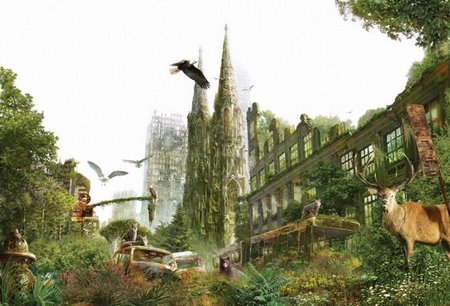
Could nature ever obliterate all our traces? How would it undo our monumental cities and public works, and reduce all our myriad plastics and toxic synthetics back to benign, basic elements?
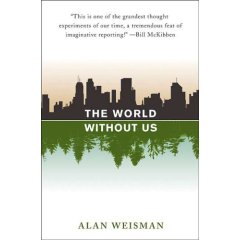
Alan Weisman: ‘The World Without Us’ 2007
Halfway through reading this enthralling book, I realized I was looking at the world in a new way. I was taking time to examine and even chart the progress of weeds bursting through the cracks in the pavement. Weisman’s detailed and wide-ranging research makes his readers that aware and curious about the world around us, that every part of nature, particularly those parts we generally ignore or suppress, becomes absorbing in the context of the book.
 For instance, his chapter on what would happen on the island of Manhattan if humans suddenly disappear, with weeds quickly growing up through the cracks, with Chinese Ailanthus trees rapidly sprouting, water flooding up from subway stations, and mosquitoes and coyotes becoming the top species quite quickly, is fascinating for those who know the city.
Weisman is clear that his main interest is not in how humans could disappear from the face of the earth – he posits a few possible scenarios, but his focus is clearly on what the planet would be like without us, and how it and other species would cope with the results of our impact upon the earth and its resources. His research and travels to explore this theme, which has been developed from an article in Discover magazine several years ago, have taken him to Ecuador, Poland and Belarus (where he explored the ancient Bialowieza Puszcza forest), the African Rift Valley, Arizona, Kenya, Cyprus, Turkey, the UK amongst others, and the mini topics he throws into the mix include underground cities; the invention of rubber; the life of Texan oil Refineries and the history of the Panama Canal; and the ecology of the demilitarized zone, the DMZ, between North and South Korea, where the eminent biologist E.O Wilson is part of an ecological restoration and protection project.

(Image credit: www.myninjaplease.com/green)
If we suddenly stopped plowing, planting, fertilizing, fumigating, and harvesting; if we ceased fattening goats, sheep, cows, swine, poultry, rabbits, Andean guinea pigs, iguanas, and alligators, would those lands return to their former, pre-agro-pastoral state? Do we even know what that was?
If I have any criticism of this epic vision that Weisman creates, it is that it is too broad and sweeping – he swoops in to forests and tribes and environmental projects (and destructive scenarios) around the world, meets the people and describes the scene, then is off again, on to the next link in the chain, or in the sorry saga of humanity’s impact.
Might we have left some faint, enduring mark on the universe; some lasting glow or echo, of earthly humanity?
Weisman’s research is blunt in that humans have had a major impact – the chemicals, leachates in our water and our soil, the plastics that are everywhere including in the stomachs of fish and cattle; the nuclear waste buried deep in deserts, the oil and gas plants that could explode at any given moment; and the conversion of vast tracts of land to our agricultural needs – at the expense of hundreds of other species … all these effects add up to a pretty negative and long-lasting legacy.
Despite the Middle Eastern contribution to humanity, through being the epicentre of wheat and barley growing 11,000 years ago, and Jericho boasting the oldest known building on earth (its stone tower); and being the oldest still-inhabited city on earth, all the wonderful achievements in art and architect (with a few interesting slow corroding exceptions), Weisman gives us a glimpse of all our achievements being brushed, pushed, washed and elbowed aside by the natural advance of the world adapting to a world without interference, albeit a contaminated and despoiled one.
I was fascinated by his suggestion that the effect of human tools being found in millenia to come (after having being submerged in the sands of time) by the dominant species of the future, could cause a quantum leap in that species’ understanding. Our slow development of creating tools to meet our needs over hundreds and thousands of human years could create a rapid development in whoever (and whatever) has got to the top of the chain after us.
There are some big concepts to consider here, and some readers might not chime with his hypothesis of ‘what if…’. But if an adventurous, environmentally-conscious reader seeks inspiration and a sense of mental expansion, and is prepared to see the world through new eyes, and travel with Weisman around the world as he conveys this challenging theme, then this is the book to read.
‘The World Without Us’ by Alan Weisman (2007) published by Thomas Dunne Books/St. Martins Press
If you’re looking for other environment-focussed books to read, check out our other Green Prophet reviews:
‘Green Chic’
‘The Lost and Left Behind’
A Crack in the Earth’



I just finished reading Weisman’s book–one of the best in a long time. Thought provoking and informative. Other than the plastic, Mayan collapse, and over-fishing, there was a lot I DIDN’T know in this book. A must read for everyone!