Dye Solar Cell “3G Solar” Moves On-Grid

3g-solar-cell3G Solar moves on-grid, where the market is  more lucrative than off-grid, developing countries

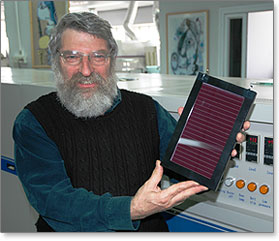
The Israeli solar power firm 3G Solar will move on grid as part of a new ownership strategy, according to PlasticEletronics.com. What sets 3G Solar apart from most other photovoltaic solar companies is its unique technology based on the Dye Solar cell, invented in 1988 by Professor Michael Graetzel of Lausanne Polytechnique in Switzerland. Today Professor Graetzel is active in 3G solar, whose so called “Graetzel” cells are  based on a layer of nano-sized titanium dioxide particles impregnated with dye.

Artificial photosynthesis

DSC technology can best be described as ‘artificial photosynthesis’ using an electrolyte, a layer of titania (a pigment used in white paint) and ruthenium dye sandwiched between two substrates, at least one of which is transparent.

Light striking the dye excites electrons, which are absorbed by the titania to become electric current. When the dye absorbs a photon, the resultant excitation injects electrons into the titanium oxide, which transports them to the negative electrode. They also claim that one of the advantages of dye solar cell is that it will offer low cost solar power with little capital imput or technical expertise by the manufacturer.

Wax off, wax on

3G Solar CEO Barry Breen added that the change of path for the company that previously focused on off-grid power production in the developing world towards an on-grid market occurred in combination with forthcoming new technological developments; the new owners aim to develop in the framework of a new three year R&D project that will boost efficiency and market share

The three year R&D period will serve as an indicator of how far away the DSC technology is from large scale commercial use. So far one of the few products that have reached the market is a backpack by the Welsh company G24 Innovation that lets is carrier load electrical batteries using a dye solar cell patch on the back of the backpack.

Low efficiency

One of the main problems with the dye solar cell technology is that it achieves only around 7% efficiency in their cells, which is lower than standard photovoltaic technology. On the other hand, it does not use silicone making it cheaper to produce and buy, hence the previous target of off-grid communities in the developing world.

Previous investors in 3G Solar include the Quercus Trust, US based 21Ventures (we’ve featured here) and the Israeli Chief Scientists Office.

Photo via 3G Solar and story via PlasticEletronics.com

More on solar technology:
Dye-ing To Power Solar Cells in Africa
Israeli Solar Company 3GSolar to Go Public in Canada
Quick Guide to Israeli Solar Energy Companies


Matt Khoury
Matt Khouryhttps://www.greenprophet.com/
Matt grew up with a love for nature; be it as a boy scout or working in his dad’s garden. After finishing University and traveling the Middle East, by cheer luck Matt got a change to try out journalism and has remained in the field ever since focusing on new cleanteach and the money behind it. In addition to news, Matt has also written several research papers on cleantech for international corporation.

Read More

LEAVE A REPLY

Please enter your comment!
Please enter your name here

TRENDING

Hydrophilis rebreather, an interview with Oliver Isler

A retired Swiss biology teacher has built one of...

Desalination experts debunk Aqua Solaire, the floating desalination barge

AI makes it easy to dream, develop, and create images of what could be world-changing ideas, until the reality sets in. A new project making the rounds is Aqua Solaire, an allged French concept for a solar-powered desalination vessel designed to bring drinking water to coastal communities facing drought, storms, and infrastructure failures.

AI data centers are triggering panic, instead of cleantech opportunities

AI may unintentionally become the economic engine that finally modernizes America’s aging grid. California is experiencing a massive AI data center boom, ranking 3rd in the U.S. with 227 operating centers and 54 more in development as of April 2026, according to Stanford.

24 7 renewable energy: how solar, wind, batteries and AI SaaS replace fossil fuels

A new report from the International Renewable Energy Agency based in Abu Dhabi makes something clear that many in the industry already suspected. When solar and wind are paired with battery storage, they can deliver reliable, round the clock electricity at costs that compete with, and often beat, fossil fuels.

Japan wants to build a solar panel ring around the moon

Unlike solar power on Earth, which is limited by night cycles, weather, and seasons, the Moon offers something close to uninterrupted exposure to the Sun. By placing solar infrastructure in orbit or along the lunar surface, engineers could generate continuous clean energy at a scale that may exceed global electricity demand,  the Japanese scientists say.

How to quiet noise from construction in your office

Streets need to be resurfaced in New York but the humming and grinding noise is unsettling. Noise is environmental pollution. 

EarthX and a blueprint for sustainable investing

Trammell S. Crow, a Dallas-based businessman and father of four, is focusing his efforts on impact investing, and media that focuses on saving the planet through EarthX.

Mining Afghanistan’s Mineral Discoveries Similar to Avatar

Now that American forces in Afghanistan are commemorating the longest period of any war that America has been involved in, including the 1965-73 Vietnam War, the recent discoveries of large and extremely valuable mineral and metal deposits may finally bring to light a reason to continue the presence of US fighting forces in this war torn and backward country.

From Pilot Plant to Global Stage: How Aduro Clean Technologies’ 2026 Expansion Signals a Turning Point for Chemical Recycling Investors Like Yazan Al Homsi

The company's Next Generation Process (NGP) Pilot Plant in London, Ontario, has officially moved into initial operating campaigns, generating the kind of structured, repeatable data that separates laboratory promise from commercial viability.

Nobul’s Regan McGee on Shareholder Value: “Complacency Is the Silent Killer” 

Why the governance framework designed to protect shareholders so...

Should You Invest in the Private Market?

startustartup Unlike public stock exchanges, which offer daily trading, strict...

How to build a 100-year-company

Kongō Gumi is a Japanese construction company, purportedly founded in 578 A.D., making it the world's oldest documented company. What can we learn about building sustainable businesses from them?

How AI Helps SaaS Companies Reduce Repetitive Customer Support Work

SaaS products are designed for large numbers of users with different levels of experience, and also in renewable energy.

Popular Categories