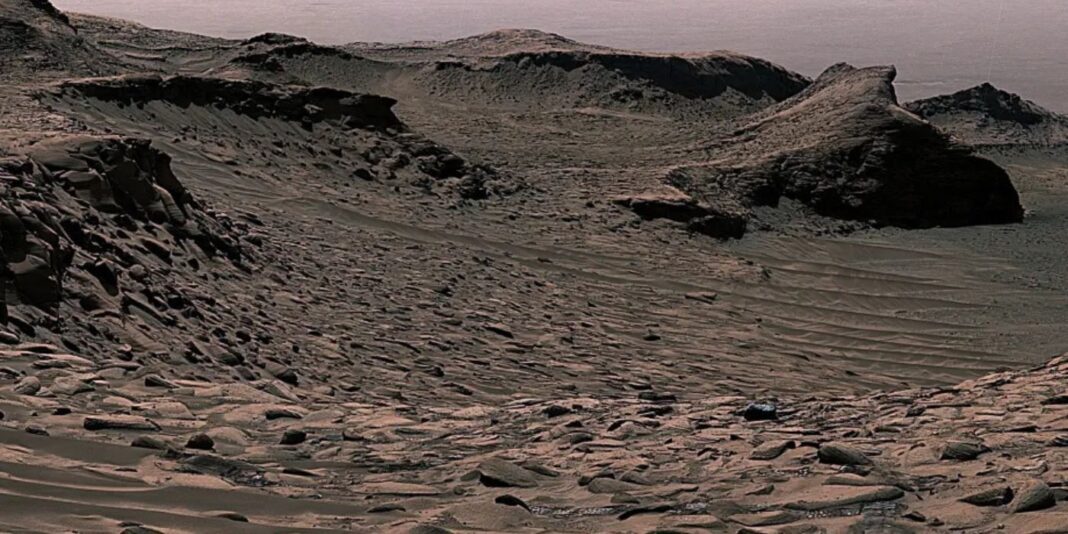


NASA’s Perseverance rover has spent three years exploring the floor of Jezero Crater, just north of the Martian equator, and the results are sparking new questions about life’s potential beyond Earth. A joint analysis by SETI Institute Senior Research Scientist Janice Bishop and University of Massachusetts Engineering Professor Mario Parente, published in Nature News & Views, reveals evidence of ancient chemical reactions that could have created energy-rich environments on early Mars.
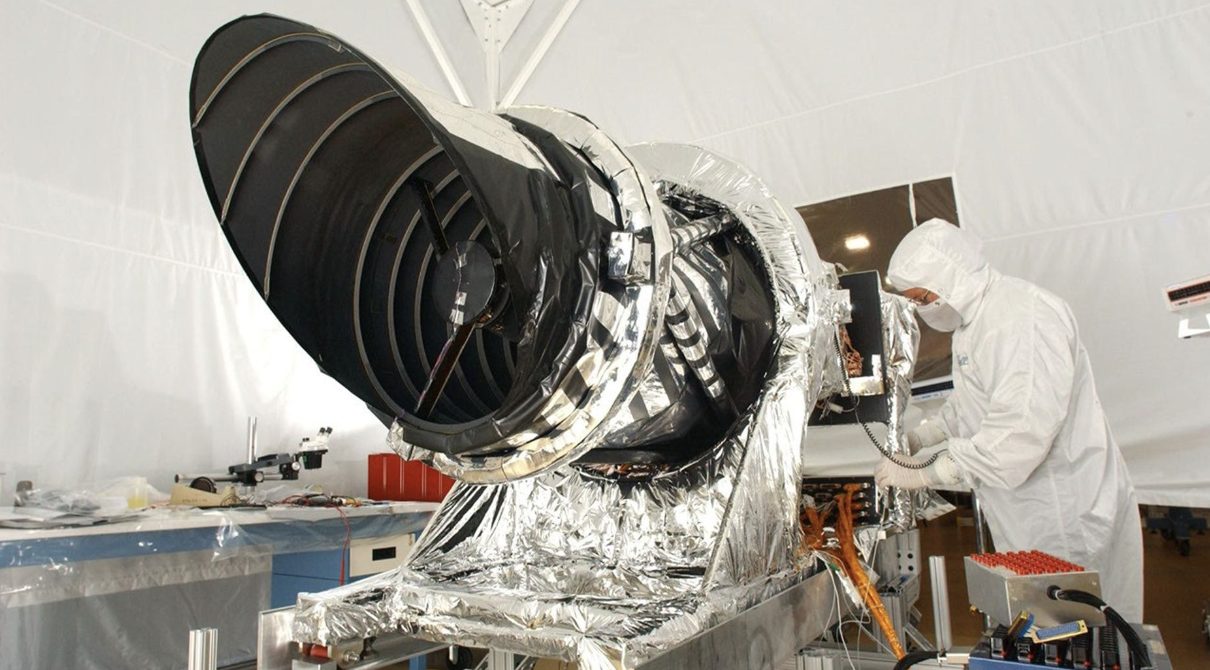
Using hyperspectral images from the CRISM spectrometer aboard the Mars Reconnaissance Orbiter, Bishop and Parente produced a high-resolution mineral map of Jezero Crater showing deposits of clays and carbonates — minerals that form in the presence of water. “Coordinating mineral detections from orbit at Mars with in situ detections by the Perseverance rover gives us a detailed look at ancient chemical reactions for a few small areas and a broader view across kilometers of the surface,” said Bishop.
Clues in the Minerals
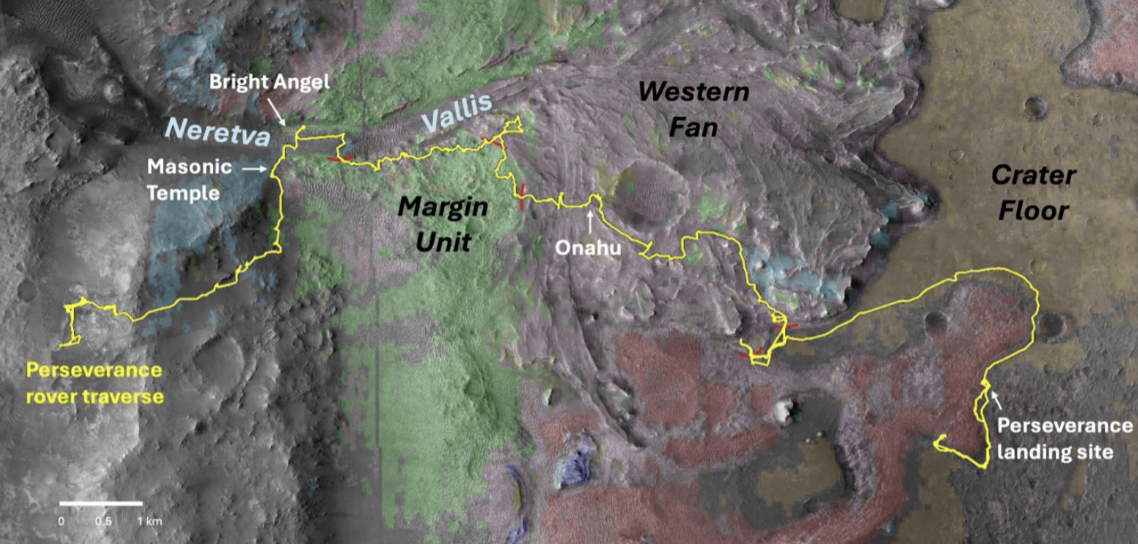
On its traverse from the landing site toward the crater’s western delta, Perseverance confirmed the presence of smectite clays and carbonates first spotted from orbit. More surprisingly, at sites named Bright Angel and Masonic Temple, it discovered tiny green-toned nodules of iron phosphate and iron sulfide embedded in clay-rich mudstone. On Earth, phosphates are essential to life, and such minerals can form through interactions between water, minerals, and organic matter.
“My group observed redox reactions in lab experiments where ferrihydrite containing oxidized iron was heated with organic compounds, including amino acids, to produce the mineral magnetite containing reduced iron,” Bishop explained. These “redox reactions” — transfers of electrons between minerals — can create energy that, on Earth, some microorganisms exploit for survival.
Raman data from Perseverance’s SHERLOC instrument suggest that the reduced minerals in Jezero’s mudstones appear more abundant in areas with higher concentrations of organic compounds. While not proof of life, this link hints at chemical pathways that could have supported microbial metabolism billions of years ago.
Signs of Change Over Time
The phosphate mineral vivianite, identified in the greenish nodules, was also found at a site called Onahu — but there it appears oxidized, or “rusted,” indicating environmental shifts in Mars’ history. Similar alternations in iron chemistry have been tied to changing habitability conditions on Earth.
Perseverance’s findings parallel discoveries in extreme environments here, such as Antarctic subglacial lakes, where microbes alter minerals in oxygen-poor water. “While there is no evidence for microbes on Mars today, if life once existed there, similar processes could have reduced sulfate minerals to sulfides in an ancient lake at Jezero crater,” Bishop said.
Parente’s work on CRISM data correction has removed distortions from Martian atmospheric effects and instrument quirks, allowing detection of subtle mineral “fingerprints” once lost in the noise. Using AI, his team created the most accurate mineral maps of Mars to date, pinpointing small outcrops and revealing mineral diversity that earlier surveys missed.
“By extracting the atmosphere’s imprint directly from the image itself, our technique yields cleaner surface spectra,” said Parente. “With CRISM data now clarified, subtle mineral features can be detected with greater confidence.”
Life, or Just Chemistry?

On Earth, similar mineral–organic interactions can be biological or abiotic. In Jezero Crater, the long geological timescales suggest the reduced vivianite and sulfides may have formed without biology — but organic compounds could still have driven the chemistry.
“Sulfur isotope analyses were used on Antarctic sediments to determine a biologic origin of the tiny sulfide crystals in anoxic water,” Bishop noted. Comparable tests on Mars samples, once returned to Earth, could help answer whether ancient Martian chemistry was purely geological — or something more.
The presence of clays, carbonates, phosphates, and organics together paints a picture of an ancient Mars where water was abundant and redox chemistry was active — two key ingredients for habitability. Whether this points to past life or not, the chemistry uncovered offers new insight into how planets evolve and how life might arise elsewhere.
More on Space from Green Prophet:
- NASA heads to Jupiter’s moon Europa to look for life below its frozen ocean
- Why Is the Martian Night Sky So Bright? New NASA video explains the Red Planet’s glow
- Mars found a way to store carbon. Can we?
- SpaceX and SETI partner to protect alien-hunting telescopes
- Ride on Japan’s space elevator
- Space-travel sunscreen found in new fungus experiment
- Can plants grow on the Moon?
- NASA’s rover finds opals on Mars
- Austrian Space Forum sets its next Mars mission to Morocco
- Microlightning in water might have sparked life
- Scientists design ‘Dune’-inspired spacesuit to recycle urine