Fine art print Lifeline documents Hamas horror – buying one supports a kibbutz

Lifeline print - Kibbutz Reim

“Lifeline” to be hung in every office and school in America; funds raised to rebuild a kibbutz community that terror ripped apart

It was 6:25 in the morning Oct. 7, and Gal-Lee Maroodi’s husband Omer put his ear to the window as dozens of rockets fired from Gaza hit his agricultural village, 3 miles from the Gaza Strip: “We were used to hiding in the safe rooms to protect us from rockets,” says Maroodi, 25, from Kibbutz Reim. “But this time it sounded different because there were rockets raining down on us non-stop. I told him it’s not safe by the window, but coming from a special guerilla unit in the IDF, he told me something doesn’t sound right. He heard AK-47s, machine guns that Israel would never use. He told me to take the baby and run.

Kibbutz Reim houses
Houses destroyed at Kibbutz Reim

“We dodged rockets and sped off down the road, warning others from the community that we are being attacked by terrorists. If we had been two minutes later on the road, we would have been shot,” says Maroodi, whose kibbutz is a community of 400 people that farm and run a factory for laser cut machine parts. Five people from the kibbutz were murdered; there are 6 hostages now in Gaza. She is the spokesperson for Lifeline –– an art print and historical project to document the painful communication between the kibbutz members on Oct. 7. They hope to raise money through sales of the prints to rebuild the kibbutz.

Lifeline Whatsapp messages Kibbutz Reim
Lifeline terror text

They are coming closer. They are in my backyard. Urgent, urgent to Dvir’s house. Daria and Levi are alone. Dvir was murdered. Urgent. Please! Friends, lock the house and stay inside. Urgent, urgent. Please. The children are alone. Please.

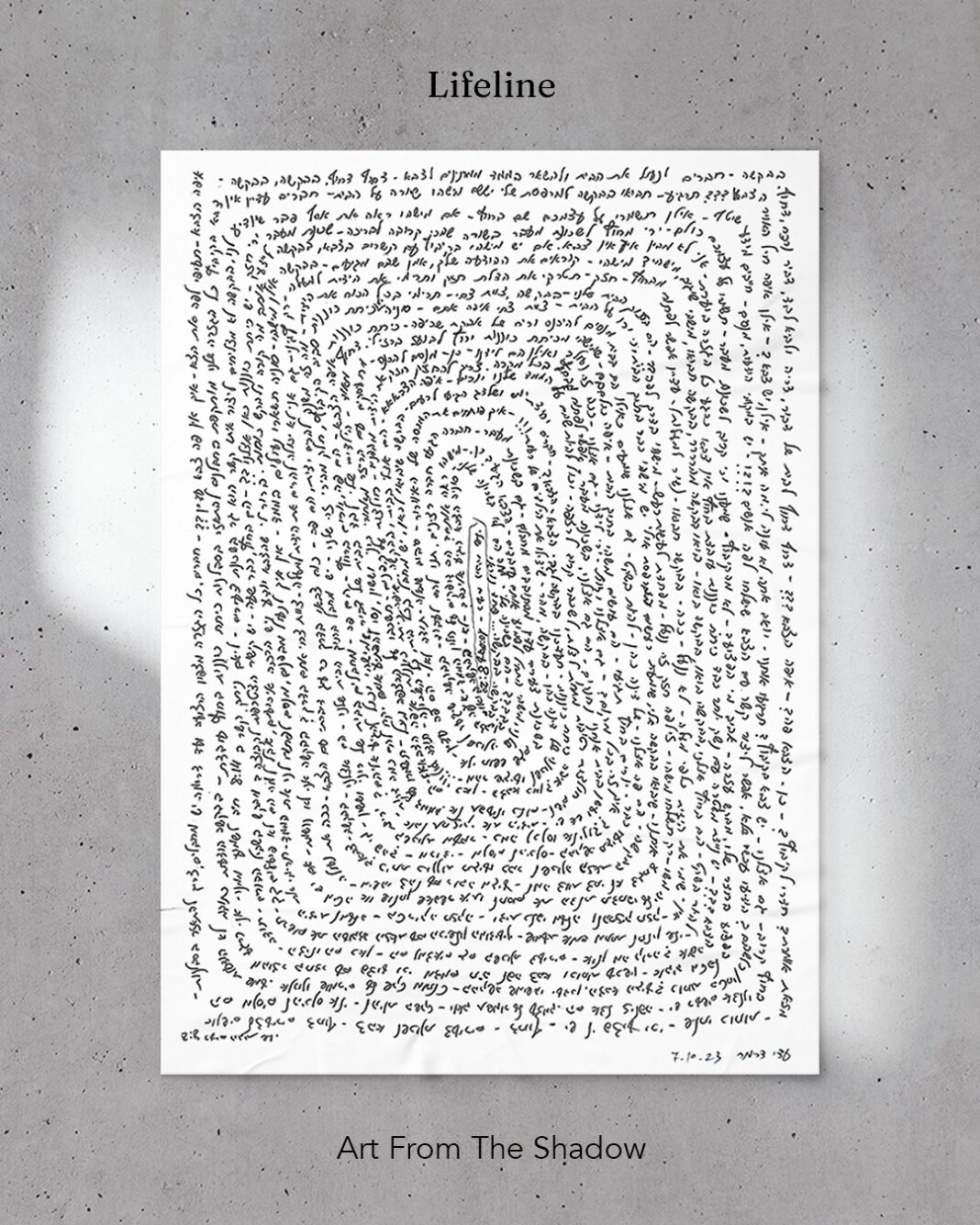
These words are a sample from several hours of Whatsapp messages during the morning of the Hamas attack. They are inscribed on a high-quality art print, written in cursive Hebrew by kibbutz member Adi Drimer. She created the unique pattern, a mandala, as a form of therapy after the terror attack and now Kibbutz Reim members are hoping this historical print will be hung in every office, school and community center in the United States and Canada.

Mandala means ‘circle’ in Sanskrit. They are used as a spiritual guidance tool, in meditation or for creating a sacred space. For Kibbutz Reim and Jews everywhere, this mandala will be a symbol of not standing for terror, and as historical evidence that Oct. 7 will never be forgotten. All proceeds raised will go to rebuilding the kibbutz.

Art that is also an historical document

Lifeline, Kibbutz Reim

The name is Lifeline because the WhatsApp group chat was the actual lifeline for kibbutz members each in their own homes. Through the app, they managed to save two kids whose father and partner were murdered right in front of them. It helps the members tell their story: how they warned each other about invaders, about the heroic acts of men who ran through hellfire to rescue children who couldn’t close the door of the bomb shelter –– because their dad’s dead girlfriend’s arm was in the way.

While memories of the horror are still fresh, kibbutz members know they will need to rebuild their homes, and businesses, and Lifeline proceeds will help them do that: to repair factories, rebuild homes and educational centers. Every dollar raised will go towards rebuilding the community ripped apart by fire, grenades, looting and machine gun fire.

Gal-Lee Maroodi, Lifeline
Gal-Lee Maroodi, spokesperson for Lifeline

“It’s a strange situation now because we are terrified about going back to the kibbutz, but we also miss it terribly because it’s our home,” says Maroodi whose home was used as a command center by Hamas. When her husband went back he found blood on the floor, pictures broken. “They went through everything. We heard them through our baby monitor.”

We won’t forget. We won’t let them win.

“It is such a beautiful area and we can’t let them win. If we don’t go back and rebuild the kibbutz, then they’ve won. So we need to rebuild even if it’s painful,” says Maroodi. “ She considers herself lucky as she wasn’t burned out of her safe room or murdered in front of her child:

“We could hear them tormenting people in their homes. Smacking their safe rooms and laughing. Burning their houses waiting for them to come out. One family stayed in the bomb shelter. They said, ‘We’d rather burn to death than, God knows what they will do to us, if we come out’.”

Lifeline is not an easy object to hold but it is essential:  “We must never forget,” says Maroodi. “People risked their lives helping each other here. That’s the beauty of the kibbutz. We are really family. Everyone feels the pain of the other. As a Jew, or even non-Jew standing by our side, Lifeline is art that every single one of us should have; it looks like a fingerprint and it’s to make sure we will never forget Oct. 7,” she concludes.

::Lifeline

Karin Kloosterman
Karin Kloostermanhttp://www.greenprophet.com
Karin Kloosterman is an award-winning journalist, innovation strategist, and founder of Green Prophet, one of the Middle East’s pioneering sustainability platforms. She has ranked in the Top 10 of Verizon innovation competitions, participated in NASA-linked challenges, and spoken worldwide on climate, food security, and future resilience. With an IoT technology patent, features in Canada’s National Post, and leadership inside teams building next-generation agricultural and planetary systems — including Mars-farming concepts — Karin operates at the intersection of storytelling, science, and systems change. She doesn’t report on the future – she helps design it. Reach out directly to [email protected]

TRENDING

Eco organization offices destroyed by Iran missile

Tel Aviv's eco organization, the Heschel Center, was impacted by an Iranian missile.

What are AWG air-water generators, and why they aren’t a golden-bullet solution (yet)

Atmospheric water generators (AWGs) sound like magic: machines that can pull drinking water out of air. The idea is mentioned in the Bible, where the elders would pray for water collected as dew on plants and the catch on turning this into a machine is in the physics. To turn invisible vapor into liquid, you must remove heat, especially the latent heat of condensation.

Jordan’s $6 Billion Aqaba–Amman Desalination Project from the Red Sea Moves Forward

In 2025, the Jordanian government signed agreements with a consortium led by Meridiam and SUEZ, alongside VINCI Construction and Orascom Construction. Under a 30-year concession agreement, the consortium will design, build, finance, operate, and maintain the system before transferring it back to the Jordanian government. The total investment is estimated at approximately $6 billion USD.

The Saudi Startup Turning Desalination’s Toxic Waste Into Its Own Disinfectant

For millennia, the Middle East's water crisis seemed an immutable fact of geography — a region defined as much by what it lacked as by what lay beneath its sands. Today, a convergence of plummeting solar costs, advancing membrane technology, and hard-won engineering expertise is rewriting that story.

Yalla Parkour – A Gaza documentary of the movement before the war

Yalla Parkour, directed by Areeb Zuaiter, captures this culture from within. The film follows Zuaiter’s long relationship with Ahmed Matar, a parkour athlete in Gaza, as she reflects on loss, memory, and belonging after the death of her mother. What begins as a personal search gradually opens into a portrait of how movement shapes young lives under constraint.

Should You Invest in the Private Market?

startustartup Unlike public stock exchanges, which offer daily trading, strict...

How to build a 100-year-company

Kongō Gumi is a Japanese construction company, purportedly founded in 578 A.D., making it the world's oldest documented company. What can we learn about building sustainable businesses from them?

From Pilot Plant to Global Stage: How Aduro Clean Technologies’ 2026 Expansion Signals a Turning Point for Chemical Recycling Investors Like Yazan Al Homsi

The company's Next Generation Process (NGP) Pilot Plant in London, Ontario, has officially moved into initial operating campaigns, generating the kind of structured, repeatable data that separates laboratory promise from commercial viability.

How AI Helps SaaS Companies Reduce Repetitive Customer Support Work

SaaS products are designed for large numbers of users with different levels of experience, and also in renewable energy.

Pulling Water from the Air

Faced with water shortage in Amman, Laurie digs up...

Turning Your Energy Consultancy into an LLC: 4 Legal Steps for Founders in Texas

If you are starting a renewable energy business in Texas, learn how to start an LLC by the books.

Tracking the Impacts of a Hydroelectric Dam Along the Tigris River

For the next two months, I'll be taking a break from my usual Green Prophet posts to report on a transnational environmental issue: the Ilısu Dam currently under construction in Turkey, and the ways it will transform life along the Tigris River.

6 Payment Processors With the Fastest Onboarding for SMBs

Get your SMB up and running fast with these 6 payment processors. Compare the quickest onboarding options to start accepting customer payments without delay.

Related Articles

Popular Categories