
 Researchers at Massachusetts Institute of Technology (MIT) have created a mobile robotic system that can build a dome-like habitat in half a day. It’s a new spin on 3D printing that could revolutionize homebuilding, allowing for faster, cheaper and more adaptable construction compared to traditional building methods.
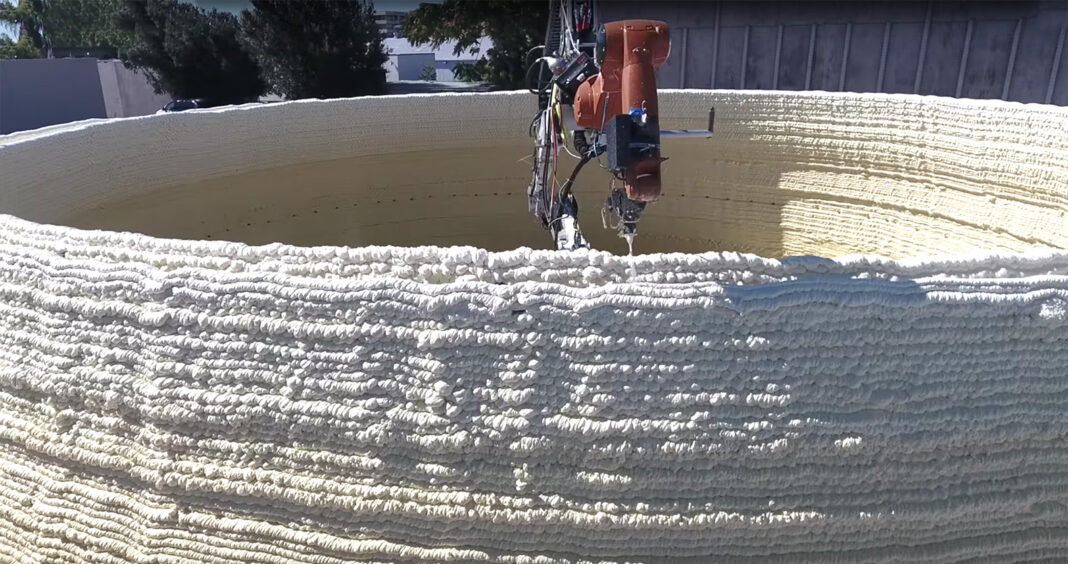
The four ton Digital Construction Platform (DCP) is solar-powered and features a large robotic arm for reach and a smaller arm for dexterity. The design is based upon an Altec aerial-lift system, much like the bucket lifts commonly used by workers on electrical power lines. In this case, the bucket has been replaced by a robotic arm.
Different tools can be attached to the smaller arm, such as a grinder or welding system or a nozzle that can mix and spray viscous building materials such as mud, foam, or concrete. The DCP is fitted out with special sensors to gauge site metrics ranging from radiation to topography. It sits atop tank treads for easy mobility on all types of building sites.
Steven Keating, of MIT’s Mediated Matter Group, took inspiration from trees, which grow on their own volition using readily available local resources such as sunlight energy and soil. A tree structure is efficient, its trunk tapers towards the sky, supported by strong outer rings which allow for a less dense core. It adapts to local conditions.
“With this process, we can replace one of the key parts of making a building, right now. It could be integrated into a building site tomorrow,” said Steven Keating, co-author of a paper published in the journal “Science Robotics.”
The system can be deployed anywhere and takes minutes to set up. It can operate for eight hours on one charge, longer if connected to diesel backup motors. DCP can fold up small enough to drive through a set of standard double doors.
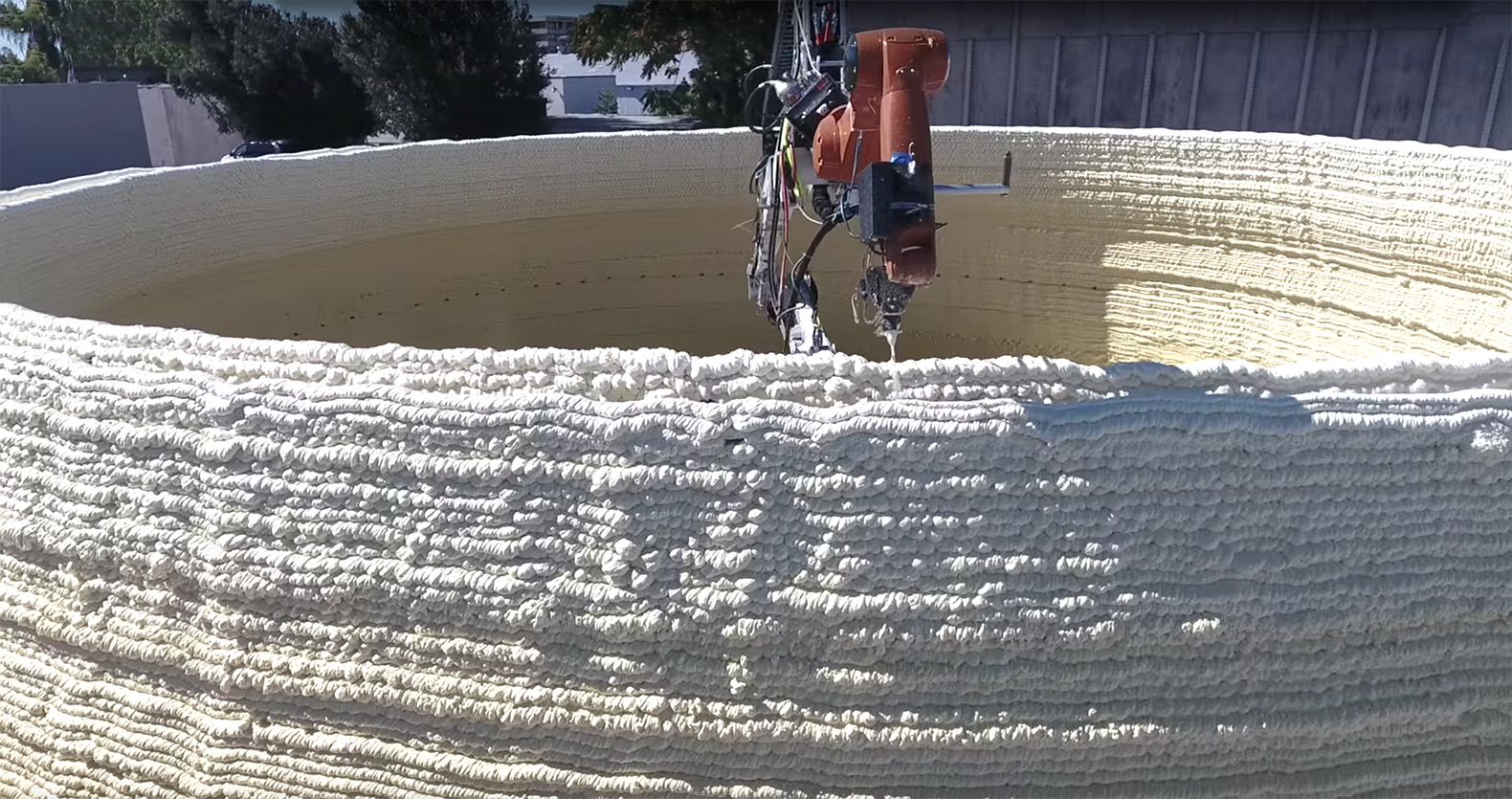
The project, which began in 2011, has evolved to a point where it can create objects ia all sizes. DCP recently completed a dome-like structure (see lead image) that measures 50 feet in diameter and 12 feet tall. It was built in 13.5 hours using a stock insultating foam spray. While this is not exactly a “house”, the dome can serve as a mold for poured-in concrete or mud that would provide structural heft. If you are looking into remodelling your house, here’s a guide for traditional homes. Compare that with mud building or doing it yourself!
“This one technique allows us to get our foot in the door on a construction site,” Keating told FastCoDesign. But his long-term vision is to deploy the system in the developing world or in disaster areas, for example after a major earthquake, to provide quick shelter. The team sees this happening within the next 10 years. Their ultimate aim is to work in remote places such as Antarctica, the moon and Mars to make buildings out of local materials such as ice or moon dust. Keating said technology like this could be ready in 50 years or sooner.
The lab isn’t writing off corporate opportunities, but it did put all of its hardware specs and digital software online for anyone to freely take and use, or expand upon. “We’ve shown how we could do [it],” Keating told CNNTech, “and NASA is very excited to use ice for printing on Mars because ice absorbs a lot of cosmic radiation.”
There is also potential to feed the DCP organic building materials, such as animal proteins and photosynthetic E. coli, to print living buildings. Mediated Matter Group has already synthesized living plastics from squid and cuttlefish. Combining robotic construction with evolving materials that can change color in the presence of carbon dioxide, or self-diagnose and repair cracks points to a future where buildings adapt to their environments and grow to nurture themselves and their cohabitants, just like trees do.