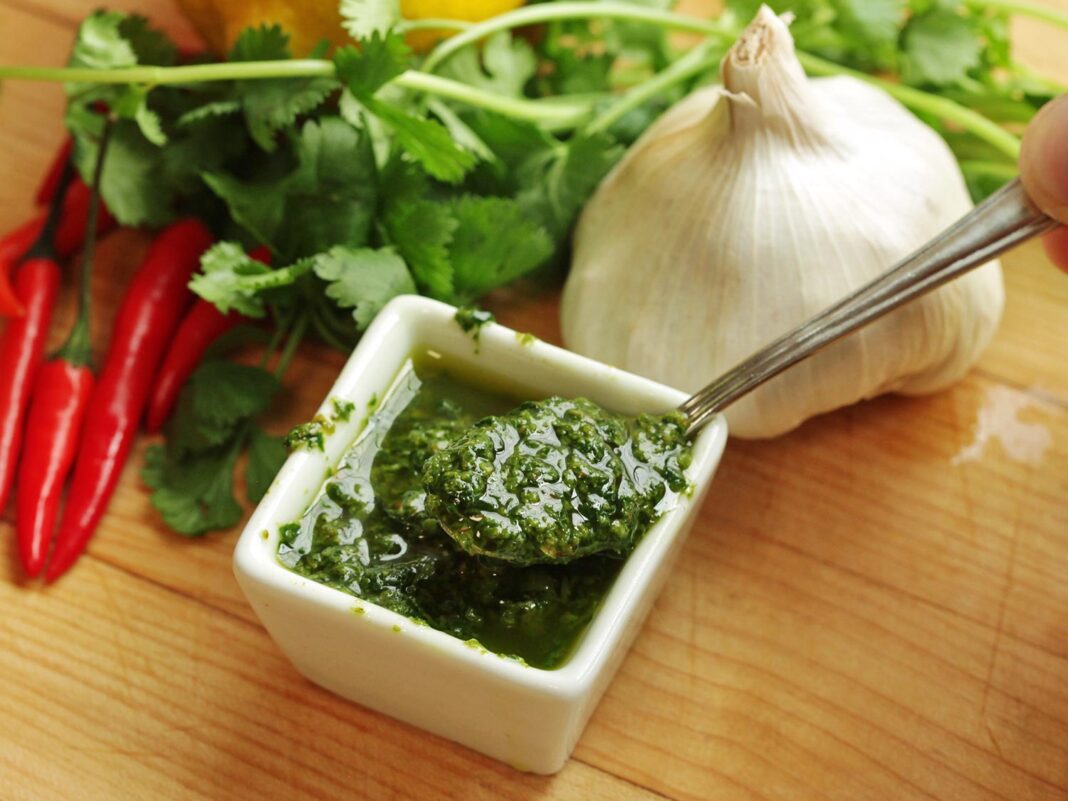
Yemenite green hot sauce (zhug)

zhougPardon me, but you you pass the green zhug?

I’m fresh from brunch with friends newly returned from Jaffa, a feast formed from foods not easily found in my Brooklyn neighborhood. Hidden among the Challah bread french toast, steaming shakshuka (egg and pepper delection that’s my go-to Jerusalem breakfast), imported tahini, and home-cured olives, was a small jar of dark green goo that packed a punch to my palate. I have to tell you about zhug which I write as s’chüg.

Legend has it that Christopher Columbus – fresh from Asia – brought the first chili peppers to Europe, and they quickly migrated to North Africa and the MiddIe East. Fans of the fiery fruit have since spawned over 2000 new varieties, each with a specific form, flavor, and heat.

Middle eastern cuisine is peppered (yes, I wrote that) with recipes built on peppers, from fil fil mahshi (meat stuffed red peppers) to harissa sauce (a Maghrebi hot chili pepper paste) to the roasted pepper salads ubiquitous across regional menus. Peppers are eaten fresh, cooked or pickled, and are an integral part of most every meal. At a minimum, they’re a staple condiment.

Zhug, sahawiq or bisbas is a hot sauce originating in Yemeni cuisine. There are many names for it. And here are a few more…s’chüg (also called zhoug  or schug or zhug – generally meaning “ground”) is believed to harken from Yemen. It’s a hot pepper sauce made from garlic, oil, spices, tons of coriander, and – of course – hot green peppers. It’s heat varies wildly depending on ingredients  (refer to our story on Wilbur Scoville and his hot pepper scale here)  but it’s always very tasty, with a wonderful scent. (Hate coriander? no worries, thanks to the magical mixing of ingredients, you won’t taste it!)

A bit of time online produced this pair of recipes. I tried both, liked both, and offer them to you for your own taste-test experimentation. Ingredients are inexpensive, and prep time is about 20 minutes. It’s the ideal accompaniment for falafel or sabich sandwiches, but it also goes great with grilled vegetables, eggs, fish, chicken and meat. Stored in the fridge in a tightly lidded jar,  it should last a few weeks.

Zhug Recipe Number 1

This version is very hot. Suggest that you wear gloves while chopping the peppers, and keep juices away from your eyes and open cuts to avoid painful burns!

Ingredients (enough to fill a small glass jar)

1 cup of chopped coriander
5 medium-sized hot green peppers
4 garlic clove
1/3 teaspoon cumin
1/2 teaspoon. salt
2 tablespoons extra virgin olive oil

Carefuly cut the peppers into small pieces, and remove all seeds. Combine with all other ingredients in a food processor until the desired consistancy is achieved.

Zhug Recipe Number 2

This is how Israeli chef Yotam Ottolenghi does zhug. His version makes about 1-1/4 cups of the stuff.

35g coriander
20g parsley
2 green chillies
½ tsp ground cumin
¼ tsp ground cardamom
⅛ tsp sugar
¼ tsp salt
2 garlic cloves, crushed
3 tbsp olive oil
2 tbsp water

Put all ingredients in a food processor and blitz to a smooth paste.  He suggests refrigerating it for up to 2 days, but my guess is that leftovers are unlikely.

Can’t stand the heat?  No need to get out of the kitchen.  Instead, whip up a batch of muhammara, a delicious red-pepper, garlic, and walnut schmear born in Aleppo, Syria.  Follow our recipe for this milder mush (link here).

And drop a comment about your experience and any recipe tweaks you recommend!

Faisal O'Keefe
Faisal O'Keefehttps://www.greenprophet.com/
Former First World tax attorney, appalled at the trajectory of world politics and public attitudes, and how his favorite vacation spots are being decimated by climate change and human disregard for nature. Took a six-month leave to consider his options. Seven years on, is still trying to figure out what to be when he grows up, and what actions he can take to best ensure he'll have a place to be it.

Hot this week

How Renewable Energy is Revolutionizing the Way We Power Our World

Solar has become the star of the transition thanks to modular hardware and straightforward installation. It fits dense cities and remote towns alike. Many companies are turning to rooftop arrays and carport systems - and exploring commercial solar installation as a practical way to lock in future savings.

How does one start prepping?

Faced with an extreme winter storm this year, Americans wonder how to be prepared for catastrophe. Miriam has lived through wars in the Middle East - so she's prepared on giving you a guide to prepping.

Fishermen sue tire manufacturers on behalf of the salmon

A federal trial in San Francisco has brought US tire manufacturers, fishing groups, and environmental scientists into court over a chemical most drivers have never heard of — but which scientists say may be silently reshaping aquatic ecosystems.

Listening to Water: Tarek Atoui’s Next Work for Tate Modern

Born in Beirut, Lebanon in 1980 and now living in Paris, Atoui has spent years building instruments that don’t sit comfortably in concert halls. Many of them involve water, glass, and ceramics — materials that react to sound instead of simply producing it.

Leading Through a Dual-Energy Transition: Balancing Decarbonisation with Energy Security

Experience in one area of the energy industry isn't enough to guarantee readiness across all the others. That's where a structured program like an MBA in energy can come in. Today's advanced curricula explore energy economics, finance, policy, and strategic management alongside the technical subjects. And when pursuing an energy MBA online, professionals can skill up and retrain without having to step out of the labor market -- an important perk at a time when skilled professionals are already in short supply.

Topics

How Renewable Energy is Revolutionizing the Way We Power Our World

Solar has become the star of the transition thanks to modular hardware and straightforward installation. It fits dense cities and remote towns alike. Many companies are turning to rooftop arrays and carport systems - and exploring commercial solar installation as a practical way to lock in future savings.

How does one start prepping?

Faced with an extreme winter storm this year, Americans wonder how to be prepared for catastrophe. Miriam has lived through wars in the Middle East - so she's prepared on giving you a guide to prepping.

Fishermen sue tire manufacturers on behalf of the salmon

A federal trial in San Francisco has brought US tire manufacturers, fishing groups, and environmental scientists into court over a chemical most drivers have never heard of — but which scientists say may be silently reshaping aquatic ecosystems.

Listening to Water: Tarek Atoui’s Next Work for Tate Modern

Born in Beirut, Lebanon in 1980 and now living in Paris, Atoui has spent years building instruments that don’t sit comfortably in concert halls. Many of them involve water, glass, and ceramics — materials that react to sound instead of simply producing it.

Leading Through a Dual-Energy Transition: Balancing Decarbonisation with Energy Security

Experience in one area of the energy industry isn't enough to guarantee readiness across all the others. That's where a structured program like an MBA in energy can come in. Today's advanced curricula explore energy economics, finance, policy, and strategic management alongside the technical subjects. And when pursuing an energy MBA online, professionals can skill up and retrain without having to step out of the labor market -- an important perk at a time when skilled professionals are already in short supply.

From Green Energy to Healthy Societies: Why old systems thinking is becoming relevant again

Across the Middle East and North Africa, large investments are being made in green hydrogen, renewable energy, water infrastructure and sustainability. Most of these efforts are discussed in the context of climate change, decarbonization and economic diversification. That framing is important, but it may not capture their full value.

We saw peace – an interreligious encounter deep in our eyes

They came from Israel, Palestine, Jordan, Iraq, Yemen, Morocco, Tunisia, Lebanon, Egypt… There are Sunni Muslims, Shiite Muslims, Jews (Orthodox and Reform), Orthodox Christians, Coptic Christians, Protestant Christians, Druze, Baha'is, a Scientologist.

Can biochar reduce ‘Forever Chemicals’ in food if it’s used in farms?

Biochar is produced by heating organic material in a low-oxygen environment so it does not burn. This process, known as pyrolysis, transforms plant matter into a stable, carbon-rich material.

Related Articles

Popular Categories