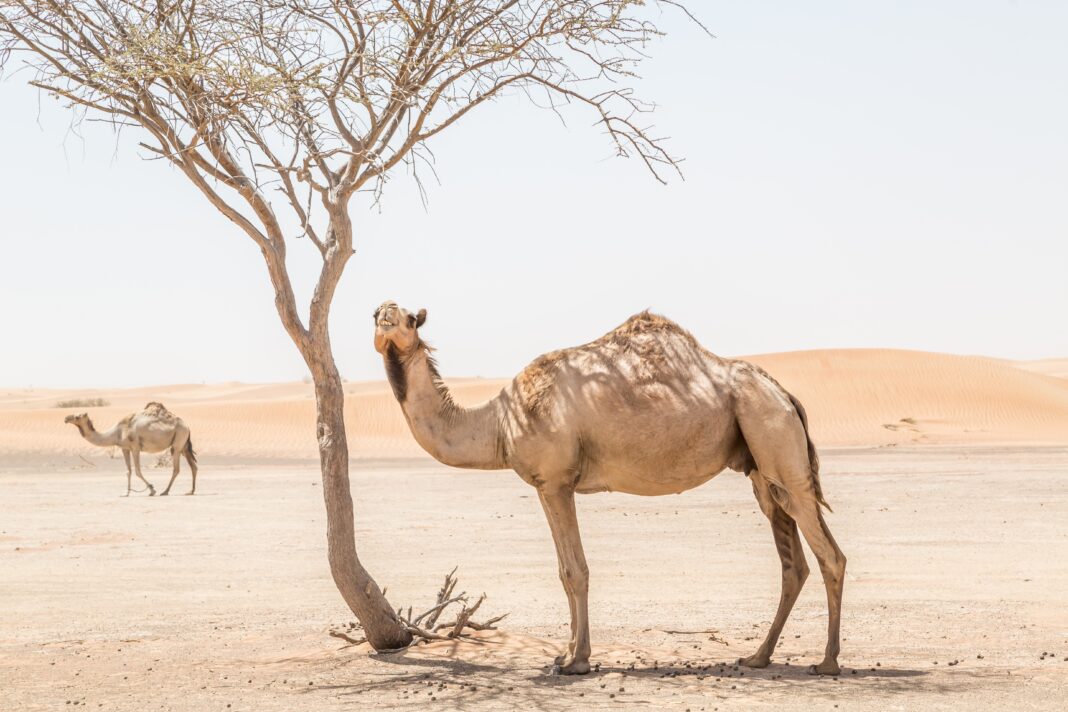


We have been roaming the Earth since long before you arrived, but maybe you haven’t noticed. We are referred to as the heroes of deserts and highlands for we can survive the toughest of climates. We create some of the world’s healthiest milks and the most comfy wools. We are camels and camelids.
In celebration of the International Year of Camelids 2024, the Food and Agriculture Organization of the United Nations is collaborating with partners to highlight the important role camelids play in community livelihoods and in building resilience to climate change – particularly in mountains and arid and semi-arid lands. They are at risk of death when they eat plastics in Dubai. So be mindful of your environment.
Camels and camelids live in over 90 countries and are crucial to the livelihoods of millions. They are a part of people’s cultures, livelihoods and identities and are working animals, supporting Indigenous Peoples and local communities. Our products contribute to nutrition, food security and economic growth all over the world.
There are several different types of us and more than you can count.
The Bactrian camel

I am a Bactrian camel, and I have two humps on my back.I am the largest living camelid, able to adapt to both climates of the desert and semi-desert regions. Much like the dromedary camels, I can travel for long periods of time without food or water by using the fat stored in my humps and turning it into energy.
Do not confuse us with wild camels, however. They are a separate species only found in the remote desert areas between China and Mongolia. Like all other camelids, I am a sturdy and resilient creature, constantly serving people in times of need.
Even in extreme climatic conditions, I continue to provide nutritious food and fibre. Like dromedaries, I am called a “ship of the desert” thanks to my ability to survive in challenging circumstances, which is why both we and dromedaries are crucial to nomadic and dryland communities.
The dromedary camel
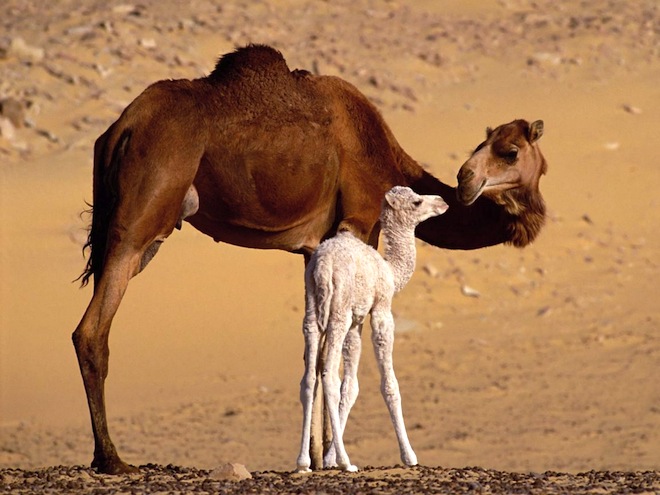
I am the one humped camel, and you can distinguish me by my long-curved neck and narrow chest. I have difficulty travelling through mountainous regions, which is why I am referred to as a camel of the plains. I exist in Africa and Asia. You might find e chasing a taxi near the Dead Sea in Jordan or in a Bedouin camp in Israel.
I travel vast distances like the Bactrian camels, surviving long periods without water. This may be why I make the ideal companion through the vastness of deserts.
The llama
A tall, horse-shaped animal with a short tail is what I am. My ears are rather long and slightly curved inward like bananas.
There are four million of us today with half of us residing in Bolivia. Yarn made from our fibres is light but will keep you exceptionally warm.
Like our other camelid friends, I appeared in South America about 45 million years ago, and I am an integral part of the identity of many cultures and societies.
The alpaca
An alpaca is what they call me, and you can spot me for I have a long neck and legs and no top front teeth. Like other South American camelids, I have soft and padded feet, so I don’t damage the grasses that feed me.
I am a social creature and love to be around other alpacas and other animals. I communicate with my body language so you can read my mood by just watching my movements and behaviour.
Spanning back to pre-Hispanic times, we alpacas and our llama brethren, were the main working animals. We also provided fibre and meat to the communities.
We alpacas and llamas are the only South American camelids to have been domesticated.
The guanaco
I am one of the largest terrestrial wild mammals in South America. You can identify me by my slender body and large pointed ears. Unlike my llama relatives, my coat colour varies very little, from only a light to a dark shade of brown, with some white underneath.
We are speedy creatures, able to run from our predators. Did you know we can run about 35 miles an hour? That’s almost as fast as a tiger! Like my other camelid counterparts, I am important to local communities for my fibre.
The vicuña
I am a vicuña, the national animal of Peru. I have woolly brown coat on my back, while my chest hair is white. Many say that I provide some of the finest fibre in the world.
I can live in cold temperatures regardless of my thin wool because my body traps the sun’s heat during the daytime keeping me warm throughout the night.
We vicuñas, like the other South American camelids – llamas, alpacas and guanacos- are also called New World camelids, and we are considered unique indigenous mammals from the continent. We are a spiritual and cultural part of Indigenous Peoples’ and local communities’ identities in the Andean highlands, much like how the Bactrian and dromedary camels are culturally and socially significant in the arid and semi-arid lands of Africa and Asia.
Communities around the world depend on camelid products and services for their livelihoods. This is why recognition and support for camelids is crucial for community livelihoods and the environment, fostering sustainable jobs and equality. Let the heroes of deserts and highlands help transform communities and cultures everywhere.