Bacteria art in a petri dish

Bacteria art in a petri dish

Nature offers us endless ways to play and be inspired. Especially when it comes to the little things that we can hardly see with our eyes. There is bacterial art that can be cultured into fabric and Stella McCartney fashion to sculptures made from bees that surround ceramic objects with real life honeycomb. Or how about the art submerged under the sea to be built on by coral reefs building their homes?

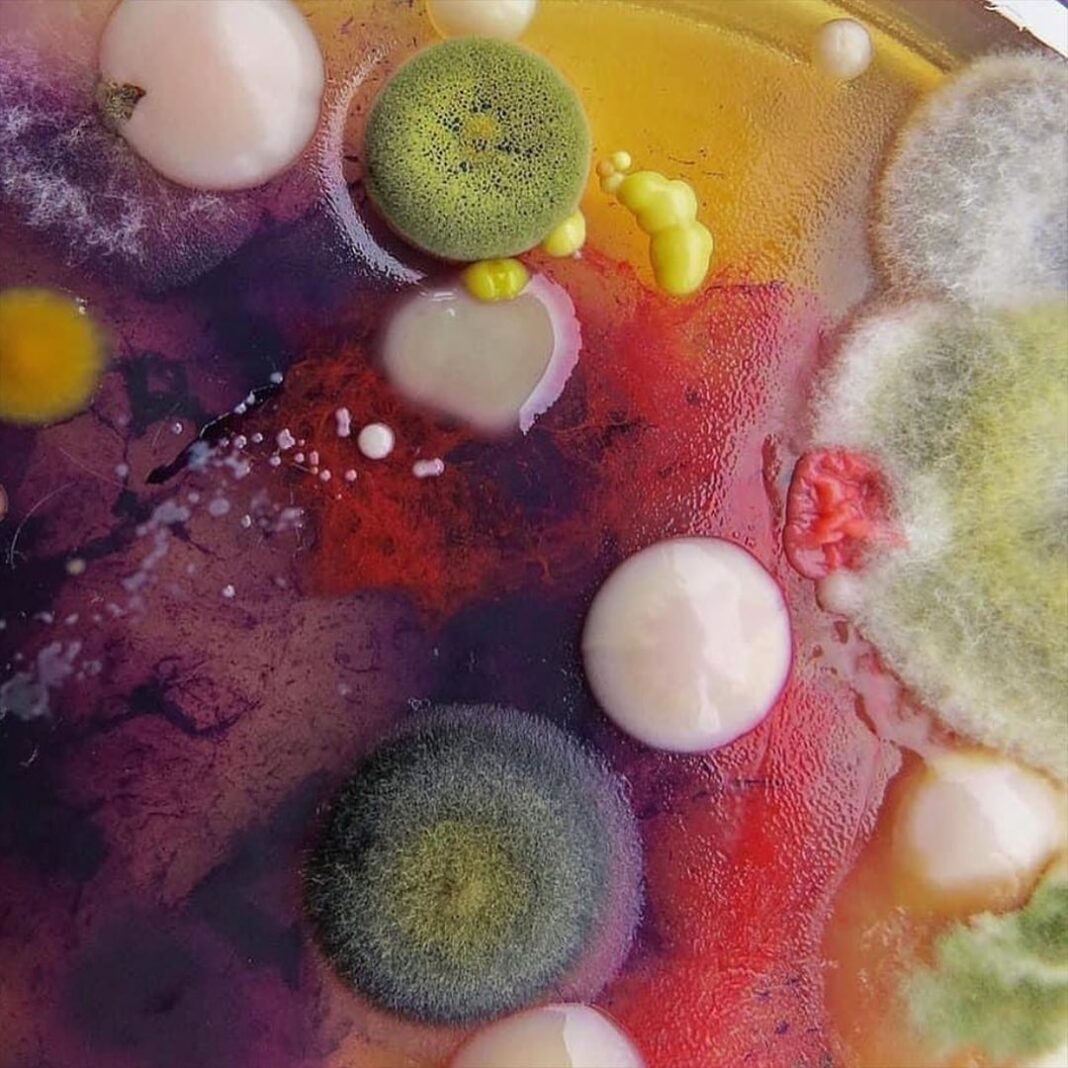
A Russian artist Daria Fedorova helps us overcome our fear of the invisible by creating art from bacteria on petri dishes. Since Covid we all have had an a rational and irrational fear of germs but Daria helps us see the decomposition and bacteria artfully in color and form. 

Dasha grows bacteria and other organisms on petri dishes and agar before applying tiny fluffy balls with sugar and sprinkles into the mix. The additions of texture and color spark the imagination and make bacteria seem playful rather than fear-inducing. Unlike viruses, you can see bacterial growth with your eyes. The shapes are fuzzy and slimy, with coils and strings and shapes from a Doctor Seuss story. 

The creations are built over about three and four weeks from what’s around us: “We are all swimming in the ocean of tiny spores and organisms, breathing them in, and carrying them on the top of our skin and inside the body. I was interested in this parallel between the physical world we can see and touch and also another physical world, which also presents, but is kind of metaphysical, invisible, somewhere between the air layers, vibrations, energies, nature,” she says on her art website. 

The way of my seeding is extremely different from the microbiological practices, so I have no incubators, and sterility, it happens as naturally as you cooking your meal. That is why all of these compositions looks so different and fulfilled, I’m not trying to get rid of some – i just appreciate their variable chaos. But also have kinda unwanted species, which covers all the area in just several hours, so I can’t see what is underneath, for example mucor, looks like a huge cotton candy.”

Explore Plesen’s works on Instagram and be inspired. 

Plesen’s work falls into decades of art in petri dishes which we’ve covered over the years. Brad Pitt’s rumored girlfriend Neri Oxman’s idea of living clothes was born out of the lab at Tel Aviv University. Sarine Zaken was the world’s first designer to incorporate living bacteria into clothing and jewelry that people can actually wear. The  third year student at Shenkar College of Engineering and Design, the young Israeli fantasized about incorporating something alive into her final project.

Other “living” ideas for petri dishes you can save from the Biology lab recycling bin: 

  • mini terrariums can be grown in them. Terrariums are encased plant and sometimes small animal systems that need no external nutrients or water for growth 
  • Germinate seeds inside a petri dish on a damp paper towel. Replant the seeds that grow.
  • Observe objects and living organisms using a magnifying glass, containing them in a petri dish 
  • Use petri dishes as mini canvases for painting
  • Use them as see-through molds for creative treats. 
Karin Kloosterman
Karin Kloostermanhttp://www.greenprophet.com
Karin Kloosterman is an award-winning journalist, innovation strategist, and founder of Green Prophet, one of the Middle East’s pioneering sustainability platforms. She has ranked in the Top 10 of Verizon innovation competitions, participated in NASA-linked challenges, and spoken worldwide on climate, food security, and future resilience. With an IoT technology patent, features in Canada’s National Post, and leadership inside teams building next-generation agricultural and planetary systems — including Mars-farming concepts — Karin operates at the intersection of storytelling, science, and systems change. She doesn’t report on the future – she helps design it. Reach out directly to [email protected]

TRENDING

Japan wants to build a solar panel ring around the moon

Unlike solar power on Earth, which is limited by night cycles, weather, and seasons, the Moon offers something close to uninterrupted exposure to the Sun. By placing solar infrastructure in orbit or along the lunar surface, engineers could generate continuous clean energy at a scale that may exceed global electricity demand,  the Japanese scientists say.

African kids born in these Star Homes are less likely to die

What the Star Home demonstrates is something bigger: that health can be built into infrastructure. Instead of relying only on healthcare systems, communities can reduce disease at the source—through smarter design.

Art from Oman at the Venice Biennale

Oman is returning to the Venice Biennale with Zīnah, an immersive installation by artist and curator Haitham Al Busafi that transforms a traditional form of horse adornment into a large-scale sensory experience.

Korean researchers create battery from greenhouse gases

Professor Ji-Soo Jang, in collaboration with Professor Taekwang Yoon of Ajou University and Professor Hansel Kim of Chungbuk National University, has developed a novel energy device that generates electricity during the process of capturing greenhouse gases.

SunZia comes online and America’s 11B, and largest renewable project begins wind power

The impact is already being felt. California has broken its wind generation record multiple times in recent weeks as SunZia begins feeding electricity into the grid. It’s a glimpse of what a renewable-powered future could look like when large-scale infrastructure finally comes online. Can we start saying goodbye to Saudi Aramco and Arabian Gulf oil? 

Nobul’s Regan McGee on Shareholder Value: “Complacency Is the Silent Killer” 

Why the governance framework designed to protect shareholders so...

Should You Invest in the Private Market?

startustartup Unlike public stock exchanges, which offer daily trading, strict...

How to build a 100-year-company

Kongō Gumi is a Japanese construction company, purportedly founded in 578 A.D., making it the world's oldest documented company. What can we learn about building sustainable businesses from them?

From Pilot Plant to Global Stage: How Aduro Clean Technologies’ 2026 Expansion Signals a Turning Point for Chemical Recycling Investors Like Yazan Al Homsi

The company's Next Generation Process (NGP) Pilot Plant in London, Ontario, has officially moved into initial operating campaigns, generating the kind of structured, repeatable data that separates laboratory promise from commercial viability.

How AI Helps SaaS Companies Reduce Repetitive Customer Support Work

SaaS products are designed for large numbers of users with different levels of experience, and also in renewable energy.

Pulling Water from the Air

Faced with water shortage in Amman, Laurie digs up...

Turning Your Energy Consultancy into an LLC: 4 Legal Steps for Founders in Texas

If you are starting a renewable energy business in Texas, learn how to start an LLC by the books.

Tracking the Impacts of a Hydroelectric Dam Along the Tigris River

For the next two months, I'll be taking a break from my usual Green Prophet posts to report on a transnational environmental issue: the Ilısu Dam currently under construction in Turkey, and the ways it will transform life along the Tigris River.

Related Articles

Popular Categories