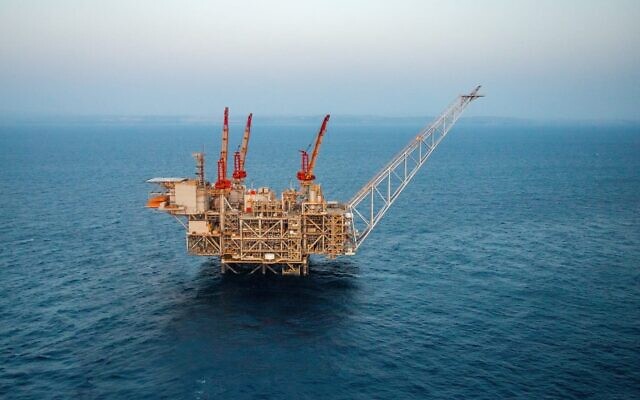
Israeli offshore gas fields are now under control of one of the world’s biggest energy companies, Chevron. It irks activists, but might spark a pan-European pipeline, one analyst suggests.
Israel started finding natural gas in offshore gas deposits more than a decade ago. They started in the 1920s under the British Mandate over Palestine with no success. Some estimate that what lies out under the shore-bed off the Israeli coast in the Mediterranean Sea could equal as much as one-fifth as all the natural gas owned by the United States.
Israel’s offshore gas deposits are known as Leviathan and Tamar deposits and they are considered one of the world’s biggest offshore gas discoveries in the last 10 years. Owners in the company exploring Leviathan were Texas-based Noble Energy, Israeli owned Ratio Petroleum, and Israeli-owned Delek Drilling.
Noble Energy held 39.66% of Leviathan, and it is also the company that operates the gas drilling platform in the reservoir. Noble Energy has two Israeli partners in the ownership of the Leviathan rights: Delek Drilling (45.24%) and Ratio Petroleum (15%).
Noble Energy had a controlling share in the Israeli gas fields but its assets officially transferred to the oil company Chevron this past Friday.
While the gas deposits are an energy game changer for Israel which had been burning coal and oil to fire its power plants, environmentalists believe that public interests and health are at stake in the business and operations of the natural gas facility. Analysts at research institutes might argue the deal is a positive game changer for Israel in politics.
Let’s start with the environmentalists: They are even more worried now thanks to the disastrous environmental record and cleanup policies of Chevron. Last summer Chevron dumped 800,000 gallons of oil and water into a California canyon. The oil and gas company has a spotty history with oil spills and environmental responsibility. Over in Kazakstan it is rumoured that Chevron violates workers’ rights and more:
“It is not by chance that Kazakhstan is considered to be the jewel in the crown of Chevron, as the country’s oil helps the company flourish,” says Sergey Solyanik, consultant to Crude Accountability.
He continues: “For Chevron and other foreign investors, Kazakhstan has long been turned into a kind of field camp, where people come to pump out natural wealth and make money, leaving behind large-scale environmental pollution, poverty and lawlessness.”
Israel’s gas went online earlier this year amid fears and protests of people worried for their health as the gas lines purged polluting water into the sea. Israel now supplies natural gas domestically as well as to Egypt and Jordan.
The addition of Noble will boost Chevron’s natural gas holdings. It also adds nearly 1 billion cubic feet of natural gas reserves close to growing markets.
The deal values Noble Energy at around $4.2 billion, excluding $8 billion in debt. This is the first big energy deal since the coronavirus crushed global fuel demand.
Natural gas has made Canada, Qatar and now Israel energy-rich, in theory. But Israelis are left scratching their heads, wondering who is benefiting from their natural resource.
While natural gas burns cleaner than oil or coal, it is not a renewable energy. Fossil fuels contribute to global warming and while Israel has been very vocal in the last 15 years about its advances in clean technology, including solar energy, it supplies solar for only a meagre 3% of its total energy use. This small number still makes it a world leader. Germany in comparison produces about 8.2% of its energy from solar, mainly via photovoltaic or PV panels.
Several people had wanted to stop the Chevron-Noble deal: US billionaire Paul Singer who invested in a stake in Noble under his firm Elliot in NY told Bloomberg that that Noble agreed to the deal [with Chevron] at the wrong time for the wrong reasons and that the company is better positioned to benefit from a recovery in oil prices if it remains independent. When the recovery happens, Noble should consider selling its Mediterranean assets, Singer advised.
Israeli solar energy pioneer Yossi Abramowitz cautioned the public to not accept the sale in the OpEd: Dear Nobel Energy Shareholders, Chevron is About to Take You for a Ride.
He and his co-author Maya Jacobs, the CEO of Zalul, an NGO to protect Israel’s sea, wrote:
“Reject the Chevron acquisition offer; they are short-changing you, and only giving you shares in a sinking business. Are you fully aware of Chevron’s environmental record and their $9.5b judgement in Ecuador for the Chernobyl of the Amazon?
“Traditional oil companies are overburdened with what will be stranded assets, as the world continues to battle Corona, adopt more Green Recovery deals, and impose carbon taxes. While Chevron is valued today at a whopping $155 billion – down $10 billion just this week — their valuation is subject to wild fluctuations, like when in March, due to Corona, it lost nearly half its value.”
In the Jerusalem Post (the competing newspaper to Times of Israel) he said: “Chevron has one of the worst environmental track records on the planet when it comes to oil safety, oil cleanup, respecting local lives and paying judgments against it.
Abramowitz also expressed concern that “it looks like the energy minister gave an assurance to Noble and Chevron [that it could] keep a significant monopoly on Israel’s energy market,” saying this was “wrong economically and wrong environmentally.”
Israelis currently pay 3 times the price for energy than others in developed nations. The promise was that when Israel invested in natural gas the citizens would earn the dividends by lower prices on their energy bills. This promise never materialised.
If you look to the INSS, the Chevron deal is good for political manoeuvring. The think tank’s analyst Oded Eran based at Tel Aviv University writes in a policy piece:
“Without a doubt, the move brings the American presence in the energy sector of the Eastern Mediterranean to a new level, which until recently was limited to the relatively minor involvement of energy giant Exxon in Cyprus and Noble Energy, which is a small American company in Israel.
Beginnings for the Eastern Mediterranean natural gas pipeline?
“Israel wants to be part of a natural gas pipeline that travels undersea to Cyprus and then Europe,” Eran writes, “it is not without a huge cost and risks shaking the boat with Turkey:
“Although the Israeli government is promoting the Eastern Mediterranean natural gas pipeline project, considerable doubt still exists regarding its technical, economic, and political feasibility.
“At a length of 1,900 kilometers, 1,300 of which are at sea, the pipeline, if and when it is completed, will transport approximately 10 billion cubic meters of natural gas from Israel and Cyprus to Europe each year.
“The cost of the pipeline has been estimated at 6 billion euros. In early January 2020, Greece, Cyprus, and Israel signed the framework agreement for the construction of the pipeline, and in July of this year the Israeli cabinet ratified the agreement.
“Turkey has already expressed its firm opposition to the project, and its dispatch of a drilling ship to Cypriot waters and its agreement with the Libyan Government of National Accord regarding the demarcation of economic waters (November 2019) should be seen as part of Ankara’s response to the alliance between Israel, Greece, and Cyprus in the natural gas sector,” Eran adds.
Chevron’s CEO Michael Wirth said in a release: “With an industry-leading balance sheet and a track record of capital discipline, we believe we’re in a different place than others and can protect the dividend while driving long-term value.”