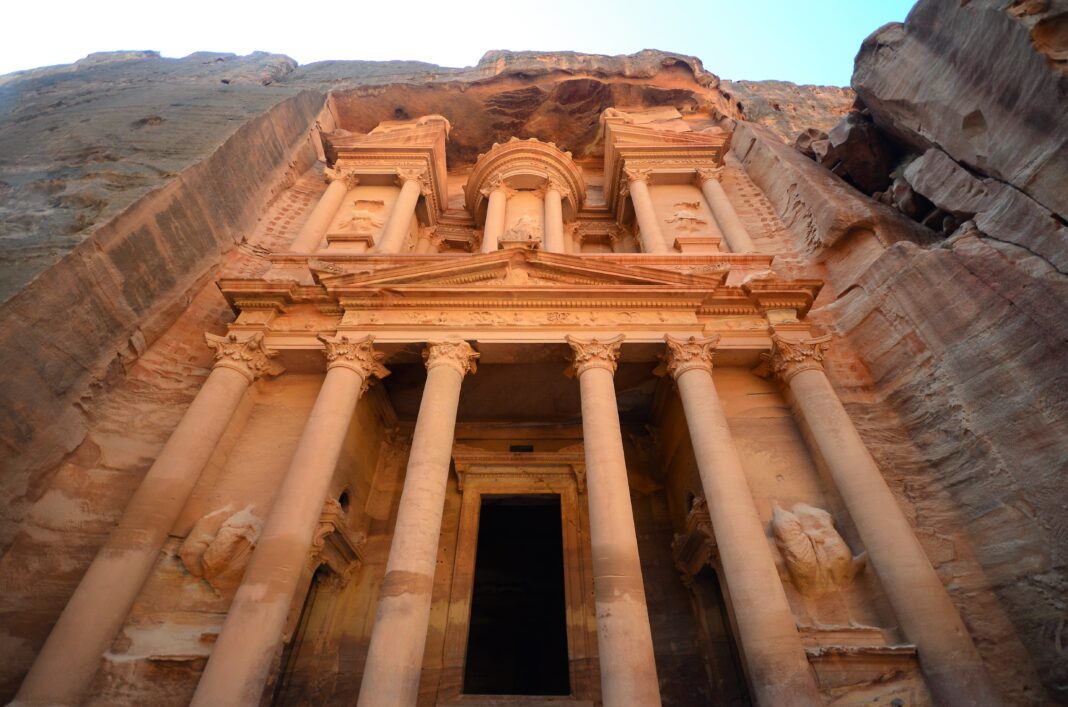


They built fortresses and forts like Petra and collected rare rainfall. Who were the Nabateans?
Nabateans were Arabian nomads from the Negev Desert who amassed their wealth first as traders on the Incense Routes which wound from Qataban (modern-day Yemen) through neighboring Saba (a powerful trade hub) and on toward Gaza on the Mediterranean Sea.
The Nabataean Kingdom stretched from the north-western part of the Arabian Peninsula on the east to the Sinai Peninsula on the west and as far north as Damascus, which was incorporated into their kingdom between 85 and 71 BCE.
The three wise men?
The main source of economic prosperity was the incense trade and the Nabataeans not only controlled trade routes in the region but had their merchant posts as far as Rome.
The economic prosperity was followed by the formation of the pantheon of Nabataean gods, similar to other Semitic people in the area or Greco-Roman deities. However, gods of the Greco-Roman tradition were anthropomorphic and we all learned about their mishaps and human-like behavior and follies.
Unlike Greco-Roman perception of Titans and Olympians, the ancient Nabataeans represented their deities in the form of stealea, which were blocks or rocks set upon the end or visual representations curved into a stone. The Nabataeans represented their deities in the form of a tomb fasade, a painted pottery, coins, lamps and jewelry. You can see these majestic carvings up close and personal in Jordan, near the Red Sea.
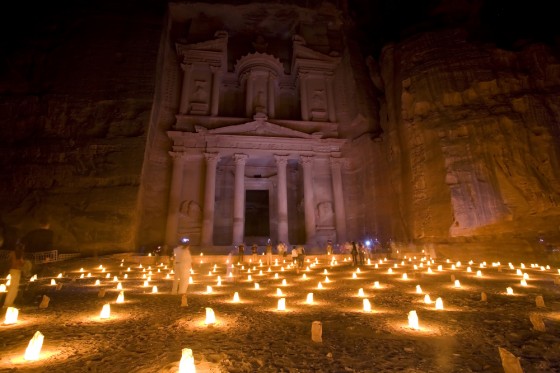
A desert Zeus?
Some gods, like Dushara, became more significant with the political and economic development of the state, said Professor Robert Wenning, who received his PhD in Classical Archaeology from University of Munster. Dr. Wenning for many years studied the Nabataean sites and religious practices.
He tells Green Prophet: “Being a regional god of the rocky area of Petra and the close by Shara Mountains, Dushara became the city god in the middle of the 3rd century BC when Petra was established as a station on the old incense road from south Arabia to the Mediterranean Sea,” Wenning noted.
Dushara means the “Lord of Mountain” and he was considered a supreme god not only in Petra but other parts of the realm.
Other major gods were: Al Qaum, Al Kutbay, Al Uzza, Manawat, Allat and Obodat.
Al Qaum was a god of war, equivalent to Greek Ares, and he protected caravans and clans.
Al Kutbay was “more intellectual” and he was the patron of learning, trade and writing, and he was the local equivalent of the Greek god Hermes.
Al Uzza was a goddess associated with power and later during the process of Hellenization of the southern Levant she was the Nabataean equivalent of Aphrodite.
Manawat was a goddess of destiny, and consequently during Hellenization she was associated with Nemesis.
Allat was a goddess of fertility comparable to Athena.
Obodat, who is most probably the deified King Obodas I (96 BC-85 BC), was a god associated with the dynastic cult.

Representation of deities in an abstract form was also practiced among Semitic nomads who dwelled in deserts of the Arabian Peninsula before they converted to Islam in 7th century AD.
Religious syncretism
According to Wenning, in ancient times a specific deity would become the supreme god, like Assur of the Assyrians, Marduk of the Babylonians and Milcom of the Ammonites.
Usually in the ancient religions there is a hierarchic structure in the relations between the deities, Wenning told us. However, “the Nabataean religion preserves only few elements of such structures and does not create a real pantheon,” the scholar highlighted.
After the Roman Emperor Trajan’s incorporation of the Nabataean Kingdom into Provincia Arabia in 106 AD, Dushara remains an important god. His anthropomorphic images became minted in various coins of that period.
The Nabataean belief system was characterized by one supreme god or goddess who meets all requirements of their worshippers, Wenning underlined, adding that a few other deities can be associated to Dushara like Al Uzza, his mother.
“Other deities cover some special aspects or the needs of particular groups. The Nabataean society was complex and Nabataean religion always reflects different local situations,” the scholar explained.
For centuries after the conquests of the Alexander the Great the Greek language was the lingua franca of the Middle East and it remained after the Roman occupation of the area. Even Jupiter was referred as Zeus in the Roman East, and another supreme Nabataean god Odoba (Avdat) was worshipped as Zeus Oboda, Wenning highlighted.
On the other hand, many scholars agree that Qasr Al Bint, a temple at Petra, was a sanctuary of Dushara.

“The Egyptian goddess Isis was the most famous female deity in Petra, even more prominent than Al Uzza following the evidence,” Wenning noted, emphasizing the religious syncretism typical for the paganism. One of such syncretists was the Roman Emperor Elagabulus ( 218 AD -222 AD) from the Severan dynasty, whose brief reign was marked by promulgation of the Middle Eastern religion as he took a baetyl of Dushara with him to Rome. However, his reign didn’t end up nicely when he was assassinated by Praetorian guards.

Inter-religious harmony
The ancient Nabataeans were religiously tolerant and their society integrated other gods and their cults into their own belief system. The Egyptian goddess Isis was very much venerated in the Nabataean Kingdom and scholars speculate that cultic material found at the Temple of the Winged Lions in Petra point to that direction. See below.
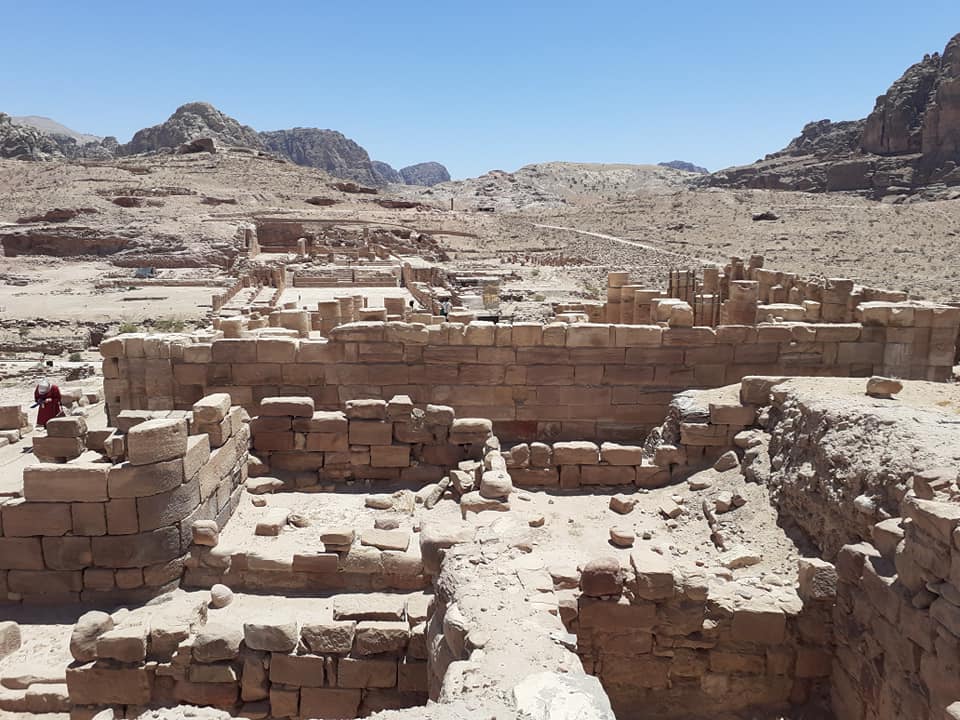
The temple was probably dedicated to Al Uzza and under the Greeco-Roman influence the Nabataeans began to depict their deities in human forms. A ring-seal displaying a nude goddess riding a dolphin, feline statuettes, a feline head made of bronze and”Eye-Idol” blocks highlight religious syncretism that characterized the polytheistic coexistence.
What happened to Nabatean tolerance?
Unfortunately, modern societies in the Middle East are often religiously intolerant and not only that three monotheistic religions often have antagonistic attitudes towards each other, but within each of them different schools or denominations believe that they are the only chosen one, while the rest are condemned for the whole of eternity.
Professor at Queen’s University Barbara Reeves underlined in her research the harmonious interreligious ties between Roman military stationed at Humayma (some 280 km south of Amman) and the local Nabataean population.
The garrison had around 500 soldiers and controlled the water springs and major roads. The “new harmony” is depicted most clearly in a community shrine where a betyl (standing stone) representing the Nabataean town god stood side-by-side with an altar honouring the Roman garrison’s god, Reeves pointed out.
Furthermore, a rock carving from a cult site in the hills also shows a Roman standard-bearer making an offering in front of both his garrison’s god and a larger-than-life-size gazelle that represents the local god Reeves stressed.
“Their side-by-side placement at the focal point of the community shrine advertises harmony between the town’s Nabataean civilians and Roman soldiers,” Reeves underscored.