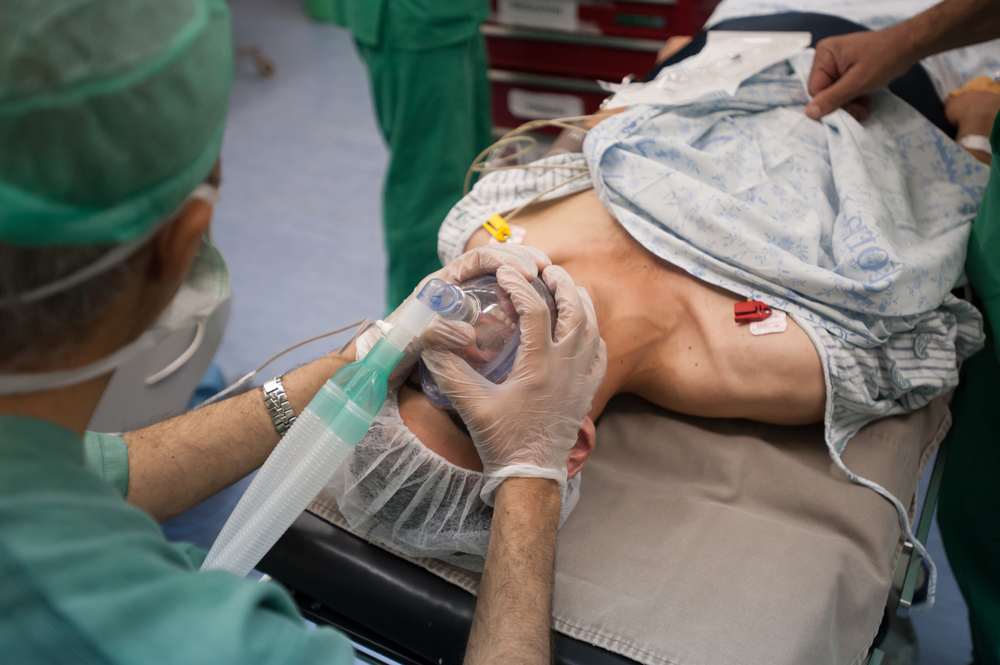
In traditional circles there’s often talk about how automobile exhaust and agricultural practices contribute to greenhouse gas emissions. However, as experienced anesthesiologist Dr. Subrata Chakravarty focuses on the best applications to help patients through the use of anesthetic agents, he is also acutely aware of global warming trends and the possible impact of them.
The reality is that popular anesthetic agents including nitrous oxide (also known a laughing gas, which is often still used for sedation in the dentist’s chair) as well as isoflurane (used in procedures requiring general anesthesia) both have a potential impact on the environment. In fact, stats show the health sector in the U.S. is responsible for about 10 percent of the overall greenhouse gases produced by the country (although medical gas providers peg the impact at lower than one percent of emissions from burning fossil fuels.)
While isoflurane is a chlorofluorocarbon (CFC) that has been shown to deplete the ozone layer, CFCs were phased out as part of an international treaty. The result is that while the hole in the ozone is repairing itself, it has also made more room for other agents used by an anesthesiologist such as sevoflorine and desflurane, both of which are hydrofluorocarbons (HFCs). This may sound positive on the surface, but while these latter agents do not harm the ozone, they are potent greenhouse gases that can contribute to the climate crisis.
There is no shortage of these agents being used – in fact, there’s an expected increase of more than 300 percent by 2030 compared to 2005 levels. Dr. Subrata Chakravarty shares that this projected increase is partially a result of developing countries having more access to healthcare.
Why Inhalation Agents are Potentially Harmful to The Environment
When discussing global warming, the finger is most often pointed at carbon dioxide. However, the potential of these analgesic gases used by an anesthesiologist to provide comfort to patients actually has significantly higher potential than CO2 for heating up the globe – perhaps surprisingly, as many as hundreds or even thousands of times more.
But why? There are essentially three criteria when it comes to judging the greenhouse effect potential of a gas. One is how long it can exist in the atmosphere (also known as atmospheric lifetime). For some context, nitrous oxide, which is still used for some applications (and recreationally) has an atmospheric lifetime of around 150 years.
Next there’s its potential during its atmospheric lifetime for absorbing infrared radiation that’s normally destined for space. The last consideration is whether there are other atmospheric elements such as moisture that absorb infrared rays on the same wavelength. If not, the potential for the greenhouse gas effect skyrockets. In the case of both CFCs and HFCs, all three boxes are ticked.
How much greenhouse gas does a procedure using desflurane produce? To put it in perspective, Subrata Chakravarty shares one estimate pegs the amount of gas flow during a seven-hour operation as the same as a 200-hour drive in a car. Other data suggests that just one hospital might have equivalent emissions of more than 1,000 cars.
Meanwhile, data suggests CFC and HFC anesthesia gas emissions are equivalent to 3 million tons of CO2, roughly the same amount produced from the annual energy consumption of 359,000 homes’.
How An Anesthesiologist Can Reduce The Impact?
Here’s what typically happens in an operating room. A patient breathes in sevoflurane or another anesthetic gas to completely knock them out during a procedure. However, Dr. Subrata Chakravarty states only a small portion of the gas is actually used by the patient, and the rest typically gets sucked out of the operating room via ventilation.
This is especially harmful if the anesthesiologist is using desflurane, as it is significantly more potent as a greenhouse gas than its counterpart sevoflurane. What’s more is that desflurane has an atmospheric lifetime of about 14 years, while the other has a lifespan of about a year. From a financial perspective, sevoflurane is considerably cheaper meaning it can save hospitals several thousands of dollars over the course of a year.
Knowing which gases have less potential for contributing to global warming is one approach being used by Dr. Subrata Chakravarty. He further explains that it’s not just the type of gas that’s important – it’s limiting the amount released into the atmosphere.
A Gradual Shift in Thinking
An anesthesiologist like Dr. Subrata is most likely focused on the health of the patient during a procedure – not the health of the planet. However, that’s not to say that some anesthesiologists aren’t making the switch when they learn the data behind potential environmental impacts.
However, there could be some sticking points. One of them is that desflurane actually allows faster recovery for the patient compared to sevoflurane. So, from a medical perspective, desflurane may still have advantages despite being a bigger problem environmentally. To be clear, sevoflurane is still regarded as a safe anesthetic in terms of patient impact. In fact, both nitrous oxide and isoflurane are considered essential medicines, according to the World Health Organization.
Another possible sticking point is that anesthetic gases weren’t included in the Paris Climate Accord, so more attention might be going to other known environment offenders.
Currently there are government guidelines in place to help reduce gas exposure inside a hospital setting, but so far there aren’t any rules about how much a hospital can emit. While a possible mitigation approach would be setting an emissions limit for anesthetic gases, it may also come down to adopting anesthetic gases that have no harmful properties to the earth – xenon is one gas that has been discussed for this reason as an alternative to nitrous oxide. Unfortunately, xenon is quite rare and therefore not too widespread aside from its use primarily in Europe.
Subrata Chakravarty’s Final Thoughts
In the meantime, Dr. Subrata Chakravarty and his anesthesiologist colleagues are focused on awareness of the issue to try to influence a change in behavior. The best hope in the short-term is that more medical professionals will choose anesthetics with the least impact, until newer and more sustainable gases are found for patient care.