

Rare Glimpse Into Ultra-orthodox World At Jerusalem Design Week

Artist Marcelle Biton in front of her display at Jerusalem Design Week’s “Haready-Made: The Product in Orthodox Society” exhibition. (Credit: Yelena Kvetany)

Jerusalem Design Week happens every year, but it was a first for some artists participating in the exhibition “Haready-Made: The Product in Orthodox Society.” Relating to this year’s overall theme of “conserve,” the exhibition showcases objects used by members of the Haredi community—ultra-Orthodox Jews who reject secular life—in order to sustain their culture in socially liberal and tech-savvy Israel.

The exhibition, which was on display at the Jerusalem Theater, ran until June 14.

Noa Cohen, the exhibition’s curator, related to The Media Line how the idea for the exhibition arose. While doing research on a different topic for her PhD thesis at Israel’s Bar-Ilan University, Cohen stumbled upon the Art Shelter Gallery nestled in Jerusalem’s ultra-orthodox neighborhood of Mekor Baruch.

“I realized a lot of artists [in this community] pursued very unique ways of making art. I volunteered as their curator for a few years and now I manage the Art Shelter Gallery. The exhibition at the Jerusalem Theater,” she continued, “is a collaboration [between the gallery and Design Week].”

Cohen said that for some of the 15 artists participating in the exhibition, it is the first time they are showcasing their art in a public place. “I realized that there are many things in the ultra-orthodox community not known by outside spectators, such as the way they live and how they make their products specifically tailored to their needs,” she noted.

One of the displays at the exhibition consists of a mannequin whose head is covered by a bright, colorful head-scarf (tichel). A cellphone is visible between the mannequin’s head and the head-scarf. Artist Marcelle Biton told The Media Line that this work is an adaptation, depicting how Haredi women often speak—often without using their hands—on “kosher” cellphones conveniently tucked underneath their tichels.

“You can’t find these scarfs in the stores; they are hand-made. And kosher phones are usually small ones produced by Nokia or Samsung,” Biton explained.
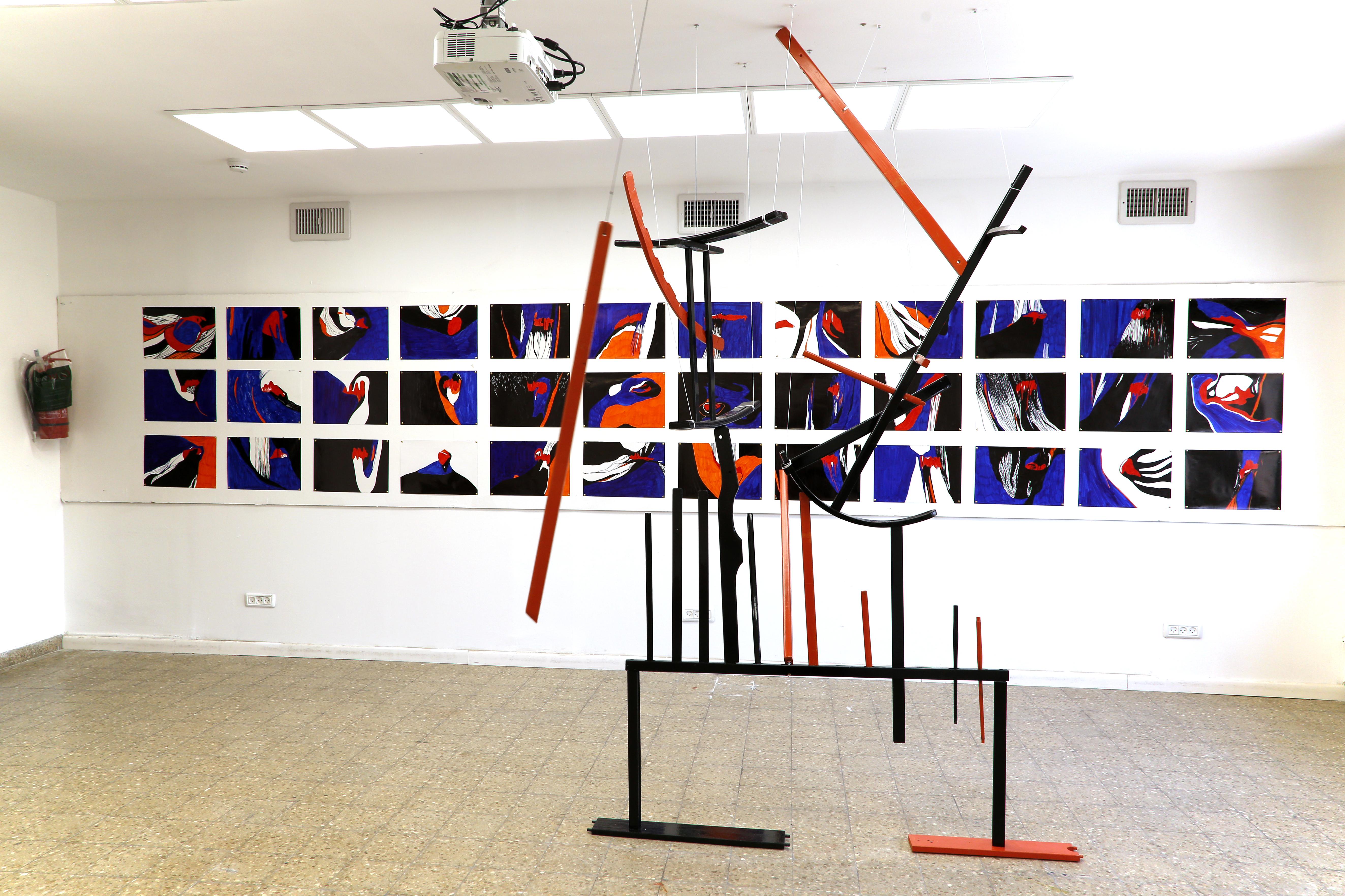
A piece by Miriam Monk, a second year student in the joint Oman-Bezalel program for haredi women, submitted as a final project at the end of the school year. (Photo courtesy the Oman School of Higher Education for the Arts)

Unlike most Haredim, Biton did not go through the community’s educational system and therefore ended up with experiences atypical of ultra-Orthodox women.

“You are inspired and want to express what you’ve experienced. The fact my artwork is being displayed during Design Week is already an achievement. Opportunities for Haredi artists to show their work are already very limited,” Cohen said. “It makes it more interesting to consider that there aren’t enough young, female artists within the Haredi community.”

Bar Mayer is another female artist who grew up within the Haredi community, but left it behind in later years. Her display at Design Week features a large portrait of her family tree.

“The work is the first I’ve done to reconnect with my family after many years of distance,” Mayer told The Media Line. The decision to make a fresh start 19 years ago meant a formal break with her ultra-Orthodox community.

A quick glance at her art reveals signs of discord. Almost half of the family members presented in the tree were either absent in the space assigned for a portrait—which was often substituted by colored papers—or they appeared with their backs to the camera. Some members wore traditional Orthodox garb such as the black fedora and suit, although some did appear in modern clothing.
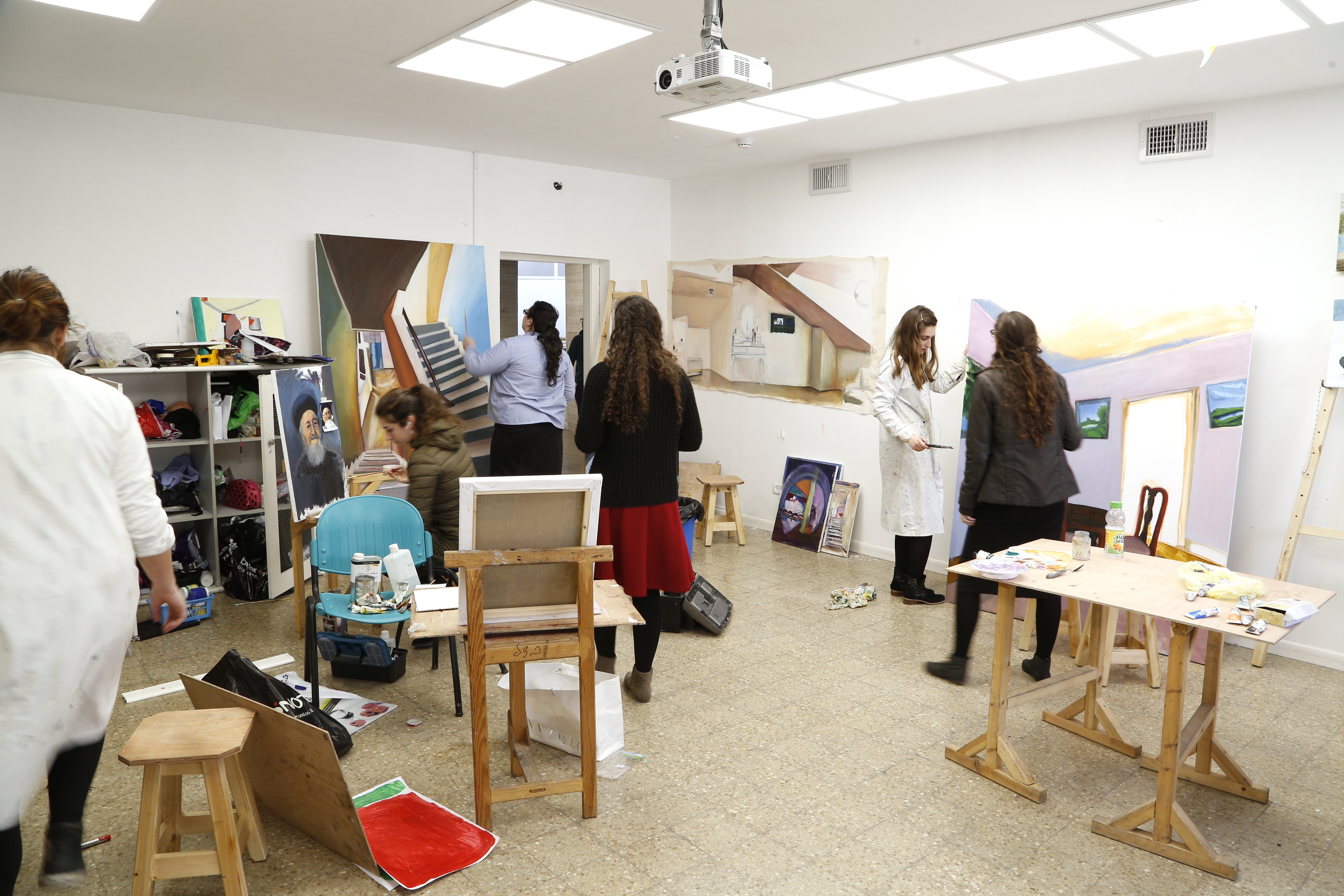
Second year students in the joint Oman-Bezalel program in their drawing studio. (Photo courtesy the Oman School of Higher Education for the Arts)

“Some of them didn’t understand why I was reconnecting with the community. Showing up with my camera was very invasive in a way. I don’t expect them to get me, because art is very marginal in the Orthodox world,” Cohen elaborated.

For artists in the Haredi community or closely linked to it, participating in shows can be very a thorny affair, especially if they take place on the Sabbath—the Jewish day of rest—or involve an international audience.

“This type of exhibition shows the diversity of the Israeli art world,” Cohen concluded. “It’s much more authentic and an opportunity to experience a broader range of Israeli art. I see the exhibition as a bridge.”

In addition to the Design Week exhibition allowing them to experiment with their artistry, both Biton and Mayer emphasized that the event has motivated them to reconnect with their Haredi heritage.


Read More

TRENDING

OPEC and energy stocks in the UAE – insight from eToro

Energy equities are responding unevenly to the evolving landscape. Companies with direct exposure to UAE production growth and infrastructure are benefiting from increased activity expectations, while global oil majors face a more mixed outlook.

10 Surprising AC Water Uses Cities Are Ignoring

All air conditioners release water. That's Physics. Cities like Los Angeles pour billions of water down the drain every year. And while home owners who are savvy to water reuse are finding ways to use AC water in the garden (here are 5 ways to use air con water at home), or in art studios (it's basically free distilled water), cities could save water in meaningful ways by using creative ideas. These are solutions you can send to urban planners and those running smart city accelerator programs. Pick one of them and you might win the grant! 

Hormuz 2026 Conflict Poses an Energy and Food Security Dilemma in a Warming World

As tensions rise in one of the world’s most critical maritime chokepoints, the ripple effects go far beyond oil—touching food systems, climate pressures, and regional stability

How does Neuralink work?

Current goals are to treat neurological disease like Parkinson’s and restore autonomy to people with severe physical limitations by controlling exoskeletons and prosthetics. There’s also huge potential to improve cognitive abilities such as memory, attention, and languages.

Street Vegan in Sri Thanu is a must-stop family lunch spot on Koh Phangan, Thailand

If you’re anywhere near Sri Thanu on Koh Phangan, Thailand, around the yoga centers: Zen Beach, Haad Yao, or Salad Beach—make time for Street Vegan. It's vegan and so satisfying that one meal might convince you that eating plant-based is not a compromise. I suggest for any vegan restaurant owner or chef to come to this modestly-priced venue to learn from a master.

From Pilot Plant to Global Stage: How Aduro Clean Technologies’ 2026 Expansion Signals a Turning Point for Chemical Recycling Investors Like Yazan Al Homsi

The company's Next Generation Process (NGP) Pilot Plant in London, Ontario, has officially moved into initial operating campaigns, generating the kind of structured, repeatable data that separates laboratory promise from commercial viability.

Nobul’s Regan McGee on Shareholder Value: “Complacency Is the Silent Killer” 

Why the governance framework designed to protect shareholders so...

Should You Invest in the Private Market?

startustartup Unlike public stock exchanges, which offer daily trading, strict...

How to build a 100-year-company

Kongō Gumi is a Japanese construction company, purportedly founded in 578 A.D., making it the world's oldest documented company. What can we learn about building sustainable businesses from them?

How AI Helps SaaS Companies Reduce Repetitive Customer Support Work

SaaS products are designed for large numbers of users with different levels of experience, and also in renewable energy.

Pulling Water from the Air

Faced with water shortage in Amman, Laurie digs up...

Turning Your Energy Consultancy into an LLC: 4 Legal Steps for Founders in Texas

If you are starting a renewable energy business in Texas, learn how to start an LLC by the books.

Tracking the Impacts of a Hydroelectric Dam Along the Tigris River

For the next two months, I'll be taking a break from my usual Green Prophet posts to report on a transnational environmental issue: the Ilısu Dam currently under construction in Turkey, and the ways it will transform life along the Tigris River.

Popular Categories