
The Crawford Hotel in Denver is the bees knees

Denver Union Station, July 9, 2014. Photo by Ellen Jaskol

I had 4 days in Denver for work mainly, but some fun too, and I wanted to experience the pulse of the city. I strive for authentic experiences in every new city I visit and while AirBnB can be a great option to meet locals, sometimes you want your privacy and not risk the unknowns by staying at another’s private house. What is it that makes any city magical? What are its people made from? Some of these things you can only feel.

It was my first time in Denver after being in Aspen for a week and I wanted to get to the pulse of the city. I found that The Crawford Hotel built out of the city’s old Union Station is the best way to stay in a hotel, yet feel part of the city.
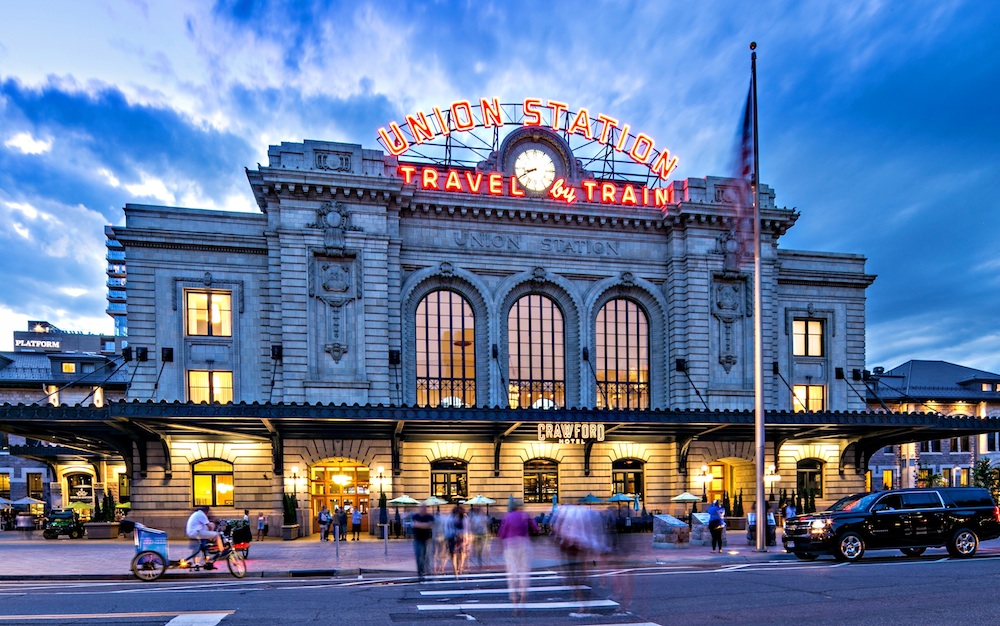
A short half hour train ride from the airport, The Crawford is in the center of it all. But it’s in no way typical, presenting itself as a boutique hotel, with rare corners, unique art and staircases, and people all around you. Because let’s face it, how many times have you been in a hotel in any-city and feel that you are anywhere and nowhere? Not The Crawford.

Get off the train at the end of the line to Denver and in 20 steps you are walking through the front door of the old station. Walk to the left, past a cafe and old tables and benches, and you reach the “lobby” a small outpost that modestly shields the staff from the bustle of a revived old train station, now a cultural hub connecting people from all walks of life, locals and tourists, to local beer, local coffee and local merchandise.

I was drawn to a few things. First was the beehive that the hotel keeps on the roof. It says something about management, about their values, that they would invest time in keeping bees. The hotel gave us a personal tour, along with showing us the inside of the roof and the large clock, and we loved every second of it.

John-Mark, the operations director for the hotel told me that “bees are vegan lovers who love to cuddle in the winter,” and that getting stung is a “cosmic inevitability” when you work with them. I felt at home in body and spirit.

I also really loved that the lobby of the hotel is a meeting space for all kinds of people. Newcomers like me, city folk coming to grab a bite at a favorite and long-lined diner (order reservation a day in advance at least); we met rich folk, homeless folk, and in general just a good healthy vibe. Hearts connected. But it’s not too busy, not too quiet.

I also appreciated all the small things in the loft room I stayed in: the coffee machine, the chocolate, the slippers and robe brought out at night, and all the shampoos and creams in the shower and bathroom. Everything smelled fresh, not synthetic, unique but not wild, natural and refreshing.

When it comes to getting around, the hotel offers an electric car shuttle within a 2-mile radius, but anything I wanted to do, like dine at Kimbal Musk’s The Kitchen restaurant, was just a short and happy walk away. With great weather outside, street music and festivals hitting the city when I was there, like the Little People of America, Denver has a feeling of a new city becoming something great, still defining itself. The Crawford fits perfectly into this impression or vision, offering you a sweet taste and gateway into that newness.

The hotel declares: “Our luxury Denver hotel accommodations are designed to give guests everything they need and nothing they don’t.”

I agree!

::The Crawford


Karin Kloosterman
Karin Kloostermanhttp://www.greenprophet.com
Karin Kloosterman is an award-winning journalist, innovation strategist, and founder of Green Prophet, one of the Middle East’s pioneering sustainability platforms. She has ranked in the Top 10 of Verizon innovation competitions, participated in NASA-linked challenges, and spoken worldwide on climate, food security, and future resilience. With an IoT technology patent, features in Canada’s National Post, and leadership inside teams building next-generation agricultural and planetary systems — including Mars-farming concepts — Karin operates at the intersection of storytelling, science, and systems change. She doesn’t report on the future – she helps design it. Reach out directly to [email protected]

Read More

TRENDING

How Responsible Tourism Could Help Protect the World’s Last Wild Places

From Antarctica and South Georgia to the Galápagos and Thailand, fragile destinations are finding ways to manage tourism without shutting visitors out. Visitor caps, conservation fees, biosecurity rules and controlled access can reduce environmental damage while helping fund the protection of wild places.

How Slow Travel Is Changing the Way We Explore

From trekking fees in Nepal and wildlife conservancies in Kenya to visitor limits in Patagonia and strict Arctic rules in Svalbard, responsible adventure travel can help fund conservation, protect habitats, and create sustainable income for local communities.

How Responsible Adventure Travel Can Protect the World’s Wild Places

From trekking fees in Nepal and wildlife conservancies in Kenya to visitor limits in Patagonia and strict Arctic rules in Svalbard, responsible adventure travel can help fund conservation, protect habitats, and create sustainable income for local communities.

Here is how Europe is still buying Russian gas

Greek-linked shipping vessels transported an estimated €2.35 billion worth of Russian Arctic liquefied natural gas to European ports during the first seven months of 2026, according to new analysis from Urgewald, a Germany-based environmental and human rights organization that investigates the financial institutions and companies supporting fossil fuel and other environmentally damaging industries.

Ancient Jewish New Year for Animals revived with global campaign against factory farming

Jewish Vegan Life has launched a global campaign celebrating the New Year for Animals, with synchronized events in Washington, D.C., Los Angeles, Pittsburgh, Montreal and Jerusalem, alongside an international livestream on August 9 featuring partners including Mercy for Animals, The Good Food Institute and Freedom Farm Animal Sanctuary.

The Essential Guide To Sustainability in Project Management

Sustainability is an approach where businesses and individuals balance the environmental, social, and economic aspects of a project such that current and future stakeholders are not overburdened with the impacts of the project in future.

Yerukim Forms a New Green Economy Where the Money is Really Green

The Yerukim members who pick up the recyclables get to keep the monetary reward, the public earns "green" bills that can be used in shops, and business owners get to be associated with environmentalism.

Choosing Riyadh over Dubai? What Investors Should Know

Saudi Arabia is deploying capital at unmatched scale to catalyze tourism and advanced industry while rewiring its power-and-water backbone. The investable frontier is widening—especially in renewables, grid storage, water efficiency/desal retrofits, and hospitality operating platforms. Prudent investors will insist on phased delivery, enforceable KPIs (energy, water, biodiversity), and RHQ/zone compliance—while pricing political-economy and reputational risks alongside growth upside.

Sell your cooking oil for biodiesel money

Want to make money on old french fry oil? Sell it.

Qatar Alternative Energy Summit Pairs Investors And Innovators

Alternative energy investors and innovators can meet n' greet in Doha, Qatar March 16 and 17.

Here’s How To Implement The Four Pillars Of Employee Engagement

If you throw a party for your work team and they are vegans, don't make it a barbecue. Know the sustainability values of your team to boost moral and retain good people.

Locals From Rishon Fight IKEA

Big Box stores are a pretty new concept in Israel, and thank God that not every Israeli city wants them in their backyard. A word from someone who has see the beautiful farmland around her hometown Newmarket, Ontario stripped and converted into vulgar strip malls of big box shops: they have no place in a healthy and sustainable town or city.

The Jewish National Fund Meets An Inconvenient Truth

According to the JNF, it has transformed thousands of acres of barren land into green forests in Israel. They state that each person emits about 23 tons of carbon per year, estimating that each tree planted can absorb one ton of carbon in its lifetime. That's a whole lot of trees you'd need to be planting. Could so many fit in Israel?

Popular Categories