
World’s oldest windmills may stop in Nashtifan, Iran

Windmill apprentices wanted: Click-clack…click-clack, click-clack the rhythm echoes the heartbeat of the Persian desert wind. For more than one thousand years the people of Nashtifan, in northeastern Iran have heard this sound as they harnessed the “storm’s sting” wind that gave their village its name.
[youtube https://www.youtube.com/watch?v=3qqifEdqf5g]
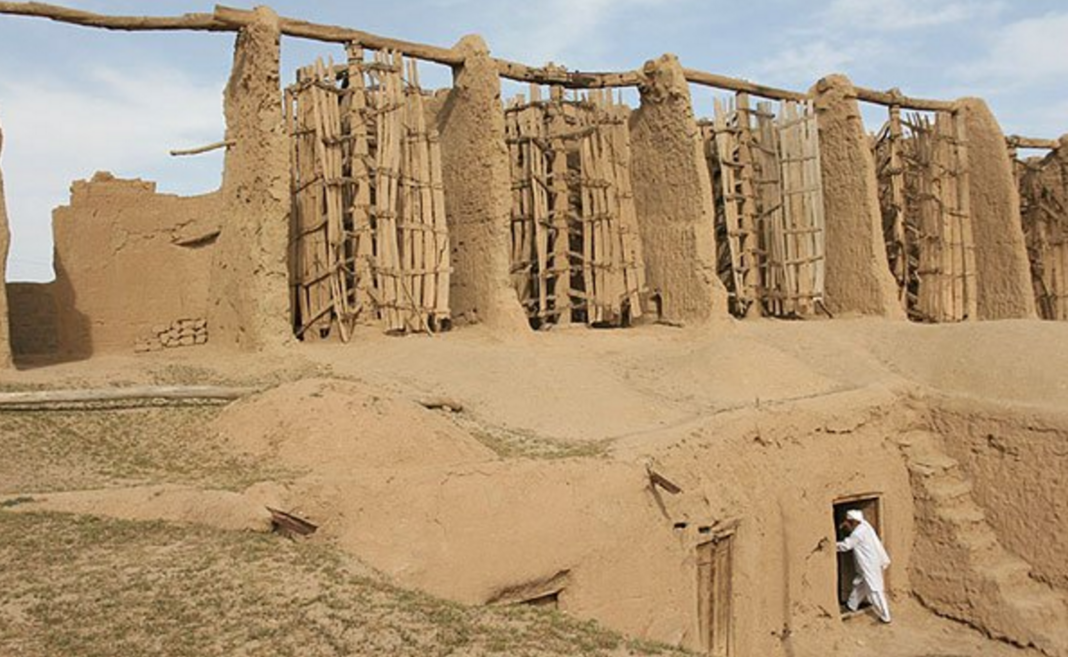
There are about 30 windmills in the desert near this sand-colored village in the Razavi Khorasan Province of northeastern Iran. Their wooden blades rotate on a vertical axis between high walls of red clay and straw. The 50 to 60 foot high machines make a familiar clatter, like a freight train on uneven track, a blend of urban industrial sounds and the natural whispers of wind in the desert. They serve the same purpose as the more familiar Dutch windmills, they turn a grindstone to turn grain into flour.

Nashtifan or nashtifun windmills in Iran, world's oldest windmills

But this relic of man’s first attempt to harness the wind for this purpose is a distant ancestor. It is thought to date back to this part of Persia sometime between 500 to 900 AD. One of the earliest records is the story of Pīrūz Nahāvandi who designed windmills and after complaining to Calif Umar of a high tax charged by his master, he promised to build a windmill for Umar, “By God, I will build this mill of which the world will talk.”

Nishatfun windmills in Iran

The world did talk of these mills. It wasn’t long before windmills spread from Persia into parts of Europe and Asia where they evolved into the more familiar horizontal axis design we see in everything from the wooden windmills that Don Quixote fought in La Mancha Spain to the 200 megawatts of offshore wind that Don Trump fought at his golf resort in Scotland.

There is a good reason for this design change. The flat vertical boards of the Nashtifan windmills are pushed by the wind on one side and unlike designs based on the Bernoulli principle, they can never move faster than the wind and they fight against the wind on the upwind side.

The Nashtifan windmills are neither modern nor efficient, but there is no shortage of wind in this part of Iran. So the mills were maintained and used by local people over centuries as an important part of their culture and history. Mohammad Etebari is the most recent keeper of the windmills.

But unfortunately he has not yet identified an apprentice to take over this centuries old tradition as he grows older. Watch the video and if you know any young person who lives near Nashtifan, ask if they will might take up this long tradition and continue this rhythmic sound in the desert.

Brian Nitz
Brian Nitzhttp://www.greenprophet.com
Brian remembers when a single tear dredged up a nation's guilt. The tear belonged to an Italian-American actor known as Iron-Eyes Cody, the guilt was displaced from centuries of Native American mistreatment and redirected into a new environmental awareness. A 10-year-old Brian wondered, 'What are they... No, what are we doing to this country?' From a family of engineers, farmers and tinkerers Brian's father was a physics teacher. He remembers the day his father drove up to watch a coal power plant's new scrubbers turn smoke from dirty grey-back to steamy white. Surely technology would solve every problem. But then he noticed that breathing was difficult when the wind blew a certain way. While sailing, he often saw a yellow-brown line on the horizon. The stars were beginning to disappear. Gas mileage peaked when Reagan was still president. Solar panels installed in the 1970s were torn from roofs as they were no longer cost-effective to maintain. Racism, public policy and low oil prices transformed suburban life and cities began to sprawl out and absorb farmland. Brian only began to understand the root causes of "doughnut cities" when he moved to Ireland in 2001 and watched history repeat itself. Brian doesn't think environmentalism is 'rocket science', but understanding how to apply it within a society requires wisdom and education. In his travels through Europe, North America, Asia and the Middle East, Brian has learned that great ideas come from everywhere and that sharing mistakes is just as important as sharing ideas.

Read More

1 COMMENT

Comments are closed.

TRENDING

24 7 renewable energy: how solar, wind, batteries and AI SaaS replace fossil fuels

A new report from the International Renewable Energy Agency based in Abu Dhabi makes something clear that many in the industry already suspected. When solar and wind are paired with battery storage, they can deliver reliable, round the clock electricity at costs that compete with, and often beat, fossil fuels.

SunZia comes online and America’s 11B, and largest renewable project begins wind power

The impact is already being felt. California has broken its wind generation record multiple times in recent weeks as SunZia begins feeding electricity into the grid. It’s a glimpse of what a renewable-powered future could look like when large-scale infrastructure finally comes online. Can we start saying goodbye to Saudi Aramco and Arabian Gulf oil? 

Renewables hit 5,149 GW in 2025 as the world edges away from oil shocks and fossil-fueled conflict

“In the midst of uncertain time, renewable energy remains consistent and steadfast in its expansion,” said Francesco La Camera, IRENA’s Director-General. “A more decentralised energy system, with a growing share of renewables and more market players, is structurally more resilient.”

Should You Invest in the Private Market?

startustartup Unlike public stock exchanges, which offer daily trading, strict...

Batteries from salt? New grid projects suggest the idea is becoming real

Peak Energy makes storage batteries from salt making us one step closer to cleaner, endless energy from the wind and the sun

How to quiet noise from construction in your office

Streets need to be resurfaced in New York but the humming and grinding noise is unsettling. Noise is environmental pollution. 

EarthX and a blueprint for sustainable investing

Trammell S. Crow, a Dallas-based businessman and father of four, is focusing his efforts on impact investing, and media that focuses on saving the planet through EarthX.

Mining Afghanistan’s Mineral Discoveries Similar to Avatar

Now that American forces in Afghanistan are commemorating the longest period of any war that America has been involved in, including the 1965-73 Vietnam War, the recent discoveries of large and extremely valuable mineral and metal deposits may finally bring to light a reason to continue the presence of US fighting forces in this war torn and backward country.

From Pilot Plant to Global Stage: How Aduro Clean Technologies’ 2026 Expansion Signals a Turning Point for Chemical Recycling Investors Like Yazan Al Homsi

The company's Next Generation Process (NGP) Pilot Plant in London, Ontario, has officially moved into initial operating campaigns, generating the kind of structured, repeatable data that separates laboratory promise from commercial viability.

Nobul’s Regan McGee on Shareholder Value: “Complacency Is the Silent Killer” 

Why the governance framework designed to protect shareholders so...

Should You Invest in the Private Market?

startustartup Unlike public stock exchanges, which offer daily trading, strict...

How to build a 100-year-company

Kongō Gumi is a Japanese construction company, purportedly founded in 578 A.D., making it the world's oldest documented company. What can we learn about building sustainable businesses from them?

How AI Helps SaaS Companies Reduce Repetitive Customer Support Work

SaaS products are designed for large numbers of users with different levels of experience, and also in renewable energy.

Popular Categories