
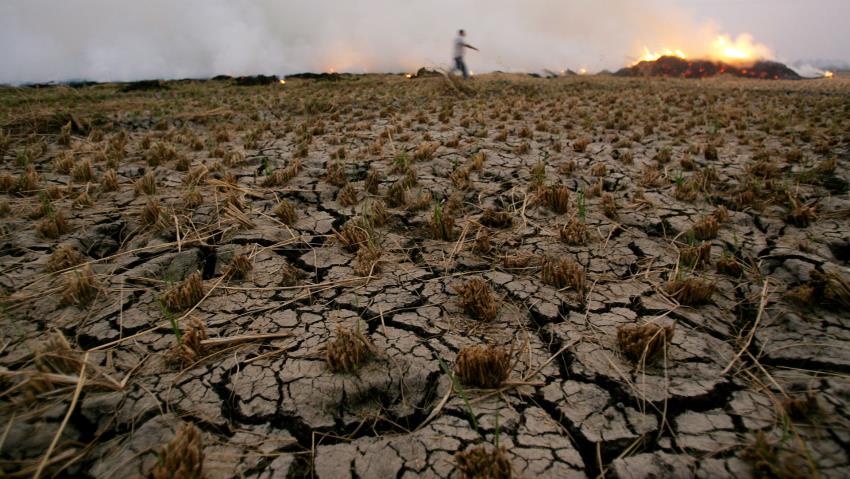


A recent study released by the National Aeronautics and Space Administration (NASA) concludes that the current drought that began in 1998 in the eastern Mediterranean Levant – which includes Cyprus, Israel, Jordan, Lebanon, Palestine, Syria, and Turkey – is the region’s worst dry spell since 1100 C.E.
NASA scientists reconstructed our regional drought history by studying records of tree rings, from dead and live specimens, across several Mediterranean countries to determine patterns of dry and wet years over a 900-year time span. Tree rings are good indicators of precipitation since dry years cause thin rings while thick rings show when water was plentiful. They concluded that the years between 1998 and 2012 were drier than any other period, and that the drought was likely caused by humans.
Ben Cook, lead author and climate scientist at NASA’s Goddard Institute for Space Studies and the Lamont Doherty Earth Observatory at Columbia University in New York City, said the range of regional weather events has varied widely over the last millennium, but the past twenty years stand out as extreme, falling outside the range of natural variability.
They also discovered that drought isn’t localized, meaning that if one region is damaged by drought, those conditions are likely to exist throughout the Mediterranean basin. Kevin Anchukaitis, co-author and climate scientist at the University of Arizona in Tucson, said in a statement on the NASA climate change website, “It’s not necessarily possible to rely on finding better climate conditions in one region than another, so you have the potential for large-scale disruption of food systems as well as potential conflict over water resources.”
Large-scale disruption of food systems as well as potential conflict over water resources.
Is anyone listening? Cook stated that the Levant region drought lasting from 1998 to 2012 was about 50% drier than the driest period in the past 500 years, and 10 to 20% drier than the worst drought of the past 900 years.
Last year, as reported by CBC News, researchers at Columbia University and the University of California Santa Barbara found that drought triggered a collapse in agriculture in Syria and the migration of 1.5 million farmers to the cities, straining resources. The water shortage was one of several contributing factors that had worsened the situation in Syria in the lead-up to the outbreak of that country’s devastating civil war in 2011.
Researchers also discovered patterns that are helping to identify underlying causes for drought, which will allow scientists to differentiate droughts made worse by human-induced global warming. Cook said the research – which is part of NASA’s ongoing work to improve the computer models that simulate climate change – supported other studies indicating human causes of extreme climate events.
The North Atlantic Oscillation and the East Atlantic Pattern are two major airflow circulation patterns influence when droughts occur in the Mediterranean, patterns which describe how winds and weather tend to behave given certain ocean conditions. They have periodic phases that tend to steer rainstorms away from the Mediterranean and bring in dryer, warmer air. The resulting lack of rain and higher temperatures, which increase evaporation from soils, lead to droughts.
“The Mediterranean is one of the areas that is unanimously projected [in climate models] as going to dry in the future [due to man-made climate change],” said Yochanan Kushnir, a climate scientist at Lamont Doherty Earth Observatory, who was not involved in the research. “This paper shows that the behavior during this recent drought period is different than what we see in the rest of the record,” he said, which means that the Levant region may already be feeling the affects of human-induced warming of the planet.
Historical documents recording droughts that occurred between the years 1100 and 2012 corroborate the findings of the tree ring research. Michael Mann, director of the Earth System Science Center at Penn State University, said the NASA study is one of several worrying reports about unprecedented climate conditions.
Meanwhile, drought continues across much of the Middle East. You can make a difference. Search Green Prophet archives for some immediate actions you can take, now. Drop a brick in your toilet tank. Try your hand at a hydroponic vegetable patch, using new green-tech to boost efficiency, such as the operating system flux. Take shorter showers.
The full report is available at the Journal of Geophysical Research-Atmospheres.



[…] это утверждается в выпущенном недавно исследовании, которое провело […]
[…] http://www.greenprophet.com/2016/05/nasa-calls-middle-east-drought-worst-in-900-years/ […]