Holy sh*t! Mummies float in Egyptian sewage!

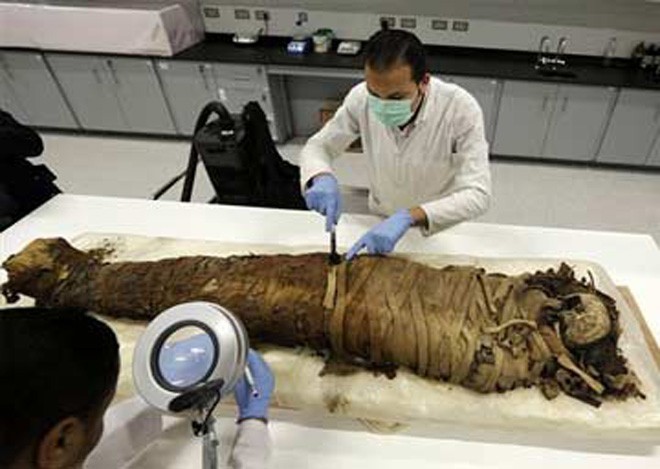
Egyptian-mummies-found-in-sewageEgypt’s Ministry of Antiquities reported a new discovery of several Greco-Roman era mummies near Minya in northeastern Egypt, 250 kilometers south of Cairo. The new discoveries occurred when police found two wooden sarcophagi floating along a village waterway in a pool of raw sewage.

Polluted water is a persistent problem for the country’s archaeological treasures.  But it’s a more serious challenge for millions of Egyptians, alive and long dead.
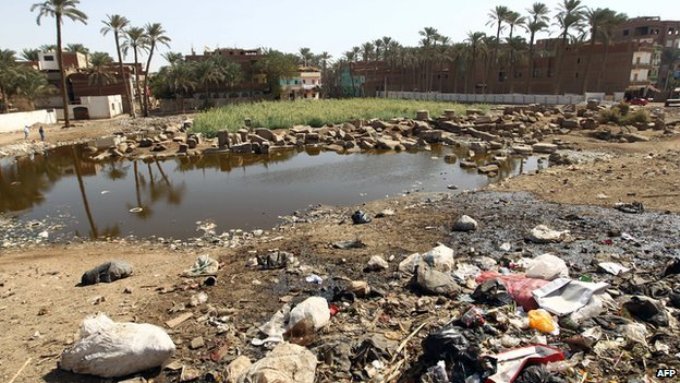
Mummies found in sewageYoussef Khalifa, the head of the Antiquities Sector, told CairoScene magazine that it’s likely the mummies were unearthed by villagers engaged in illegal excavations, then discarded in the cesspool (image above) to cover their tracks. Egypt imposes tight restrictions on excavations; in October 2014 authorities arrested seven people after an illegal dig in Giza uncovered the remains of an ancient temple. Neither risk of arrest nor filthy muck deterred these thieves.

Thick layers of linen swaddled the mummies, whose conditions were radically deteriorated by the surrounding waste.  Only a few human remains could be identified, according to the ministry’s report.

Two sarcophagi colorfully painted with the images of women’s faces date back to around 332 BC to 395 AD, but the Ministry of Antiquities says little is left of the bodies. “Although the coffins were decorated with colorful designs, they were missing any ancient Egyptian inscriptions or hieroglyphics,” the ministry said in a statement. A third, empty sarcophagus was also found.

Restoration has been only mildly successful, according to Egypt’s Daily News.  Eventually the mummies and sarcophagi will be displayed at Minya’s Hermopolis Museum.

Mummies are commonly found across Egypt.  We recently reported on archaeologists from Utah’s Brigham Young University now digging in a cemetery estimated to hold over a million ancient Egyptians. It’s disturbing that villagers would drop these latest finds into a cesspool, despite understanding their historical significance. But urban Egypt’s plastic pollution and open sewage pools are perhaps more unsettling.

Read More

TRENDING

Iron age folks made tools from dead peoples’ bones

Scientists have uncovered evidence of an Iron Age funerary tradition involving the deliberate removal of human brains and the fashioning of long bones into sharp tools.

Most of the world’s marine protected areas are polluted by sewage

Research from the Wildlife Conservation Society (WCS) and the University of Queensland, published in Ocean & Coastal Management, found that nearly three out of four marine protected areas (MPAs) worldwide are exposed to sewage pollution.

Egypt building nuclear power

Egypt is building a nuclear energy plant, expected to go online in 2026 when countries like Germany have shut down all its domestic nuclear power. The El Dabaa Nuclear Power Plant is the first nuclear power plant planned for Egypt and will be located at El Dabaa, Matrouh Governorate, Egypt, about 320 kilometers northwest of Cairo. 

Ancient Clay Jug with Camel Art Unearthed in Israel’s Yatir Forest

The striking red-painted jug was found in a cave that had once been an underground olive press before being repurposed as a dwelling. Researchers believe the cave was in use during the Abbasid period (9th-10th centuries CE), when camels dominated trade routes, helping to move goods across vast distances.

Why do mummies smell so sweet?

Researchers are investigating whether the smell of an Egyptian mummy could enable them to discover what materials were used to preserve the body without disturbing it. They extracted air from the sarcophagi of nine mummies and asked expert smellers to rate the scents for contemporary odour qualities such as woodiness and sweetness.

Yerukim Forms a New Green Economy Where the Money is Really Green

The Yerukim members who pick up the recyclables get to keep the monetary reward, the public earns "green" bills that can be used in shops, and business owners get to be associated with environmentalism.

Choosing Riyadh over Dubai? What Investors Should Know

Saudi Arabia is deploying capital at unmatched scale to catalyze tourism and advanced industry while rewiring its power-and-water backbone. The investable frontier is widening—especially in renewables, grid storage, water efficiency/desal retrofits, and hospitality operating platforms. Prudent investors will insist on phased delivery, enforceable KPIs (energy, water, biodiversity), and RHQ/zone compliance—while pricing political-economy and reputational risks alongside growth upside.

Sell your cooking oil for biodiesel money

Want to make money on old french fry oil? Sell it.

Qatar Alternative Energy Summit Pairs Investors And Innovators

Alternative energy investors and innovators can meet n' greet in Doha, Qatar March 16 and 17.

Here’s How To Implement The Four Pillars Of Employee Engagement

If you throw a party for your work team and they are vegans, don't make it a barbecue. Know the sustainability values of your team to boost moral and retain good people.

Locals From Rishon Fight IKEA

Big Box stores are a pretty new concept in Israel, and thank God that not every Israeli city wants them in their backyard. A word from someone who has see the beautiful farmland around her hometown Newmarket, Ontario stripped and converted into vulgar strip malls of big box shops: they have no place in a healthy and sustainable town or city.

The Jewish National Fund Meets An Inconvenient Truth

According to the JNF, it has transformed thousands of acres of barren land into green forests in Israel. They state that each person emits about 23 tons of carbon per year, estimating that each tree planted can absorb one ton of carbon in its lifetime. That's a whole lot of trees you'd need to be planting. Could so many fit in Israel?

How to quiet noise from construction in your office

Streets need to be resurfaced in New York but the humming and grinding noise is unsettling. Noise is environmental pollution. 

Popular Categories