The best reason for growing rhubarb that we’ve ever heard


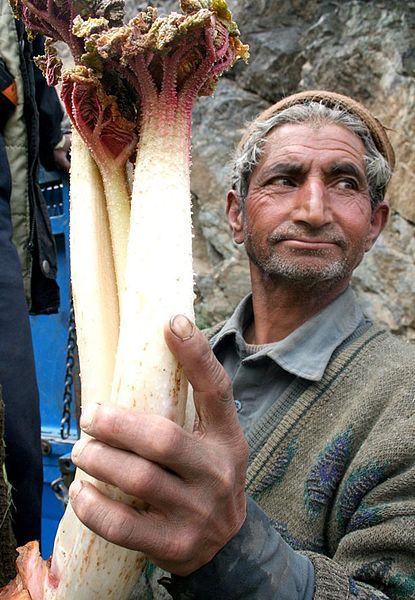
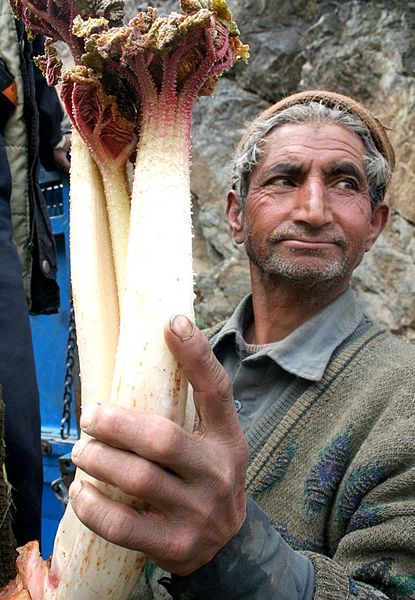
iranian_man_with_rhubarb

While we contemplate whether GMO engineers can free our world from its glaring lack of light emitting houseplants and radiant pigs, we overlook far more amazing secrets of nature which make our best bio-science minds look like rank amateurs. The humble rhubarb plant is one such example.

Harvard scientists recently discovered a secret lurking beneath the oversize leaves of this bittersweet plant. This secret may lead to more widespread and efficient use of solar energy.

Bionic Rhubarb

The Six-Million Dollar man, the Bionic Woman and Robocop redefined the word bionic to mean a biological/robotics crossbreed. But long before the advent of bad 1970s television shows and Arnold Schwarzenegger movies, the word bionic referred to a technique of learning from nature.

Bionics meant the study of nature and the application of what we learn to meet our needs. So, for example, people studied the nanoscale engineering which gives lotus leaves their self-cleaning properties. From this they developed replicas of this design. Velcro is another example. Swiss engineer George de Mestral noticed how tenaciously the seeds of wild burdock stuck to his clothes and his dog’s fur. He studied the burrs and applied their shape to his invention. So what can we learn from rhubarb?

Amazing Rhubarb
Rhubarb is an amazing plant. Some varieties such as the desert rhubarb (Rheum palaestinum) are able to irrigate themselves.

Their enormous 1/3 square meter leaves collecting more than four liters of water each year, sixteen times what similar-sized plants can collect in their Negev desert environment where as little as 75mm of rain falls each year. These amazing plants literally water themselves!!!

Other rhubarb varieties such as Rheum rhabarbarum, are able to survive long cold dark winters in northern climates. They begin producing sugar in early spring thanks to the photosynthesis generated in its enormous dark-green leaves. The thick pinkish-red stems of this large-leafed plant are used in European and American cakes and pies.

You won’t find corned-beef and cabbage served in authentic Irish homes during Saint Patrick’s day holiday but the powerful smell of rhubarb and mackerel is likely to waft from many Irish kitchens before, during and after this upcoming holiday.

Rhubarb’s Energy Secret
But now scientists at the Harvard School of Engineering and Applied Sciences (SEAS) have extended the use of rhubarb beyond cakes and pies and smelly fish meals. They discovered ways in which rhubarb an used in solar energy generation.

Just imagine giant rhubarb leaves adorning our electric cars and solar homes. Imagine that at night they are illuminated by the glare of genetically modified flying pigs!

Actually, that isn’t how rhubarb can be used. The Harvard team including Michael J. Aziz, Tracy Sykes, Roy G. Gordon, Thomas Dudley Cabot and Alán Aspuru-Guzik was searching for better and cheaper chemicals to use in flow batteries.

What is a Flow battery?
The batteries used in portable electronics and cars typically use a liquid or semi-liquid (so-called “dry” cell) electrolyte separating two dissimilar metal electrodes. The electrochemical reaction between the metals can cause an ion flow within the electrolyte which is balanced by an electrical current flow outside of the battery.

Typically the electrolyte isn’t used up as the battery discharges but one or both of the electrodes are chemically changed until the battery no longer works. If you want a high capacity solid electrode battery, say for a photovoltaic utility, your only choice is to make it big and when it’s dead you have to figure out how to dispose of the thousands of tons of corroded electrode.

Flow battery capacity is limited only by the size of the tank holding the flowing electrode liquid. Flow batteries seem the perfect fit for the utility-sized batteries necessary to make photovoltaic solar energy a 24/7 energy choice. The problem is that the best existing flow batteries used vanadium, an exotic metal which costs almost $3000/kg.

The flow battery chemical the Harvard team discovered is an organic (carbon-containing) molecule known as a quinone which is very similar to the quinones found in rhubarb which by comparison to vandium, can be grown or purchased for well under $3000/kg.

It might not be as exciting as illuminated flying pigs but as someone much wiser than me once said, you can’t always get what you want, but if you try sometimes you just might find, you get what you need.

Photo of Iranian man with Rhubarb by Masoud Soleymani Sepehr via Wikipedia

Brian Nitz
Brian Nitzhttp://www.greenprophet.com
Brian remembers when a single tear dredged up a nation's guilt. The tear belonged to an Italian-American actor known as Iron-Eyes Cody, the guilt was displaced from centuries of Native American mistreatment and redirected into a new environmental awareness. A 10-year-old Brian wondered, 'What are they... No, what are we doing to this country?' From a family of engineers, farmers and tinkerers Brian's father was a physics teacher. He remembers the day his father drove up to watch a coal power plant's new scrubbers turn smoke from dirty grey-back to steamy white. Surely technology would solve every problem. But then he noticed that breathing was difficult when the wind blew a certain way. While sailing, he often saw a yellow-brown line on the horizon. The stars were beginning to disappear. Gas mileage peaked when Reagan was still president. Solar panels installed in the 1970s were torn from roofs as they were no longer cost-effective to maintain. Racism, public policy and low oil prices transformed suburban life and cities began to sprawl out and absorb farmland. Brian only began to understand the root causes of "doughnut cities" when he moved to Ireland in 2001 and watched history repeat itself. Brian doesn't think environmentalism is 'rocket science', but understanding how to apply it within a society requires wisdom and education. In his travels through Europe, North America, Asia and the Middle East, Brian has learned that great ideas come from everywhere and that sharing mistakes is just as important as sharing ideas.

Read More

TRENDING

Bricks and Minifigs, and the Future of Circular Play

A second-hand LEGO marketplace keeps plastic bricks circulating for years instead of ending up forgotten in basements or discarded in landfills. It gives children access to building materials at lower prices. It extends the lifespan of a product that was originally designed to last generations.

Barnacle glue could fix coral reefs, inspire new advances in building and medicine

Aalto University researchers create a protein-based adhesive inspired by barnacles and mussels that works underwater and could aid coral reef restoration.

Why wombats have cubed poop – with photos

Why is wombat poop cubed? Plus great photos.

Don’t Regret Your Host: Alternatives to SiteGround That Impress

Discover top alternatives to SiteGround that offer impressive features and performance. Make an informed choice for your hosting needs today!

How Termites and Ants Built the Tropics’ Best Soil

This is like discovering that the pyramids weren’t built by natural erosion, but by ancient engineers

Yerukim Forms a New Green Economy Where the Money is Really Green

The Yerukim members who pick up the recyclables get to keep the monetary reward, the public earns "green" bills that can be used in shops, and business owners get to be associated with environmentalism.

Choosing Riyadh over Dubai? What Investors Should Know

Saudi Arabia is deploying capital at unmatched scale to catalyze tourism and advanced industry while rewiring its power-and-water backbone. The investable frontier is widening—especially in renewables, grid storage, water efficiency/desal retrofits, and hospitality operating platforms. Prudent investors will insist on phased delivery, enforceable KPIs (energy, water, biodiversity), and RHQ/zone compliance—while pricing political-economy and reputational risks alongside growth upside.

Sell your cooking oil for biodiesel money

Want to make money on old french fry oil? Sell it.

Qatar Alternative Energy Summit Pairs Investors And Innovators

Alternative energy investors and innovators can meet n' greet in Doha, Qatar March 16 and 17.

Here’s How To Implement The Four Pillars Of Employee Engagement

If you throw a party for your work team and they are vegans, don't make it a barbecue. Know the sustainability values of your team to boost moral and retain good people.

Locals From Rishon Fight IKEA

Big Box stores are a pretty new concept in Israel, and thank God that not every Israeli city wants them in their backyard. A word from someone who has see the beautiful farmland around her hometown Newmarket, Ontario stripped and converted into vulgar strip malls of big box shops: they have no place in a healthy and sustainable town or city.

The Jewish National Fund Meets An Inconvenient Truth

According to the JNF, it has transformed thousands of acres of barren land into green forests in Israel. They state that each person emits about 23 tons of carbon per year, estimating that each tree planted can absorb one ton of carbon in its lifetime. That's a whole lot of trees you'd need to be planting. Could so many fit in Israel?

How to quiet noise from construction in your office

Streets need to be resurfaced in New York but the humming and grinding noise is unsettling. Noise is environmental pollution. 

Popular Categories