In Jordan and Israel There is a Desert Plant That Waters Itself

desert-rhubarb-israel-jordan-photo

A team of researchers from the University of Haifa have stumbled upon a rare desert plant living in Israel’s mountainous Negev desert, which can irrigate itself.

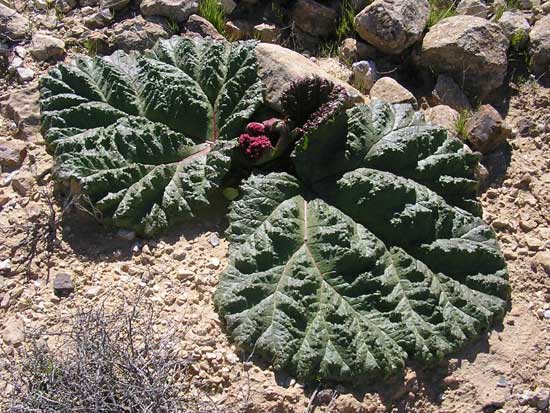
The plant, the desert rhubarb, Rheum palaestinum, was first classified by a local Israeli botanist about 70 years ago. It has adapted to harsh desert climates by developing specially designed leaves — broad and with grooves and channels — to funnel even the slightest bit of rainwater directly to its roots.

It is the only known plant of its kind in the world, and could teach science — and people — new ways for maximizing water distribution in agriculture, especially in extremely arid regions. Locals say it is found only in Israel and nearby Jordan.

ISRAEL21c asked one of the Israeli researchers, Prof. Simcha Lev-Yadun, a botanist, who recently measured the water intake capabilities of the desert rhubarb, if it could lead to new water-collecting devices (like the ones we’ve written about here — see the story on Tal-Ya Water) based on bio-mimicry.

“You are 2,000 years too late,” he says. “This same type of typography that we see on the plant’s 1/3 square meter surface was done on the scale of hundreds of meters, if not kilometres, by ancient people who lived in the Negev Desert until the first millennium CE. I am sure that people found this simple physical rule and exploited it,” he adds.

No leaves unturned

Aside from being a botanist, Lev-Yadun is also an archeologist, with a first and second degree in the field. He explains that Nabatean people living in the Negev Desert after the second Temple Period and the late Byzantine period, would pile stones in mounds that the local Arabs call “mounds for grapes”.

These stones were set up to funnel water down a hill for irrigation purposes, before the water “infiltrated the hill,” says Lev-Yadun, and resembled the surface of the rhubarb.

With his research partners Gadi Katzir and Gidi Ne’eman, also from the University of Haifa, Lev-Yadun ascertained that the reason the rare rhubarb flourishes in hostile areas in the desert, is because it can collect up to 16 times more water than other plants growing in the same region.

They findings were published recently in the journal Naturwissenschaften.

Characterized by large rosette leaves with deep grooves, Lev-Yadun — also an avid hobby photographer — says that the leaves when photographed up close starkly resemble the mountainous regions in which they grow.

Like rainwater through a valley

And the water on the leaves of the rhubarb travel off its surface, in much the same way that rainwater flows through the valleys and slopes of the mountains in the Negev Desert, but on a very different scale.

According to the recent study, the desert rhubarb can harvest 4.2 liters of water each year, with the largest of its kind collecting an astounding 43.8 liters. Compared to an average rainfall of 75 mm a year, the rhubarb has found a way to make the most of its limited environment.

Additional research into the mechanics of the plant finds that the plant not only funnels the water to its roots, but the water is able to penetrate 10 cm into the soil, 10 times deeper than if the rain landed by itself on the desert sand.

A tough waxy surface on the leaves, lends additional support in funneling the water to the roots where it is needed.

Can scientists take home a message from this plant and create the ultimate irrigation machine? Lev-Yadun has no designs on such an invention, but doesn’t rule out the possibility.

“It’s a rare plant. We can’t plant them by the billions and irrigate with them.” But, he adds: “theoretically one could do the same with plastic and collect the water. This is already done on a small scale here and there,” adds Lev-Yadun.

(This story was first published on ISRAEL21c – www.israel21c.org) [image via tiuli]

Karin Kloosterman
Karin Kloostermanhttp://www.greenprophet.com
Karin Kloosterman is an award-winning journalist, innovation strategist, and founder of Green Prophet, one of the Middle East’s pioneering sustainability platforms. She has ranked in the Top 10 of Verizon innovation competitions, participated in NASA-linked challenges, and spoken worldwide on climate, food security, and future resilience. With an IoT technology patent, features in Canada’s National Post, and leadership inside teams building next-generation agricultural and planetary systems — including Mars-farming concepts — Karin operates at the intersection of storytelling, science, and systems change. She doesn’t report on the future – she helps design it. Reach out directly to [email protected]

Read More

1 COMMENT
  1. By itself, our instinct to grow is totally irrational, so without thinking, scientists continue searching for new ways to feed the ever-growing human population. Unfortunately, planet Earth is NOT growing, but slowly shrinking with each volcano and earthquake. So, how many people can the Earth feed? If there is still time, we should peacefully reduce our human population with family planning education, and safely recycle 100% of our waste products and materials, before the Earth’s biosphere collapses around us.

TRENDING

Mona Khalil, Orange House Project founder, sea turtle protector killed in Lebanon

Mona Khalil spent decades protecting Lebanon's sea turtles and coastal ecosystems. Her death in the ongoing conflict between Israel and Hezbollah shines a light on a broader environmental tragedy unfolding across northern Israel and southern Lebanon. From damaged wetlands and disrupted bird migrations to threatened seed banks and endangered wildlife, the region's ecosystems are becoming casualties of a war with no clear end in sight.

Who Owns the Farm Robot? A State of Jefferson Startup Takes on Carbon Robotics

In California's self-proclaimed State of Jefferson, a small agricultural technology company is challenging the dominant laser-weeding business model. Laudando & Associates believes farmers should own and repair their AI-powered weeding tools rather than pay ongoing subscription fees. The approach has put the company on a collision course with industry leader Carbon Robotics, sparking a patent dispute that has pushed the Jefferson startup toward overseas markets while raising broader questions about ownership, right-to-repair, and the future of farm automation.

Regenerative Wool or Greenwashing? Zentera Responds to Critics

Zentera responds to questions about ZQ wool, animal welfare, regenerative farming, ethical fashion and the fallout from PETA's New Zealand investigation.

Dan Zaslavsky’s energy tower dream is rising again in Iran and China

The Energy Tower idea never made the leap from drawings and engineering studies to full-scale construction. But nearly two decades after most people stopped talking about it, the concept is quietly evolving in two unexpected places: China and Iran. The concept let dreamers dream and doers do - figuring out more pleasing designs and engineering.

A visit to Amirim, Israel’s first all-vegetarian village in the Galilee

Just 15 kilometers from Tzfat there is a moshav that was founded in the late 50s that was ideologically influenced by organic, vegetarian and vegan principles. My hostess at Ohn-Bar, the tzimmer where I stayed, explained that the people of Amirim were among the pioneers of Israel’s strong vegetarian movement.

Yerukim Forms a New Green Economy Where the Money is Really Green

The Yerukim members who pick up the recyclables get to keep the monetary reward, the public earns "green" bills that can be used in shops, and business owners get to be associated with environmentalism.

Choosing Riyadh over Dubai? What Investors Should Know

Saudi Arabia is deploying capital at unmatched scale to catalyze tourism and advanced industry while rewiring its power-and-water backbone. The investable frontier is widening—especially in renewables, grid storage, water efficiency/desal retrofits, and hospitality operating platforms. Prudent investors will insist on phased delivery, enforceable KPIs (energy, water, biodiversity), and RHQ/zone compliance—while pricing political-economy and reputational risks alongside growth upside.

Sell your cooking oil for biodiesel money

Want to make money on old french fry oil? Sell it.

Qatar Alternative Energy Summit Pairs Investors And Innovators

Alternative energy investors and innovators can meet n' greet in Doha, Qatar March 16 and 17.

Here’s How To Implement The Four Pillars Of Employee Engagement

If you throw a party for your work team and they are vegans, don't make it a barbecue. Know the sustainability values of your team to boost moral and retain good people.

Locals From Rishon Fight IKEA

Big Box stores are a pretty new concept in Israel, and thank God that not every Israeli city wants them in their backyard. A word from someone who has see the beautiful farmland around her hometown Newmarket, Ontario stripped and converted into vulgar strip malls of big box shops: they have no place in a healthy and sustainable town or city.

The Jewish National Fund Meets An Inconvenient Truth

According to the JNF, it has transformed thousands of acres of barren land into green forests in Israel. They state that each person emits about 23 tons of carbon per year, estimating that each tree planted can absorb one ton of carbon in its lifetime. That's a whole lot of trees you'd need to be planting. Could so many fit in Israel?

How to quiet noise from construction in your office

Streets need to be resurfaced in New York but the humming and grinding noise is unsettling. Noise is environmental pollution. 

Popular Categories