

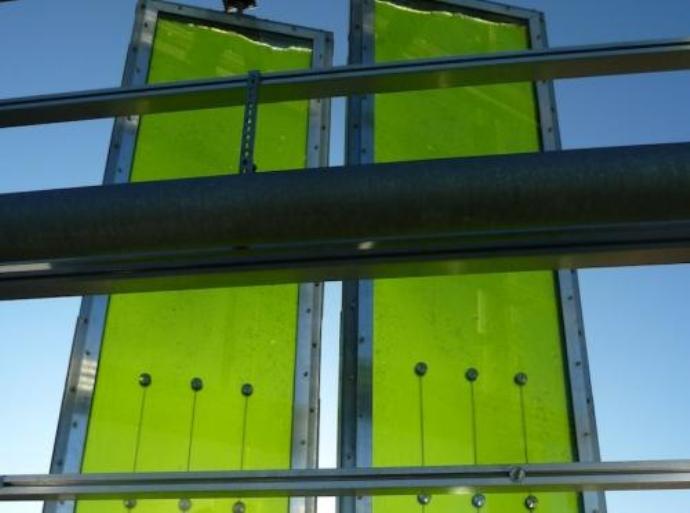
 A five-story apartment building in Hamburg, Germany gets its juice from its algae skin. It’s an example of the kind of architectural innovation that could readily transplant to the Middle East. So why is partnership between designers, investors and government largely absent in this region?
The continuing drought of global investment requires innovative approaches to project underwriting. The most successful strategies involve collectives of stakeholders each with a unique interest in a common project. Singularly, none would back the initiative, but in combination with others, sufficient momentum is created to realize the scheme. There’s power in unusual partnerships, but let’s get back to the building.
The Bio Intelligent Quotient House (BIQ) was designed by Arup, SSC Strategic Science Consultants and Splitterwerk Architects to demonstrate the use algae as an alternative to other renewables for heating and cooling large buildings. BIQ, which contains fifteen apartments, is the first building in the world to be powered exclusively by algae.
One hundred and twenty-nine algae filled tanks are suspended across the southeast and southwest sides of the building. The algae was harvested from the nearby Elbe River and placed inside thin rectangular cases. Each transparent tank was then attached to scaffolding around the building exterior.
The tanks turn mechanically to face the sun, similar to solar collector technology. An automated system also provides carbon dioxide and nutrients to the algae, which lives in a water solution inside each panel.
 The growing algae provides shade for the building and also works as a buffer for ambient noise. Excess heat that collects in the tank water is transferred to underground storage for later use. Algae growth is monitored, with occasional harvesting. Inside a building laboratory, the harvested biomass is converted to biogas which can be burned to provide winter heat. Algae produces up to five times as much biomass per hectare as terrestrial plants and contains oils that can be also be used for energy.
The design and construction of the $6 million BIQ has taken three years, funded by Internationale Bauausstellung as part of the ongoing International Building Exhibition 2013. It’s one of 16 featured projects that seek to demonstrate cost effective ways of bio-friendly building. BIQ serves as a test case to be studied by architects and engineers from around the world, assessing potential impact beyond its Hamburg location.
Instead of copycatting fast-food and home delivery, why not replicate a Western concept that might positively shape the Middle East’s future? Germany has a long history of building exhibitions, a tradition that would easily export to deep-pocket Arab countries like Qatar, Saudi Arabia and Dubai. These nations could underwrite building competitions and exhibitions bespoke to the challenges of the Middle East, encourage home-grown innovation and generate ideas to solve our most pressing problems. A girl can dream…



Hi
This is good technology .
we at Infosys would like to have a proto type set in our campus .
Please lead us to the people whoom we can contact and get things done .