Middle Eastern & Mediterranean Cities Face 100-Year Floods

pyramids flooded under water global warming
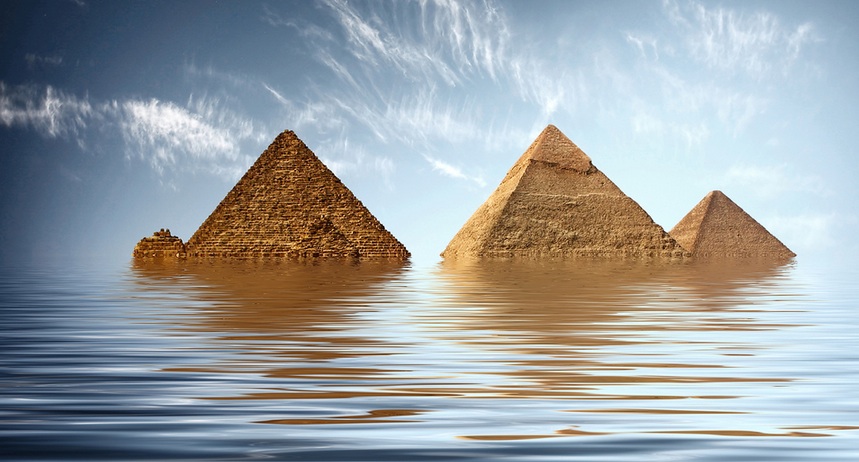
Imagine the famous pyramids under water? Alexandria, Egypt holds top risk, followed by Istanbul, Turkey.

Think “Mediterranean” and most Westerners conjure up Monte Carlo or Mykonos, Cannes or Nice, often overlooking the southern coastline cities that lie in Turkey, Cyprus, Syria, Lebanon, Israel, Egypt, Libya, Tunisia, Algeria and Morocco. Fourteen Mediterranean port cities are at risk of extreme and repetitive flooding due to climate change, soils erosion, spikes in population and urban sprawl, according to a Program for the Prevention Preparedness and Response to Natural and Man-Made Disasters (PPRD South) report.  According to ANSAmed, PPRD’s top eight cities-at-risk all boast Middle Eastern zip codes: Alexandria holds top risk, followed by Istanbul, Benghazi, Casablanca, Smyrna, Algiers, Rabat, and Beirut.

European cities of Marseille-Aix-en-Provence, Barcelona, Tripoli, Athens and Naples bring up the rear of the riskiest waterfronts, but we head back to the MidEast for the finale – roll up your pant legs, Tel Aviv-Jaffa.

The World Bank offers a bleaker prediction, stating rising sea level could affect 43 port cities: 24 in the Middle East and 19 in North Africa. It ventures that  a 0.5 meter rise near Alexandria would displace more than 2 million people, with $35 billion in losses in land, property, and infrastructure, as well as incalculable losses of cultural assets.

Rising sea levels and temperatures are predicted to incite increased storms, putting these coastal cities at high risk of experiencing extreme “hundred year floods” (floods of such severity that scientists would estimate them occurring only once in any given century).

The PPRD report, which was commissioned by the Organization of Economic Cooperation and Development, warned that rapid urbanization will see populations in these cities tripling by 2070.

The Mediterranean Sea is increasingly at risk on every level: 30% of the world’s cargo ships sail it, including 25% of the global oil tanker fleet. Millions of people depend upon this waterbody for their livelihoods.

Last week in Calabria, Italy, a one-day conference entitled The Future of Mediterranean Economies and the Promise of Green Economy was held to discuss this subject along with a broader agenda of sustainable development in the Mediterranean region. Experts joined together to devise ways to reduce man-made wastes, switch fossil-fuel based economies to ones based on renewable energy, and introduce sustainable development in the poorest coastal areas.

Good stuff, but we need to widen the focus on this looming dilemma: this trickle of attentiveness won’t stem rising tides.

Image of flooded pyramids by Shutterstock

Read More

TRENDING

Barnacle glue could fix coral reefs, inspire new advances in building and medicine

Aalto University researchers create a protein-based adhesive inspired by barnacles and mussels that works underwater and could aid coral reef restoration.

Listening to Water: Tarek Atoui’s Next Work for Tate Modern

Born in Beirut, Lebanon in 1980 and now living in Paris, Atoui has spent years building instruments that don’t sit comfortably in concert halls. Many of them involve water, glass, and ceramics — materials that react to sound instead of simply producing it.

Slow food market Souk el Tayeb in Lebanon celebrates food and Eid El Barbara

What makes Souk El Tayeb in Lebanon remarkable is not only its insistence on local, seasonal produce, but its belief that dignity and sustainability must go hand in hand. Farmers are paid fairly. Villages are uplifted. Traditional recipes are kept alive not as nostalgia but as knowledge systems: real food is carbon-light, waste-free, and is adapted to the land.

The Pope visits Lebanon and the site of the deadly Beirut blast

“Lebanon, stand up,” he added. “Be a home of justice and fraternity! Be a prophetic sign of peace for the whole of the Levant!”

Lebanon ski resorts and when to escape climate change

Lebanon’s mountain resorts — from Mzaar Ski Resort Faraya to the Cedars of God in Bsharri — offer rare snow in the Middle East, where you can ski by day and swim in the sea by night. But climate change is shrinking snow seasons fast. Resorts like Zaarour, Laqlouq, Faqra, and the Cedars are adapting, turning toward year-round eco-tourism and mountain conservation.

Locals From Rishon Fight IKEA

Big Box stores are a pretty new concept in Israel, and thank God that not every Israeli city wants them in their backyard. A word from someone who has see the beautiful farmland around her hometown Newmarket, Ontario stripped and converted into vulgar strip malls of big box shops: they have no place in a healthy and sustainable town or city.

The Jewish National Fund Meets An Inconvenient Truth

According to the JNF, it has transformed thousands of acres of barren land into green forests in Israel. They state that each person emits about 23 tons of carbon per year, estimating that each tree planted can absorb one ton of carbon in its lifetime. That's a whole lot of trees you'd need to be planting. Could so many fit in Israel?

How to quiet noise from construction in your office

Streets need to be resurfaced in New York but the humming and grinding noise is unsettling. Noise is environmental pollution. 

EarthX and a blueprint for sustainable investing

Trammell S. Crow, a Dallas-based businessman and father of four, is focusing his efforts on impact investing, and media that focuses on saving the planet through EarthX.

Mining Afghanistan’s Mineral Discoveries Similar to Avatar

Now that American forces in Afghanistan are commemorating the longest period of any war that America has been involved in, including the 1965-73 Vietnam War, the recent discoveries of large and extremely valuable mineral and metal deposits may finally bring to light a reason to continue the presence of US fighting forces in this war torn and backward country.

From Pilot Plant to Global Stage: How Aduro Clean Technologies’ 2026 Expansion Signals a Turning Point for Chemical Recycling Investors Like Yazan Al Homsi

The company's Next Generation Process (NGP) Pilot Plant in London, Ontario, has officially moved into initial operating campaigns, generating the kind of structured, repeatable data that separates laboratory promise from commercial viability.

Nobul’s Regan McGee on Shareholder Value: “Complacency Is the Silent Killer” 

Why the governance framework designed to protect shareholders so...

Should You Invest in the Private Market?

startustartup Unlike public stock exchanges, which offer daily trading, strict...

Popular Categories