
A Desert Shrub That Outwits Mice

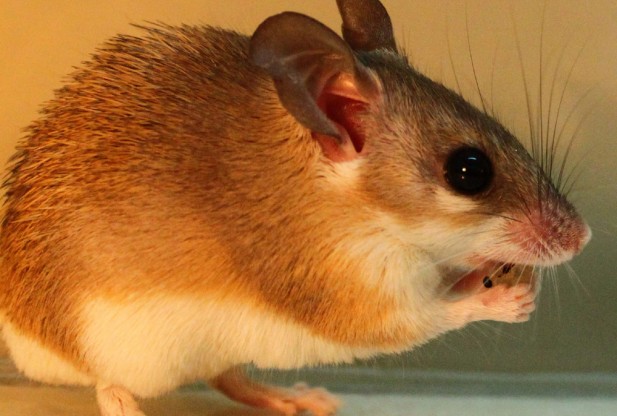
nature, evolution, wildlife, desert, IsraelWhile humans inch closer to their eventual demise by burning up the resources upon which they so richly depend, the earth’s “lower” species are making moves to ensure their longevity. US and Israeli researchers published a joint study in the journal Current Biology that unveils how a desert shrub called Ochradenus baccatus outwits the spiny mice by planting a “mustard bomb” in its seed. When a mouse chews the seed, which then turns to pulp, an embedded enzyme releases a toxic cocktail that causes the mouse to spit it out. This in turn ensures the seed’s survival.

Hot mustard

Researchers from the University of Utah and the Technion-Israel Institute of Technology discovered that enzymes present in mignotte berries release isothiocyanates – the flavor of hot mustard – in order to deter the mice from consuming them completely.

When scientists deactivated the mustard bomb enzyme in labs, the mice devoured up to 80% of the seeds, leaving none behind for dispersal.

However, when mice eat mignotte berries in their natural habitat, they tend to retreat to areas that are favorable for the desert bush, according to the study’s co-author and Professor of Biology at the Univeristy of Utah Denise Dearing.

Directed deterrence

As a result, once the hot mustard chemical prompts the mice to spit out the gnarled seeds, they are primed for successful germination.

“The mice are actually dispersing the seeds to a suitable habitat for germination,” Dearing told Red Orbit. “Under the parent plant is a bad spot. A rocky crevice would be a cool, suitable location because it’s not in direct sunlight.”

The process by which plants “outwit” their consumers is called “directed deterrence.”

The best known example before the new study, Dearing noted, involved chili peppers, which deter mammals from eating their seeds because mammals feel pain induced by their ingredient, capsaicin. Because birds “don’t feel the heat at all, they tend not to crush the seeds while they are feeding, so they are good dispersers of chili pepper seeds,” said Dearing.

Chewed seeds are stronger

Most remarkably, the researchers discovered that the chomped seeds were actually twice as likely to germinate as un-chomped seeds, revealing an exciting symbiosis between the spiny mouse and the “clever” bush. We have a lot to learn.

Although human beings have neglected nature’s genius in the last century or so, some enlightened individuals are not only beginning to discern its inherent wisdom, but are attempting to mimic it in design and other fields.

We previously talked to Melissa Sterry, one of the foremost experts on biomimicry, but Egypt has its proponents too. Dayma leads tours that teach young and old about the lessons that camels, scorpions and other species can teach us, and how we can mimic their adaptations to improve life for us as well.

:: Red Orbit

Photo Credit: Michal Samuni-Blank, Technion-Israel Institute of Technology

More on Nature’s Genius:

Israeli Military Uses Biomimicry to Design Butterfly Drone

Inspired by Nature, Water Tips for the Middle East

What Camels and Scorpions Teach Dayma Tourists in Egypt 

Curvy Desert Home Designed by Iranian Students Mimics the Snail
 

Tafline Laylin
Tafline Laylinhttp://www.greenprophet.com
As a tour leader who led “eco-friendly” camping trips throughout North America, Tafline soon realized that she was instead leaving behind a trail of gas fumes, plastic bottles and Pringles. In fact, wherever she traveled – whether it was Viet Nam or South Africa or England – it became clear how inefficiently the mandate to re-think our consumer culture is reaching the general public. Born in Iran, raised in South Africa and the United States, she currently splits her time between Africa and the Middle East. Tafline can be reached at tafline (at) greenprophet (dot) com.

Read More

TRENDING

Bricks and Minifigs, and the Future of Circular Play

A second-hand LEGO marketplace keeps plastic bricks circulating for years instead of ending up forgotten in basements or discarded in landfills. It gives children access to building materials at lower prices. It extends the lifespan of a product that was originally designed to last generations.

Barnacle glue could fix coral reefs, inspire new advances in building and medicine

Aalto University researchers create a protein-based adhesive inspired by barnacles and mussels that works underwater and could aid coral reef restoration.

Why wombats have cubed poop – with photos

Why is wombat poop cubed? Plus great photos.

Everything is better when you spend 5 days in a cave

She spent 5 days in a cave in the dark. See what it did to her body.

What is the Jewish Climate Trust?

Jewish Climate Trust has quickly attracted the attention and support of some of the most influential voices in Jewish philanthropy, drawing backing from prominent family foundations and business leaders connected to the Bronfman and Schusterman philanthropic networks, alongside climate-focused investors and community builders aligned with founding leader Nigel Savage. Together, these donors have committed many millions of dollars to build a serious, long-term climate platform for the Jewish world — not as a symbolic gesture, but as a strategic intervention in one of the defining challenges of this generation.

Yerukim Forms a New Green Economy Where the Money is Really Green

The Yerukim members who pick up the recyclables get to keep the monetary reward, the public earns "green" bills that can be used in shops, and business owners get to be associated with environmentalism.

Choosing Riyadh over Dubai? What Investors Should Know

Saudi Arabia is deploying capital at unmatched scale to catalyze tourism and advanced industry while rewiring its power-and-water backbone. The investable frontier is widening—especially in renewables, grid storage, water efficiency/desal retrofits, and hospitality operating platforms. Prudent investors will insist on phased delivery, enforceable KPIs (energy, water, biodiversity), and RHQ/zone compliance—while pricing political-economy and reputational risks alongside growth upside.

Sell your cooking oil for biodiesel money

Want to make money on old french fry oil? Sell it.

Qatar Alternative Energy Summit Pairs Investors And Innovators

Alternative energy investors and innovators can meet n' greet in Doha, Qatar March 16 and 17.

Here’s How To Implement The Four Pillars Of Employee Engagement

If you throw a party for your work team and they are vegans, don't make it a barbecue. Know the sustainability values of your team to boost moral and retain good people.

Locals From Rishon Fight IKEA

Big Box stores are a pretty new concept in Israel, and thank God that not every Israeli city wants them in their backyard. A word from someone who has see the beautiful farmland around her hometown Newmarket, Ontario stripped and converted into vulgar strip malls of big box shops: they have no place in a healthy and sustainable town or city.

The Jewish National Fund Meets An Inconvenient Truth

According to the JNF, it has transformed thousands of acres of barren land into green forests in Israel. They state that each person emits about 23 tons of carbon per year, estimating that each tree planted can absorb one ton of carbon in its lifetime. That's a whole lot of trees you'd need to be planting. Could so many fit in Israel?

How to quiet noise from construction in your office

Streets need to be resurfaced in New York but the humming and grinding noise is unsettling. Noise is environmental pollution. 

Popular Categories