


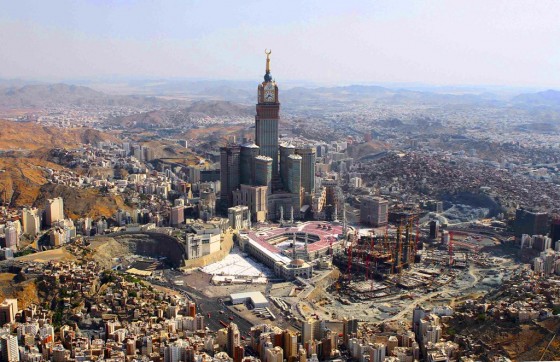
 Despite having enough solar power to energize the planet for the next 20 centuries, Saudi Arabia has instead reaped the benefits of its oil reserves for decades. This wealth has spurred a spate of massive developments in Mecca, transforming a small desert hamlet into a thriving metropolis. But this may be a curse for Islam’s holiest city and the 6 million pilgrims who flock there each year.
Last August, the Kingdom unveiled a $21.3 billion plan to upgrade the Grand Mosque in Mecca to accommodate an additional 2.5 million pilgrims a year. 20 Percent of the demolition has been completed, and a new $1.8 billion railway to link all of the holy sites in Mecca is also underway. How does one tap into the divine amidst so much noise and distraction?
Demolition before Ramadan
The new Haram expansion project will cover an area of 356,000m2, according to Construction Week Online, and is being built around the Kaaba shrine towards which Muslims point while conducting their prayers each day.
In order to accommodate the growth, owners of real estate in the area were displaced, although their compensation is included in the overall price tag.
The addition will be linked to the existing mosque via a series of pedestrian bridges and then entire complex will feature air conditioning systems to relieve visitors from the extraordinary heat.
Saudi Binladin Group are the main contractors carrying out the project and King Abdullah has ordered for the demolition to be completed before Ramadan so that employees can conduct their fast without being subjected to hard summertime construction work without sustenance.
Spiritual epiphany amidst the noise?
Last year Arwa reflected on the change that has occurred in Islamic architecture. She quoted renowned Qatari architect, Ibrahim Mohammed Jaidah, who told the Peninsula Qatar that “the new developments in Islamic cities don’t reflect the Islamic art of architecture as it was in the past.”
“Kaaba, the first building chosen by Ibrahim was reflecting the simplicity of Islamic architecture,” he said.
But now this crucial site is being drowned out by incessant developments. Although the Kingdom should be lauded for making the pilgrimage, during which Muslims fulfill their Hajj and Umra duties, comfortable and safe, and although a green guide has been launched so that this deluge does not completely destroy the earth, the spirit of the pilgrimage is completely lost.
How many epiphanies have you had while standing in the middle of a giant building with the noise of air-conditioning units and escalators and foot traffic drumming in your ear? Most people retreat to a quiet space, either in a mosque or in nature, to find the quiet voice of their conscience or creator.
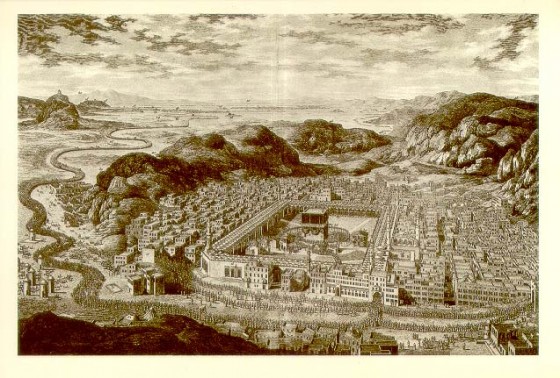
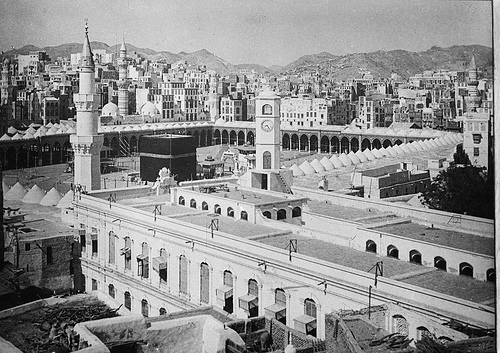
In 1850 and even in 1910, as the above wikipedia images depict, the holy city was a place that could offer genuine sacred appeal. None of the massive glass and steel buildings that now exist were there before. Mecca was a manageable place with organic infrastructure, a place with character and spirit.
But what about now? I hate to be the one to say it, but Mecca is becoming nothing more than another mega urban sprawl.
Lead image via Muslim Media Network
More on Saudi Architecture:
Sustainable Architecture Saudi Style
Saudi Teacher Built a Funky Guesthouse out of Recycled Materials
Proposal for Riyadh Performance Hall Distorts Bedouin Values


The Hajj is a spiritual journey without parallel in any other religion in the world and with the number of pilgrims rising each year, expansion becomes necessary. I don’t think anyone who has actually experienced the Hajj or gone on Umrah could say that there is no spiritual connection upon arrival. It strengthens one’s connection and love for Allah and when the Imaam gives the call to prayer and everyone stands shoulder to shoulder united, I cannot think anyone is worried about the modern day architecture that the Saudi government has decided to install into the new expansion.
Personally I don’t feel someone who hasn’t experienced being at the Hajj can comment on the spirituality a person fells at being at such an amazing location.
Afzal, I’m really glad that your pilgrimage was not negatively impacted from the development. Development certainly is a catch 22, isn’t it?
Having just returned from Umrah I have seen the mass redevelopment at work but none of this distracted us from our pilgramage. When you are standing face to face with the Kaaba the connection is between you and your Lord and nothing comes between that. With increasing number of pilgrims the Saudi govt has no choice but to expand. Limiting numbers of visitors is not an option as they don’t have the right to stop people visiting Gods House during umrah season.
i think your point about overdevelopment is a good one but the point about spirituality and hajj is wrong.
first, because hajj is not undertaken in order to experience epiphanies. it is an obligation, an acknowledgement of one’s slavehood. we are simply answering the call of the Lord.
second, because noise and distraction, just like silence and contemplation and everything else in creation, comes from Allah. the real epiphany is to see Allah in all of His creation, including the noises and distractions.