

As West Bank settlers develop water sources, Palestinians say they are excluded. Which narrative is right?
Ein Ariq, WEST BANK — A convoy of white United Nations jeeps pulls into the olive-tree laden valley below the Jewish community of Eli. They are greeted by Jamal Deragmeh, the mayor of the nearby Palestinian town of Lubban Al-Sharkiya, who points out the cement pool around the spring and complains.
“If you weren’t here,” he says to the representative of the UN Office for the Coordination of Humanitarian Affairs (OCHA), “The [Jewish] settlers would come and put a bullet in my head.”
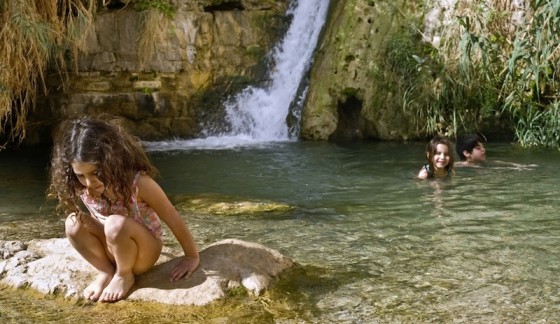
Scores of springs like Ein Ariq pepper the valleys and slopes of the Samarian and Judean hills of the West Bank. Palestinians use them to water their flocks and irrigate fields. But some have been neglected and forgotten, and in recent years residents of Jewish settlements in their vicinity have come to clear out stones and mud, build small pools, put in a few picnic tables and turn them into parks.
And this has raised the ire of the local Palestinians, who say the Israelis have taken over the springs and keep them away. The UN’s OCHA has investigated the claims and has issued a report sharply criticizing what it calls the “entrenchment of the settler enterprise” in the West Bank by taking over Palestinian water springs.
In the report “How Dispossession Happens,” OCHA says settlers use “intimidation and threats” and sometimes erect fences to take over the springs.
“The problem is this is private Palestinian land, which has been taken over by settlers from the Eli and Shilo settlement here,” Yeheskel Lein, head of research and analysis for OCHA, told The Media Line. “They have developed this as a tourist site and together with the army they are preventing free access to the owners of the land and Palestinian farmers all around who were relying on this spring for the watering of the livestock and for the irrigation of their crops and for their household consumption.”
According to OCHA’s report, some 30 springs have come under full settler control, with no Palestinian access, and 26 are at risk of being taken over. Some springs have been renamed. The Hebrew name for Ein Ariq is Ein Ha’gvura, or the spring of heroism, to commemorate a fallen Israeli soldier.
Amid the commotion at the spring, a sole white jeep arrives. Behind the wheel is Amiad Cohen, the security coordinator for Eli. Leaving behind his assault rifle in the vehicle, he approaches the group of Palestinians, UN officers and journalists. An argument ensues.
“I never stopped any Palestinian from coming to the spring. I’ve been the head of security for three-and-a-half years and I never stopped any Palestinian to come here,” Cohen says.
Asked if Palestinians can swim in the pool, he answers: “Of course. Is their blood different than mine? Do they dirty the water when they come here? No.”
“When I come here the settlers come and tell me to get out of here,” Deragmeh tells him, to which Cohen replies that he has his phone number and he should call him if it happens again and he will come to make sure he was not hassled. He also reminds the mayor that youths in his village prevent Jewish settlers from visiting a spring there.
The story here is more than just about water springs. It is a fight for the narrative.
“We are developing because the Jews love the land of Israel. We love to develop it. We plant trees. We love the fountains. We love the springs. We love this country. This is our country and we like it. So we develop it,” Cohen says.
“But this is the West Bank, not Israel,” a reporter from the Al-Jazeera television network responds.
“That is your narrative. My narrative is that this is Israel,” Cohen replies.
“But you are inside the West Bank,” she insists.
“Israel. This is my narrative,” he answers.
But the springs only manifest a greater problem in the eyes of the UN. They see the upgrading of the springs and their environs by the Jewish settlers as a way to further solidify their hold on the land, which the UN says is illegal, and to normalize their presence.
“They are contributing to the entrenchment of the settler enterprise by generating employment and revenue for settlements,” Lein of OCHA says. “One of the effects of this development of tourism infrastructure in the West Bank is that for certain parts of Israeli society settlements are being normalized. They are being seen as a subject of fun of relaxation and not only as a contentious issue of politics and ideology and confrontation with the Arabs.”
The report says that in 40 of the 56 springs identified in the survey Jews are developing the surrounding area into a “tourist attraction.” The spring of Ein Sheban is about five kilometers (three miles) east of Ramallah. It is one of the springs considered “at risk.” A large mulberry tree grows out of a crack in a cliff with water trickling down into a cement pool constructed years ago by the Palestinians.
Dror Etkes, who monitors settlement building for the leftist Peace Now organization and is author of the OCHA report, explains that it’s not the development of the springs that bothers them, but the illegal development by Jewish residents.
“This is an older pool that was made by the Palestinians and hasn’t been demolished, Etkes tells The Media Line. “What you can see in terms of settlers developing is actually the signs leading to the site, which are in Hebrew and English only, of course the picnic benches which have been put there and the parking lot… The idea behind it is to convert this into a spot that is visited by Israelis and, of course, once it is visited by Israelis the interest to Palestinians is very, very limited.”
“Development of a spring by settlers is one mean that the settlers are using in order to enlarge their encroachment into new parts of the West Bank which haven’t been taken by them in the past,” Etkes added.
The UN report says the takeover of the springs could not have been done without the “active support of the Israeli authorities.” It asserts that some of the springs waters have been diverted so that Palestinian farmers can’t use them for irrigation and have caused a “loss of control over space” by the Palestinians. It says 84% of the springs were on private Palestinian land.
In reaction, the Israeli Civil Administration called the UN report “distorted, biased and full of inaccuracies.”
“As a general rule, it has been made clear that everyone has the right to access the local natural springs in the public spaces… there is nothing preventing the Palestinians from accessing the natural springs,” the spokesman for the Coordinator of Government Activities in the Territories said in a statement to The Media Line.
It also said that all construction at springs required permits and they had recently demolished an illegal one at El Kabira and initiated legal proceedings against another called Ein Elmah’na. It also urged anyone who is prevented or threatened from going to a spring to report it to the police.
“There is no permanent settler presence or army presence that is preventing people from reaching this area. It’s a history of harassment or intimidation attacks that has deterred the people from entering areas like this one. They have internalized the level of threat that is involved in getting closer to settlements or to settlement areas and they have stop relying on that because of the dangers,” Lein says.
(This article is via the Mideast News Source, The Media Line)

There is nothing in International Water Law that says springs on “Private Palestinian Land” are for them only. Springs fall into the public domain whether “Palestinian” or “Israeli” or in this case both. The springs are jointly held and in order to be best maintained for the future Israelis honestly have a much better track record.
In addition, since Palestinians normally dump their sewage wherever they please instead of treating it, then they are ruining both their own main drinking water supply as well as some of Israel’s. Instead of complaining about a few springs, the UN, the Palestinians, and Peace Now should be concentrating on making a comprehensive water policy for the greater good instead of just a few localized farmers, who still have access to this water anyway. Once they ruin the groundwater, it cannot be fixed easily or replaced!
I was there (Ein Gedi) last summer and there were people of all persuasions there, including Jewish and Arab. I found this to be true of many parks and natural resources and sites. Once again, controversy doesn’t show the nuances on the ground.