


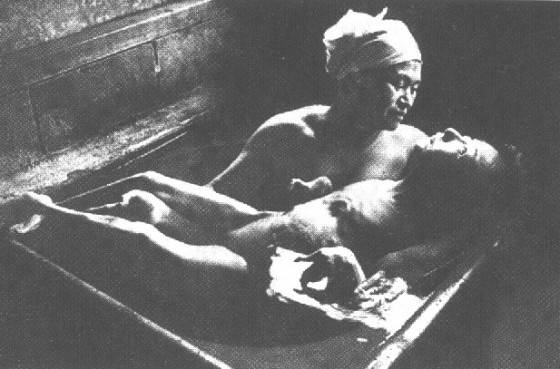
 Gulf experts say that shark meat contains extremely high levels of mercury. The picture above depicts a deformed Japanese boy whose mother had mercury poisoning.
If shark conservation isn’t your thing, and you are one of the people creating a worldwide demand for shark fin soup, think about this next time you slurp: filmmaker and activist Jonathan Ali Khan is presenting a new TV documentary in the United Arab Emirates on the health risks of eating shark meat, the Gulf News reports.
Collecting footage for the NGO Shark Quest Arabia, we featured Jonathan Ali Khan here. His new show will document in detail how sharks, high on the food chain in the marine ecosystem, have dangerously high levels of mercury. This metal is linked to brain damage and infertility.
Working on sampling for mercury levels in the Gulf “You need testing from fishing and landing sites, biopsy samples. You need a small tissue or blood specimen. But some fishermen don’t take too kindly to that — they’re getting a bit more defensive,” Ali Khan said.
Our own reporter Tafline went undercover and took pictures of sharks in a fish market in Dubai, where they are sold openly even though it is not lawful to do so. Even mainstream grocery stores throughout the Gulf country stock sharks that have not yet had a chance to mature.
Mercury flows to the ocean via industrial processes and the metal is stored in the fat of the sharks over time. We hope that Ali Khan’s documentary will scare people away from eating shark meat and shark fins.
In the Middle East sharks are poached illegally for their fins and meat. Although shark fins are nothing more than rubber cartilage, I guess people like eating shark because it makes them feel omnipotent.
We recently reported that Red Sea sharks face extinction because no one in Egypt is monitoring illegal poaching, and fishermen are culling the animals en masse to satisfy a steady demand for shark fin soup. Pretty soon there may be no more sharks left thanks to this idiotic fetish.
:: Gulf News
More on the threats to Sharks in the Middle East:
How Sharks Keep Us Breathing: An Interview With Filmmaker Jonathan Ali Khan



chinese soup is a extraction into liquid state from vegetables, meats or sometimes even fishes. It is a complicated mixture of acids in what i consider it..
No one can tell you if it is healthy or not.. that’s what they assume. I am a born chinese. and consume these soup in a regular basis.. It is so attached to the tradition it is hard to remove. Most chinese are thin but it didn’t mean they are healthy. Even too much good thing can be consider a bad thing. I feel soup examine by nutrientlist thoroughly.
Ms. Kloosterman, do you know when the last reported instance of mercury poisoning occurred anywhere on the planet? It was in the 1950s and 60s in Japan related to the incident of the industrial accident you noted above. Extraordinarily high levels of mercury were spilled into fish feeding areas near coastal Japan. That was over 50 years ago. Why hasn’t a single instance of mercury poisoning been reported since? Where are all these people who should have brain damage and should be dying from mercury poisoning? Did you know that on the Island of Seychelles, residents eat about 12-15 servings of fish per week and show higher levels of mercury in their systems than US residents yet show no signs of negative health effects? You are the worst kind of fearmongerer.
I hope he uncovers new data, because that’s one of the problems in the Middle East – no data.
Much of the mercury in the oceans comes from volcanoes and deep sea vents.
I wonder if Mr Khan has analyses of mercury in Red Sea sharks, or is using scare tactics using data from Japan or China.
I asked about other foods because I’m a veggie these past 35 years. I never eat fish or any other kind of meat. So, I guess we’re fairly safe from contaminated food, but of course we all breathe air and drink water. I’m in fairly good health for my age, but most of my neighbors have various health problems connected to their diet which includes everything.
Yes, toxins are everywhere. Some places worse than others. Ask your local authorities for particular guidelines on what fish are safe to eat, and how often per month. It varies from place to place. But since fish swim, and water flows, tracking what fish are safe can be tricky.
The lower down you eat on the food chain the less chance you will accumulate toxins in your body. Large mammals and fish bio-accumulate toxins which are stored in their fat. When we eat them (with us at the top of the chain presumably) we eat all the toxins they’ve been storing over a long lifetime. Read here why the women who live on Faroe Islands are not advised to breast feed, or if they do not eat whale fat, their staple:
“Women of child-bearing age are advised, as they have been since 1998, not to consume blubber at all until they have had their children and are no longer breast-feeding, and to refrain from eating whalemeat three months prior to, and during, pregnancy and while breast feeding. These limits are intended to safeguard against the risks associated with heavy metals and PCBs, while acknowledging the nutritional benefits of whale meat and blubber, which are rich in poly-unsaturated fats and essential vitamins and minerals.”
http://www.vmr.fo/Default.aspx?ID=6771
So now it’s all over the World in all the fish everywhere. What about vegetables, wheat, flax seed, fruits, etc.? I guess a lot of people get used to it, while some cannot and get sick, or they’re unlucky and eat the wrong fish at the wrong time. What percentage of mercury is recycled by the “scrubbers” attached to some coal-fired power plants? If the corporations’ stubborn resistance to recycling goes on much longer, this biosphere is trash, literally.
Mercury is biomagnified in fish and sharks. Where does mercury found in every fish tested in the US come from?
Wikipedia: Much (an estimated 40%) of the mercury that eventually finds its way into fish originates with coal-burning power plants and chlorine production plants.[7] The largest source of mercury contamination in the United States is coal-fueled power plant emissions.[5] Chlorine chemical plants use mercury to extract chlorine from salt, which in many parts of the world is discharged as mercury compounds in waste water, though this process has been replaced for the most part by the more economically viable membrane cell process, which does not use mercury. Coal contains mercury as a natural contaminant. When it is fired for electricity generation, the mercury is released as smoke into the atmosphere. Most of this mercury pollution can be eliminated if pollution-control devices are installed.[7]
Many years ago in Japan the Minimata corporation dumped excess mercury into the ocean off the coast contaminating the fish eaten by the people living there and many children were deformed for life. I see it may be happening again, this time in the Middle East? So where is the mercury coming from this time?