

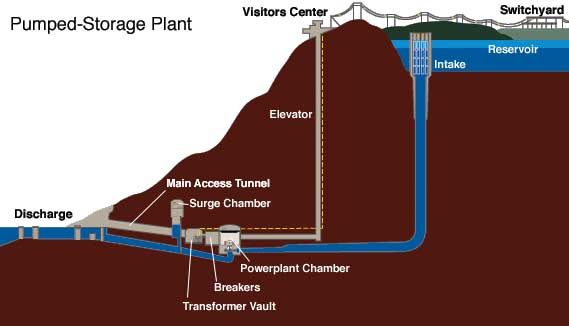
 One alternative to the Red-Dead Canal is the Med-Dead Canal hydro pump. The massive hydro pump idea has been around since the 70s and has questionable environmental outcomes.
The Israel Chamber of Commerce recently requested that the government reinvestigate a project to connect the Dead Sea and Mediterranean Sea. In a joint letter to Environmental Protection Minister Gilad Erdan and Energy and Water Minister Uzi Landau, Chamber president Uriel Lynn argued that the project would have multiple benefits. Apart from augmenting water flows to the ever-dwindling Dead Sea, Lynn noted the project would improve the environment, tourism and agriculture and produce energy.
The idea is not new. Known as the “Med-Dead” project, it has been kicked around by engineers and environmental experts for decades. In response to Lynn’s letter, Minister Landau wrote that his office had been conducting a feasibility study for a similar project, the “Red-Dead” canal, which would connect the Dead Sea with the Red Sea.
The Israeli government conducted a feasibility study of the Med-Dead Canal in the 1970s and nearly began construction. However, it never went forward due to financial concerns and trans-boundary issues with Jordan – the Dead Sea straddles the Jordanian border.
Ultimately, as noted in Landau’s response, the government determined that the Red-Dead project was more promising. A canal beginning at the Red Sea could provide source water for desalination and hydroelectric power in addition to filling the Dead Sea’s water deficit.
And now a team of scientists from the World Bank, Israel, Jordan and the Palestinian Authority are determining whether the plan is economically feasible – and if so, at what environmental cost. That long-awaited recommendation may soon be in the hands of the Prime Minister.
Migration impossible, and salt leakage possible
But either plan is fraught with difficulties. For example, saltwater leakage from the canal system could result in groundwater contamination. Construction and maintenance of the project could disturb wildlife – many species are sensitive to noise and dust. And the canal itself will likely obstruct wildlife corridors, making migration for many species nearly impossible. The intake system for the Red-Dead project could disturb sensitive coral communities, which line the seashore in the city of Eilat.
This is to say nothing of the massive untested experiment of taking saltwater from one place and moving it to another. What effect will it have on the water column? Might this canal carry non-native species into the heart of Israel, possibly wreaking havoc on the ecosystems there?
Meanwhile, a Dead Sea Restoration bill floating around the Knesset for some time has died. For the second time, the Cabinet rejected the legislation, which would have funded a comprehensive rehabilitation of the struggling water body. The measure was introduced to maintain water levels in the northern basin, conserve natural resources in the area, and rearrange the system of mineral extraction to ensure the Dead Sea’s protection.
Sinkholes good for the environment, one MK claims
According to Environment Minister Erdan’s office, Minister Bennie Begin of the Likkud party stated during the cabinet discussion that the Dead Sea was not a “catastrophe” and the sinkholes from receding waters were attracting tourists to the area.
This action came shortly after the Cabinet approved a mining agreement between the Dead Sea Works and the Finance Ministry. Pursuant to that pact, a full salt harvest will occur this year with the company shouldering 80% of the financing and the government receiving 10% royalties.
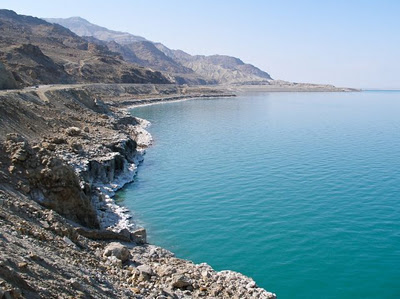
While the Red-Dead report is dragged out and politicians insist on milking every mineral, the Dead Sea shrivels and buckles. But nobody seems particularly interested in restoring the one Million year old water body to a state anywhere near its historic vigor.
This icon of Israel is visited by tourists the world over. They marvel at its buoyancy and the healing properties of its mud. It is a natural wonder and a unique resource. Perhaps one day the government will understand its worth. But for now, the promise of energy production, desalination and mineral royalties seem to have trumped it.
Above image via Wikipedia illustrates a hydro pump system that stores reserve energy.



More information about “blue energy”.
Osmotic power
http://en.wikipedia.org/wiki/Osmotic_power
Thanks… we’ll look into it 🙂
Why this plan not combined with a “blue energy” plant?
Blue Energy
http://www.wetsus.nl/research/research-themes/blue-energy
Solar distillation & desalination would solve these concerns of cross-contamination as well as concerns for energy consumption. I have heard no one say “We are running out of Sunshine”, ever.
Think of a simple Salt Farm pond with a dome placed over it to contain the moisture in the air till it gets drawn off by the cool surface of an air well or Atmospheric water generator as is commonly used to grab the 10% RH of the Morning Air.
If there are concerns of other contaminants, develop a BioChar Industry to provide more filtration material as a waste of Power Generation (Producer gas)
And if that proves to be too insufficient in flow, use Methane also generated with the wastes of the new Agricultural industries in these regions to get their GPM where they want it at.
Producer Gas generation makes BioChar as a waste.
Methane Production makes Compost as a waste.
When the two are blended and amended with simple fertilizers or manures they make an excellent product for a rapidly growing Agricultural sector.
The wastes from a renewable Energy Industry could very well be all the Dirt you will ever need.
http://en.wikipedia.org/wiki/Terra_preta
It would indeed be eco and profitable to let the Jordan waters run along the river and to a lesser extent irrigate farming in the valley but then one needs alternative water supplies for Haifa and Galilee generally. This should not be a big problem with desalination plants on the coast using gas for their energy for the moment; but plannning for wind and solar energy in twenty years’ time.
Surely, it would be much less costly and less environmentally damaging for the Israeli government to allow the Jordan River to run into the Dead Sea the way nature intended? I have never come across that option being considered in the press yet. Are those words forbidden to say for some reason?
It has never been a problem to design a Med-Dead tunnel say 4m in diameter (London Tube concrete segment lined mature technology) to drop a mere 50 m (water flows from the Lake District to Manchester on 1/3000 gradient)and to run a hydro power plant at the shore of the Dead Sea within the evaporation rate of the Dead Sea whether constantly, or at volume in peak hour demand when the advantage of hydro plants is instant reactions to populations using soap opera advertising breaks on television to use toilets or boil a kettle.
The real problems are the chemistries of [Med or Red]sea and the Dead Sea is different and could lead to the profitable minerals precipitating in the lake instead of the industrial lagoons of the extraction plants. More important besides the eco-questions in the main article, the area is notoriously part of the Great Rift Valley and subject to earthquakes as in 1927(?) which are not welcome to investors.
Any talk of the Red -Dead canal or piped power scheme has more to do with drinking water for Amman than developing the Arava – and hasa salt disposal problem. It makes far more safe sense to build solar energy power on the Gulf of Eilat/Aqaba with desalination there and then pipe the fresh water to Arava agriculture by gravity and pump it by solar power to the Jordanian towns that are historically “desert ports” and now have outstripped their own local wells.