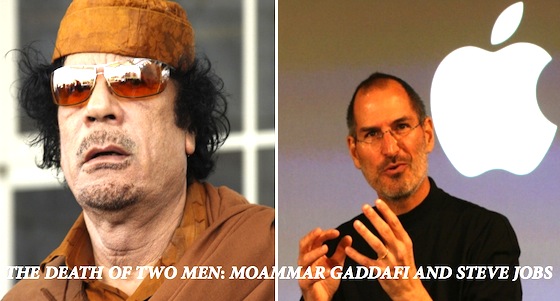

 When Steve Jobs died, the world mourned. But the Arab World is throwing a party at news of Gaddafi’s violent end. How are these two men different and how can we prevent the rise of future Gaddafis? Tafline explores these questions in the following opinion piece.
After Steve Jobs died, the world poured out their sorrow. We held vigils and wrote flowery tributes. The media analyzed everything from what motivated his iron discipline right down to the black turtleneck shirt he used to wear. He wasn’t a saint. After all, he denied the existence of a child he fathered. Yet we treated him like one.
But upon hearing the reports that Gaddafi was finally captured and killed after months of shocking violence, news that was verified by Al Jazeera’s disturbing footage of Libya’s former leader lying dead and wide-eyed in blood and dirt, we find ourselves fighting callous impulses to celebrate his death. Gaddafi, we all know, was a bad, bad man.
There is reason to compare these two charismatic figures. Although Gaddafi had much better fashion sense than Jobs, both of them came from broken homes, both possessed inordinate intelligence, and both relentlessly pursued their ambitions, amassing great wealth in the process. So, what went wrong? How is it that genius can take two such vastly different trajectories?
The examined life
The fundamental difference between Steve Jobs, who suffered from pancreatic cancer with quiet dignity, and Colonel Gaddafi, an eccentric, vain man who would have been mortified to see the images of his half-naked, violated body tossed around by jubilant rebels, is the level to which they indulged themselves.
Steve Jobs was accountable to the people in his firm, to his family, and to the millions of customers around the world who came to rely on Apple’s superior service and technology.
He exercised discipline, and asked himself on a daily basis whether or not the thing he was doing was meaningful. Wealthy enough from his Disney shares, Jobs paid himself $1 instead of buying fancy cars and glitzy jewelry. For him, success was never about the money or the power. It was about doing what made him happy, for happiness’ sake.
Jobs led an examined life. He protected his family from the limelight and actively kept perspective of what really matters.
The other side of Jobs
Don’t get me wrong. Gaddafi and Jobs comprise two faces of the same coin. Without holding himself to some kind of moral standard, Apple’s co-founder could easily have slipped into Gadhafi state of narcissistic paralysis. And given the millions of dollars that he generated for his firm, who would have said no to a mean Jobs?
If the rest of corporate America offers any kind of indication, not very many people. But they didn’t need to. Although he was an exacting leader with high standards, Steve Jobs kept the dark tendencies that lie latent in all of us firmly in check. But Gaddafi and all of his followers gave in to his eccentricities, and he became a monster.
Although he showed moments of keen foresight and occasionally developed projects that were genuinely helpful to the populace he promised to serve, including the great man-made river that transports drinking water from the south to the dry northern sections of the country, the rest of the time he was, in a nutshell, a spoiled brat.
His irrational behavior is well documented, though Business Insider put together a wonderful list of his top 10 absurd ticks. For starters, the man refused to travel without Galyna Kolotnytska, his “voluptuous blonde” nurse, and he used to travel with dozens of female bodyguards. He pitched an absolute fit at at United Nations meeting in New York when he was prohibited from erecting his coveted Bedoiun tent and was known for his shameless self-promotion.
The era of megalomania
This behavior would never have been acceptable for a man without the oil and power Gadhafi possessed, but he became accustomed to going unchallenged. Lacking Steve Jobs’ willingness to reflect on his faults, lacking the ambition to be a solid and respectable human being, he instead became increasingly irascible as the years wore on. So when the Arab revolutions arrived at his doorstep and his authority was finally questioned, Moammar Gaddafi absolutely lost his mind.
Who is to say if the former Libyan leader got what he deserved when the rebels killed him today in his home town of Sirte? The more interesting question is how do we prevent the rise of future Gaddafis? Can we educate our young Arabs to become accountable to themselves and others? To value integrity over wealth?
What will it take to replace self-aggrandizing Sheikhs who etch graffiti visible from space into sand with more gentle green-minded Sheikhs? Only when we find and implement these answers will the Arab world stand any chance of ending the era of megalomania.
More on Libya, the great man-made river, and Gadhafi:
Gaddafi Promises Long War, Oil Up to $103 per Barrel
Libyan Revolutions Will End Gaddafi’s Green Visions
Fears That Gaddafi will Sabotage Oil Facilities