

Police Beat, Tie-Up, and Fire On Citizens Protesting Dying Ramsar Protected Lake in Iran

environmental activism, Lake Urmia, Iran,

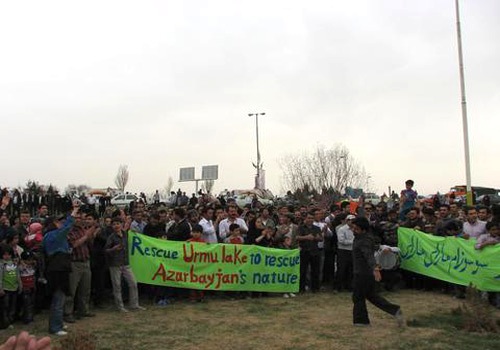
Police violently repressed activists protesting the nearly irreversible damage done to the Middle East’s largest salt lake over the weekend. This image was taken of a protest earlier this year.

Like a chain of dominos, citizen protests are erupting everywhere: following the Tunisian and Egyptian revolutions catalyzed in part by skyrocketing food prices, political protests have swept throughout the Arab world. But it hasn’t stopped there, and not all battles are political.

In Jordan, ordinary people are protesting government plans to include nuclear power in its arsenal of energy sources, while in the United States, Bill McKibben and other well-respected community members, including Jim Hansen from NASA, have been arrested for marching against the Keystone XL Pipeline –  a carbon bomb that climatologists say would officially end the battle against climate change (humanity 0 vs. climate change 7 billion). But none of these latter environmental events has garnered such an extreme response as the Lake Orumiyeh protests in Iran, where bloggers report that people are being arrested, beaten, and in some cases tied to trees for protesting the slow death of the world’s second largest salt lake.
environmental degradation, Lake Urmia, Iran, Salt Lake, protestors

Dried up Mecca

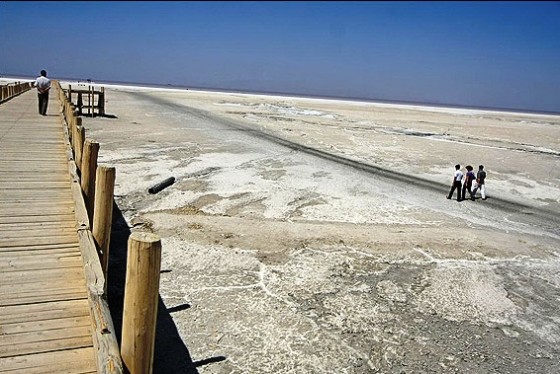
In part because of drought and in part because of poorly managed dam construction and irrigation projects, Lake Orumiyeh or Urmia in Northwestern Iran has shrunk to roughly 60% of its original size. Once a mecca for flamingos and other wildlife, the dying lake now more closely resembles a dusty moonscape.

Residents in Azerbaijan that rely on the Ramsar protected site for their sustenance claim that Revolutionary Guards are responsible for shrinking lake levels and the subsequent rise in salinity and decrease in biodiversity. Global Voices claims that if Lake Urmia dries up completely, millions of people will have to settle elsewhere.

Authorities get dirty
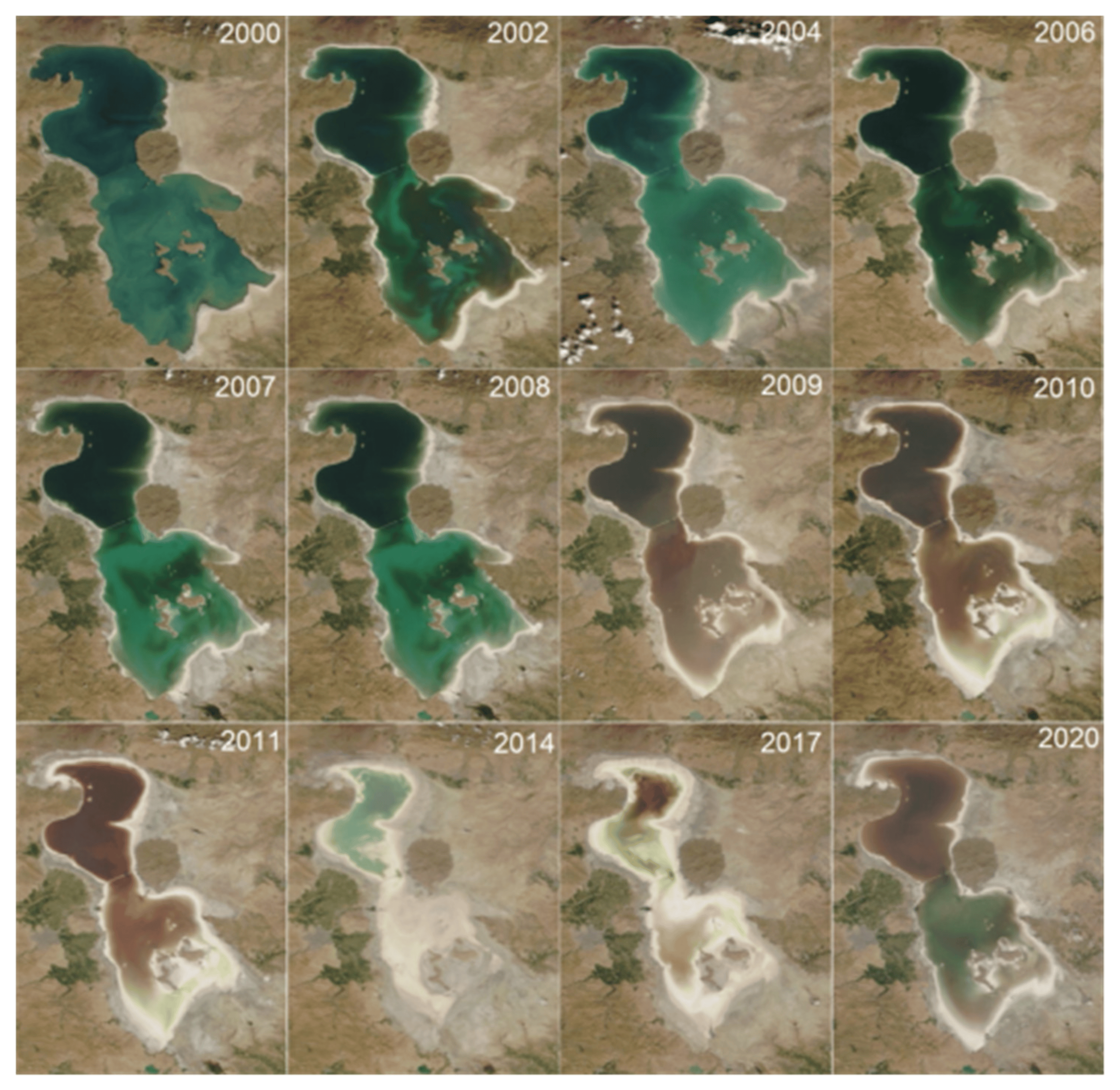
Lake Urmia according to NASA, over time

Spurred on by these concerns, thousands of protestors spilled into the streets of Tabriz and Urmia last weekend in order to put pressure on the government to step up conservation efforts. But eyewitnesses report that protests quickly took an ominous turn.

According to one blogger, Urmuiscielli, policemen beat and arrested protestors, some of whom were tied to trees.

Although the police crackdown was censored in the mainstream Iranian press, Iran’s Independent Press picked up the story, and the blogosphere was populated by video footage and calls for other citizens to support Azeri activists and re-launch anti-regime demonstrations.

Crimes against humanity

If taken seriously, the increase of environmentally-themed disputes between citizens and their governments, even in the Middle East, could spur a whole new era of accountability measures. Protestors who show little willingness to compromise until real action is taken have the power to disrupt the smooth functioning of society to such an extent that governments (a la Egypt) will have no choice but to instill effect change.

And eventually, when environmental degradation is unequivocally linked to an increase in environmental refugees, green-minded lawmakers such as Polly Higgins, who has been campaigning the United Nations to make Ecocide a crime against humanity, will be better poised for success.

Of course, none of this will happen in Iran anytime soon given that country’s oppressive regime and appalling environmental record, even though these protests show an increasingly emboldened (or desperate?) populace.

:: Global Voices

More on Iranian Environmental Issues:
Saltier than the Dead Sea, Lake Orumiyeh is in Trouble

Iran Lacks Water Planning

Iran and Qatar Align to Help the Environment

Tafline Laylin
Tafline Laylinhttp://www.greenprophet.com
As a tour leader who led “eco-friendly” camping trips throughout North America, Tafline soon realized that she was instead leaving behind a trail of gas fumes, plastic bottles and Pringles. In fact, wherever she traveled – whether it was Viet Nam or South Africa or England – it became clear how inefficiently the mandate to re-think our consumer culture is reaching the general public. Born in Iran, raised in South Africa and the United States, she currently splits her time between Africa and the Middle East. Tafline can be reached at tafline (at) greenprophet (dot) com.

Read More

TRENDING

Is Qatar paying UNESCO to turn a blind eye on the Seychelles?

Is UNESCO being paid off by Qatar so it can own a private airstrip in a strategic location in the Seychelles?

5 Reasons Why You Should Save Seeds (and plant them)

Saving seeds from tomatoes, peppers, herbs and flowers helps preserve biodiversity, strengthen food security, and keep heirloom varieties alive. Even a small balcony garden can make a difference.

The US leaves 66 United Nations organizations to “put America first”

The world needs a reset and to restart well intentioned cooperation projects from start. Because right now the UN and EU projects look like software built on code from the 80s, rickety, patched, slow to adapt, and prone to crashing under the weight of outdated assumptions.

UNESCO forest being developed in Iran

Environmental activists in Iran often face significant personal risk when speaking out about illegal land grabs, deforestation, or the destruction of protected areas. In recent years, several high-profile environmentalists have been detained, interrogated, or imprisoned on broad national-security charges, sometimes without transparent legal proceedings.

Iran’s rarest forest is on fire

It's full of rare and endemic species, and it's a UNESCO heritage site. Iran's natural treasure, a 1000-kilometer forest, the Hyrcanian forest has been on fire for several days. It stretches from the Caspian Sea and into neighboring Azerbaijan and is home to more than 3,200 kinds of plants. 

Yerukim Forms a New Green Economy Where the Money is Really Green

The Yerukim members who pick up the recyclables get to keep the monetary reward, the public earns "green" bills that can be used in shops, and business owners get to be associated with environmentalism.

Choosing Riyadh over Dubai? What Investors Should Know

Saudi Arabia is deploying capital at unmatched scale to catalyze tourism and advanced industry while rewiring its power-and-water backbone. The investable frontier is widening—especially in renewables, grid storage, water efficiency/desal retrofits, and hospitality operating platforms. Prudent investors will insist on phased delivery, enforceable KPIs (energy, water, biodiversity), and RHQ/zone compliance—while pricing political-economy and reputational risks alongside growth upside.

Sell your cooking oil for biodiesel money

Want to make money on old french fry oil? Sell it.

Qatar Alternative Energy Summit Pairs Investors And Innovators

Alternative energy investors and innovators can meet n' greet in Doha, Qatar March 16 and 17.

Here’s How To Implement The Four Pillars Of Employee Engagement

If you throw a party for your work team and they are vegans, don't make it a barbecue. Know the sustainability values of your team to boost moral and retain good people.

Locals From Rishon Fight IKEA

Big Box stores are a pretty new concept in Israel, and thank God that not every Israeli city wants them in their backyard. A word from someone who has see the beautiful farmland around her hometown Newmarket, Ontario stripped and converted into vulgar strip malls of big box shops: they have no place in a healthy and sustainable town or city.

The Jewish National Fund Meets An Inconvenient Truth

According to the JNF, it has transformed thousands of acres of barren land into green forests in Israel. They state that each person emits about 23 tons of carbon per year, estimating that each tree planted can absorb one ton of carbon in its lifetime. That's a whole lot of trees you'd need to be planting. Could so many fit in Israel?

How to quiet noise from construction in your office

Streets need to be resurfaced in New York but the humming and grinding noise is unsettling. Noise is environmental pollution. 

Popular Categories
