Feasting On Fairtrade This Ramadan

With just over two weeks left till Ramadan the Islamic month of fasting, Muslims are being urged to go fairtrade

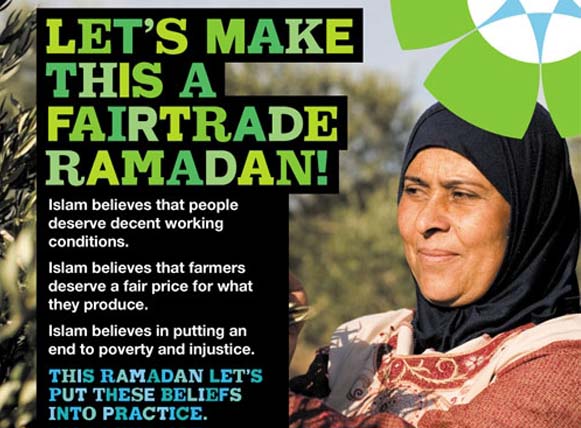
For the typical Muslim family, the last couple of days before Ramadan, the holy month of fasting, is a mad dash to get everything sorted. Mums and dads will be finding time to do those odd jobs around the house (so they can invite visitors round) and buying enough food basics to last the month (so they won’t have to go shopping when they’re hungry). But the UK-based Muslim organisation the ‘Radical Middle Way’ is urging Muslims to take a step back and think about consciously buying, using and serving Fairtrade products this Ramadan.

As they explain, Islam believes that people deserve decent working conditions and a fair price for what they produce, so why not put these beliefs into practice this Ramadan?

Muslims Embrace Fairtrade for Ramadan

Last year, I covered the ‘Buy-Nothing-Ramadan’ Challenge where Muslims were encouraged to give consumerism a miss for 30 days as well as 6 easy steps to go green for Ramadan. This year, I’ll be following Radical Middle Way’s efforts to encourage Muslims to embrace fair-trade.

They explain that Islam has always valued fairness in trade which ensures that workers get a fair price for their work whilst producers get a fair price for their produce. Consequently, buying and supporting fair-trade is a logical step for Muslims which should be encouraged and what better time is there to kick start a new habit than Ramadan? As they saying goes, it takes a month to instill a new habit so the holy month of fasting is perfect!

Take The Fairtrade Pledge

Radical Middle Way, which was established in 2005, is a progressive Muslim organisation based in the UK which works to promote a mainstream and moderate understanding of Islam that young people can relate to. They have previously encouraged Muslims to go green for Ramadan and Abdal Hakim Murad, who is part of the project to create a green Mosque in Cambridge, works closely with the organisation. They are asking Muslims to take the Fairtrade Ramadan pledge which states:

I pledge to:

1. Affirm the spirit of Ramadan in word and in deed – a spirit which calls on me to draw close to God by seeking His mercy, being charitable and promoting justice for all.

2. Consciously buy, use and serve Fairtrade products this Ramadan in preparing meals and breaking my fast – products like bananas, dates, olive oil, coffee, tea and chocolate.

3. Promote the principles of Fairtrade and encourage my family and friends, mosques and community organisations to commit to using Fairtrade products whenever possible seeking trade justice and a better life for all producers.

To find out more and take the pledge yourself, check out their facebook page.

: Image via Radical Middle Way

For more on Green Ramadans see:

10 Ways To Eat More Halal

30 Mosques in 30 States: USA’s Organic Muslims
Detox Your Life: Take The ‘Buy-Nothing’ Ramadan Challenge

Go Green This Ramadan (6 Steps)

Arwa Aburawa
Arwa Aburawahttp://www.greenprophet.com
Arwa is a Muslim freelance writer who is interested in everything climate change related and how Islam can inspire more people to care for their planet and take active steps to save it while we can. She is endlessly suspicious of all politicians and their ceaseless meetings, especially as they make normal people believe that they are not part of the solution when they are the ONLY solution. Her Indian auntie is her model eco-warrier, and when Arwa is not busy helping out in the neighborhood alleyway garden, swap shopping or attempting fusion vegetarian dishes- with mixed success, she’d like to add- she can be found sipping on foraged nettle tea.

Read More

TRENDING

Muslim potter shapes the 99 names of God into clay

In a studio in the DC Maryland Virginia area, ceramic artist Alison Kysia is working with clay in a way that feels both grounded and personal. She makes pottery and abstract Islamic sculptures, and one of her recent works focuses on the 99 Names of God in Islam.

Sustainable Architect Ronak Roshan on the Politics Behind the Houston Ismaili Center

Roshan’s reflection situates the Houston Ismaili Center within a broader discussion about architecture as diplomacy — where aesthetics, faith, and geopolitics intersect. Her words challenge readers to question whether “green” design and grand symbolism can coexist without transparency and accountability.

Eat for your eyes and against cancer –– the power of zeaxanthin

Zeaxanthin is already sold as an over-the-counter supplement, but getting it from food is safer and more enjoyable. Unlike synthetic pills, food provides a synergistic mix of vitamins, fibers, and bioactive compounds. As Chen explains, this discovery is still in the early stages, but it “opens a new field of nutritional immunology” where everyday food choices can directly influence the immune system.

Ancient mud buildings in the Muslim world are spectacular and sustainable

Other notable mud structures in the wider Muslim world include the Bob Dioulasso Grand Mosque in Burkina Faso, and the Khiva Wall in Uzbekistan, which is built around a collection of Islamic schools and mosques. The Siwa Oasis in Egypt (which we visited and posted about here) and the Eastern Castle in Syria have also employed mud bricks in their construction, and research shows that the famous walls of Jericho were built using sun-dried mud bricks.

Why Muslims don’t drink beer

Many Muslims avoid beer because Islamic law forbids all intoxicants, yet drinking habits vary across cultures. Green Prophet explores the religious basis, real-world exceptions, and the rise of alcohol-free trends like mocktails and kombucha among Muslim and non-Muslim drinkers.

Yerukim Forms a New Green Economy Where the Money is Really Green

The Yerukim members who pick up the recyclables get to keep the monetary reward, the public earns "green" bills that can be used in shops, and business owners get to be associated with environmentalism.

Choosing Riyadh over Dubai? What Investors Should Know

Saudi Arabia is deploying capital at unmatched scale to catalyze tourism and advanced industry while rewiring its power-and-water backbone. The investable frontier is widening—especially in renewables, grid storage, water efficiency/desal retrofits, and hospitality operating platforms. Prudent investors will insist on phased delivery, enforceable KPIs (energy, water, biodiversity), and RHQ/zone compliance—while pricing political-economy and reputational risks alongside growth upside.

Sell your cooking oil for biodiesel money

Want to make money on old french fry oil? Sell it.

Qatar Alternative Energy Summit Pairs Investors And Innovators

Alternative energy investors and innovators can meet n' greet in Doha, Qatar March 16 and 17.

Here’s How To Implement The Four Pillars Of Employee Engagement

If you throw a party for your work team and they are vegans, don't make it a barbecue. Know the sustainability values of your team to boost moral and retain good people.

Locals From Rishon Fight IKEA

Big Box stores are a pretty new concept in Israel, and thank God that not every Israeli city wants them in their backyard. A word from someone who has see the beautiful farmland around her hometown Newmarket, Ontario stripped and converted into vulgar strip malls of big box shops: they have no place in a healthy and sustainable town or city.

The Jewish National Fund Meets An Inconvenient Truth

According to the JNF, it has transformed thousands of acres of barren land into green forests in Israel. They state that each person emits about 23 tons of carbon per year, estimating that each tree planted can absorb one ton of carbon in its lifetime. That's a whole lot of trees you'd need to be planting. Could so many fit in Israel?

How to quiet noise from construction in your office

Streets need to be resurfaced in New York but the humming and grinding noise is unsettling. Noise is environmental pollution. 

Popular Categories