

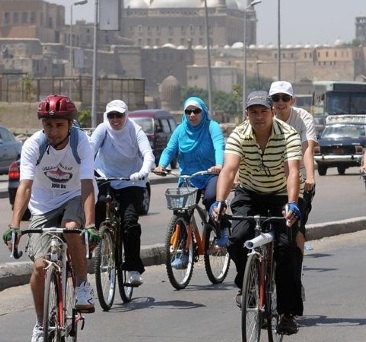
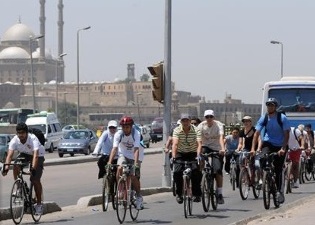
Before the 25th of January no more than 150 cyclists could pedal together without attracting police authorities’ attention. In Cairo, Inji El Abd from Cycling for Change, talks about a revolution for bikes.
Che Guevara had his motorcycle and they had their bicycles: Revolutionaries on wheels went from all corners of Cairo to Tahrir Square to demand a better future for their country. They got there faster than most, as traffic was a killer and the metro station on Tahrir square was no longer operative. Once there, they voiced their demands for freedom and dignity. The people demanded the removal of the regime and the regime obliged.
On the 12th of February the revolution showed a new even more beautiful face, overnight it metamorphosed into a green revolution. People cleaned Tahrir square, separating waste at source and sweeping every grain of dust on the pavement. Afterwards, they started repairing and painting the sidewalks and fences.
Seeing thousands of people brooms and paint brushes in hand in Tahrir Square on the 12th of February brought tears to my eyes. Egyptians were finally reclaiming their streets and concerned with the beautification of their surroundings. I asked myself, why would that be? Is it a new born sense of ownership? Is it the hope that was born with the revolution? I even contemplated other potential changes, will the revolution impact cycling?
The old regime which was a bit tight on agglomerations and under the emergency law police kept their eyes on large gatherings. Egyptian cyclists occasionally riding in groups of 100 to 150 were harassed. Ride leaders were interrogated as to the nature of activities (and whether the rides were demonstrations of some sort) and requested to issue permits for events gathering a large number of people.
Now that the right to peaceful demonstration has been granted (or rather snatched from the claws of the regime) and at a time when we expect the lifting of the emergency laws, can we hope for a change? Can we expect thousands of cyclists to fill the very same square that called for democracy to in turn call for a bicycle friendly city?
Will Cairo that kept the whole world glued to television and computer screens in the past weeks be the next Critical Mass city?
Critical Mass is a bicycling event typically held on the last Friday of every month in over 300 cities around the world. The ride was originally founded in 1992 in San Francisco. The inspiration behind the ride was to create social space via the bicycle. The purpose of Critical Mass is not usually formalized beyond the direct action of meeting at a set location and time and traveling as a group through city or town streets on bikes, although for some bigger scale events there is an activist group formed around it, organizing the rides and communicating the desires and problems of the cyclists to the city council.
Critical Mass rides have been perceived as protest activities. A 2006 New Yorker magazine article described Critical Mass’ activity in New York City as “monthly political-protest rides”, and characterized Critical Mass as a part of a social movement; and the UK e-zine Urban75, which advertises as well as publishes photographs of the Critical Mass event in London, describes this as “the monthly protest by cyclists reclaiming the streets of London.”
More on greening Cairo:
Keep It Clean Cairo
Tap Into Solar Energy at MENASOL
Get A Ride With Egypt Car Poolers
Inji El Abd is the co-founder of the Green Arm (a platform and incubator for environmental initiatives in Egypt) and the Cycling for Change movement (whose mission is to make Cairo a bicycle friendly city).



Hi Hara! We should go cycling together soon!
find me on FB, and I’ll check the page now.
Inji
http://www.facebook.com/pages/Critical-Mass-Cairo/209572555736962
now we also have a page!
please join and help us organize the first ride!
here is the link
http://www.facebook.com/home.php?sk=group_195725337129530
There is a new Facebook group about Critical Mass in Cairo.
Feel free to join!
Karin, Yes, I ride my bike in Cairo. Where do you go cycling?
I live in Jaffa, Israel. That’s where I would cycle if someone didn’t steal my bike!
Yes, it is time to start Critical Mass in Cairo.
The traffic jam every day is horror!!!
It is time for people to realize that they have to move and care about their health. The city is totally polluted.
Let’s promote active transport in Cairo. It would be a paradise with more pedestrian zones, more bike paths and less cars.
Hara,
Are you riding your bike in Cairo?