

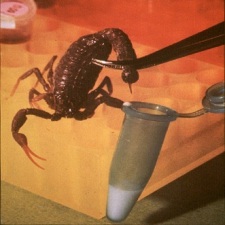
 Scorpions deliver a powerful, paralyzing venom — a complex cocktail of poisonous peptides — that immobilize animal prey on the spot. Some of the toxins in this cocktail damage only insects, which is why a Tel Aviv University researcher is harnessing them to create a safe and ecologically sound pesticide.
Prof. Michael Gurevitz of Tel Aviv University’s Department of Plant Sciences has isolated the genetic sequences for important neurotoxins in the scorpion venom. He’s also developed methods to produce and manipulate toxins to restrict their toxicity in certain insects or mammals.
“Two decades ago I realized that scorpion venom is a goldmine for possible insecticidal and therapeutic agents. This raised the question of how to use them as ecologically-safe agents against insects in a farmer’s fields, or in medicinal disorders,” he says.
In his study of the toxins and the evolution of their genes he recently published a paper in the journal Molecular Biology and Evolution that demonstrates how computational analyses at the gene sequence level leads to better understanding of how to manipulate toxin activity.
A venom factory in the lab
Rather than isolating the venom constituents of the Israeli yellow scorpion, known to be among the world’s most poisonous scorpions, Prof. Gurevitz developed genetic methods for producing and manipulating the desired toxins in bacteria. He then investigated how they act against insects and mammals, paving the way for potential use in the agriculture industry.
He went in this direction because attempts to insert a certain neurotoxin gene into a plant genome hoping for the plant to produce the toxin and kill infesting insects has failed. As a peptide, the toxin was metabolized in the insect guts, which evidently seems to require that it first be engineered to be able to penetrate into the insect blood stream to have its impact on the nervous system.
Prof. Gurevitz says that some neurotoxins in the scorpion are highly active against some insects — leaf-eating moths, locusts, flies and beetles — but have no effect on beneficial insects like honeybees or on mammals like humans. He continues to pursue an effective mode of delivery for what could be a new insecticide.
Prof. Gurevitz is considered one of the world’s pioneers in this field, having published numerous papers on this subject. He spent six years as a research fellow at Washington University in St. Louis and Michigan State University, beginning his scorpion studies while an M.Sc. student in Jerusalem 35 years ago. Since then, he’s developed methods of toxin gene cloning, production and modification in his lab, paving the way for an entirely new molecular field based on the venom of the deadly insect.



A Deadly Scorpion Provides a Safe Pesticide – http://bit.ly/928e0g RT @PidginPost RT @risovic @arkarthick
A Deadly Scorpion Provides a Safe Pesticide – http://bit.ly/928e0g RT @PidginPost RT @risovic
Thanks for RT 🙂 – A Deadly Scorpion Provides a Safe Pesticide – http://bit.ly/928e0g @PidginPost
Thanks for RT 🙂 – A Deadly Scorpion Provides a Safe Pesticide – http://bit.ly/928e0g @arkarthick @martinpmathew
RT @risovic: A Deadly Scorpion Provides a Safe Pesticide – http://bit.ly/928e0g
A Deadly Scorpion Provides a Safe Pesticide – http://bit.ly/928e0g
A Deadly Scorpion Provides a Safe Pesticide | Green Prophet http://url4.eu/16mxL
News:: A Deadly Scorpion Provides a Safe Pesticide http://www.greenprophet.com/2010/01/12/16129/scorpion-pesticide/